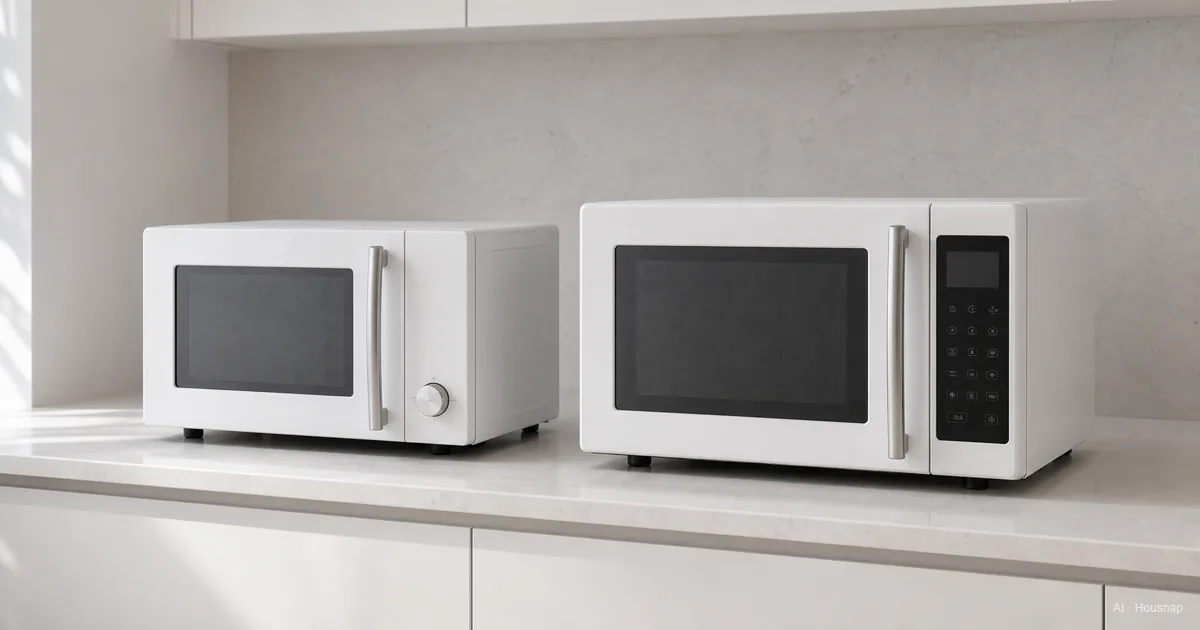
Start with the meal you want to make
Write down three things you expect to cook. Leftover soup, a frozen meal and a cake ask different things of the appliance.
- Solo. Start here if reheating and defrosting cover your needs, especially if you already have an oven.
- Grill. Consider this for a browned finish as well as microwave heating. A grill label alone does not promise convection baking.
- Convection combination. Look here when baking or roasting is part of the plan. A heater and fan circulate hot air; check the available temperatures and modes.
These distinctions follow Panasonic's cooking-method guide. The shortlist above is a way to choose by use, not a ranking of brands.
A convection microwave can serve as a small oven, but check whether your intended recipe requires preheating and whether its dish fits. Whirlpool explains the extra oven function. If you already have microwave reheating covered and mainly want crisp food, compare air fryers and toaster ovens before buying another microwave.
Size the cavity around your actual dishes
Measure your widest plate, your usual lunch container and any baking dish, including handles. Compare those measurements with cavity width, depth and usable height, not just 20L, 25L or 30L on the label. Whirlpool's dimension guide shows why height above the turntable and turntable diameter are separate measurements.
For a turntable model, check that the container can rotate without touching the walls. For a flatbed, check its stationary footprint and height. Both layouts exist in Panasonic's range; the layout name alone does not establish which heats more evenly.
Choose the smallest cavity that accommodates the dishes you actually use. A household headcount is less useful than knowing whether you heat individual plates or one large serving dish.
Check the counter before committing
Measure the appliance's outside dimensions plus the clearance required by its manual. Leave room to open the door and lift a hot dish out comfortably. Panasonic specifies a stable, level surface, unobstructed ventilation and a nearby grounded outlet in its countertop placement advice.
A cabinet opening is a different installation problem. Do not assume a countertop unit becomes built-in just because it fits: check explicit approval and the required installation kit. Installation type should be settled before comparing features; model-specific installation dimensions matter more than a generic gap measurement.
Compare cooking watts, then the controls
Check microwave output, rather than confusing it with electrical input or grill power. Panasonic's NN-CV87QS specifications list these separately; the figures describe different things.
A 700–800W model can suit smaller reheating tasks if you accept longer waits. Higher output can shorten heating, but 1000W is not a universal minimum. Use the wattage stated on your food's instructions, not an assumed recipe standard. Whirlpool's wattage guide gives the broader tradeoff.
Then try the controls you will use daily: choosing a lower power, entering time and stopping a cycle. For frequent reheating, a relevant sensor program may be useful. GE's steam-sensing programs adjust time for the selected food; this is not a measurement of its center temperature. Check the program's food and container instructions.
Check cookware and finish your shortlist
Before ordering, check cookware permissions for each mode. Microwave-safe does not mean ovenproof: Whirlpool's combination-cooking instructions require both for the specified SpeedCook mode. Use racks and metal accessories only as your model permits.
Microwaves do not cook from the inside out; thick centers also warm by conduction. Follow the food's stirring and standing instructions. The FDA explains the heating mechanism; also follow the manual's liquid-heating limits, since overheated water can erupt without obvious boiling.
Keep only candidates that pass these checks:
- Cooking: the modes cover your three actual meals.
- Fit: both the dishes and the installation space work.
- Use: output settings, controls and compatible cookware suit your routine.
If reheating is all that remains on your list, a solo model still answers the brief. Add convection for a real baking task you can name.
Wie dieser Guide entstand
Written by Chexlow AI using manufacturer buying guides, specifications and operating instructions, plus FDA guidance on microwave heating. This guide turns those sources into a first-purchase checklist; it does not report hands-on product testing or a new human review.
Vom Chexlow-Team redigiert · Die Bilder sind KI-generierte Illustrationen