
Choose the task before the comb
Think about the moment when your current routine gets awkward. Are you working through tangled lengths, or trying to separate a neat section for styling?
- Detangling comes first. Shortlist a wide-tooth comb intended for that task. Oribe describes its Wide Tooth Comb as suitable for detangling and styling wet or dry hair.
- Precise sections come first. Shortlist a tail comb. ghd’s Sectioner has fine teeth and is intended for sectioning, backcombing and intricate styling. Its instruction for precise sections is specific: use the tail, rather than the teeth.
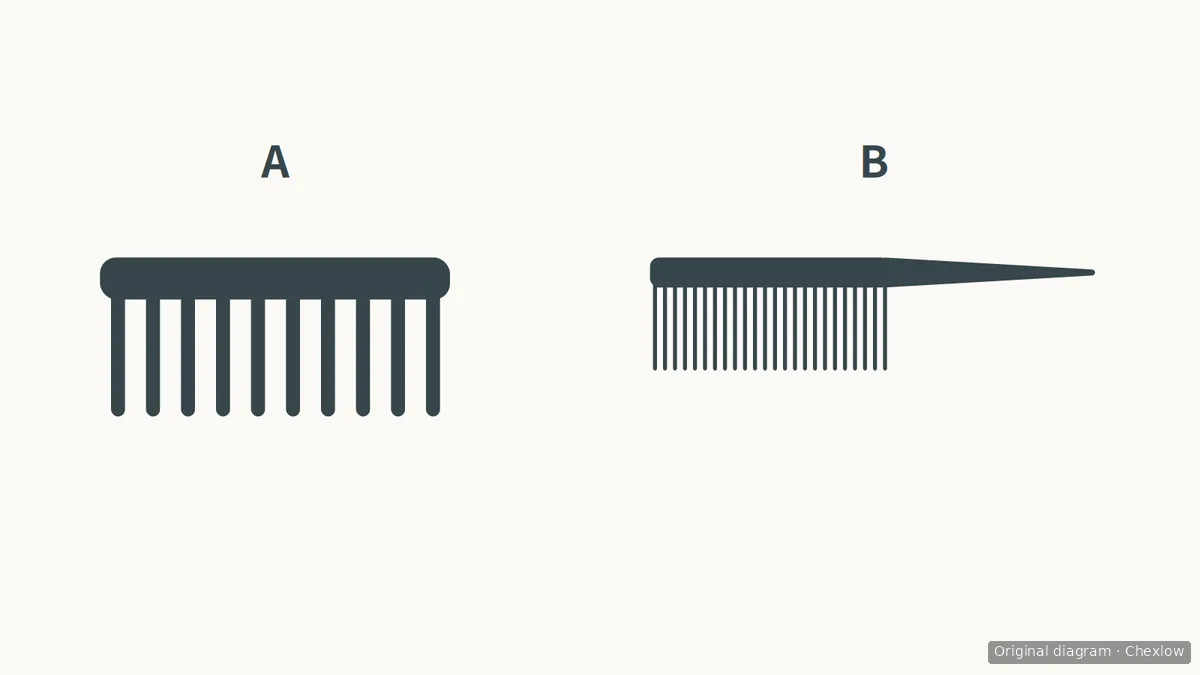
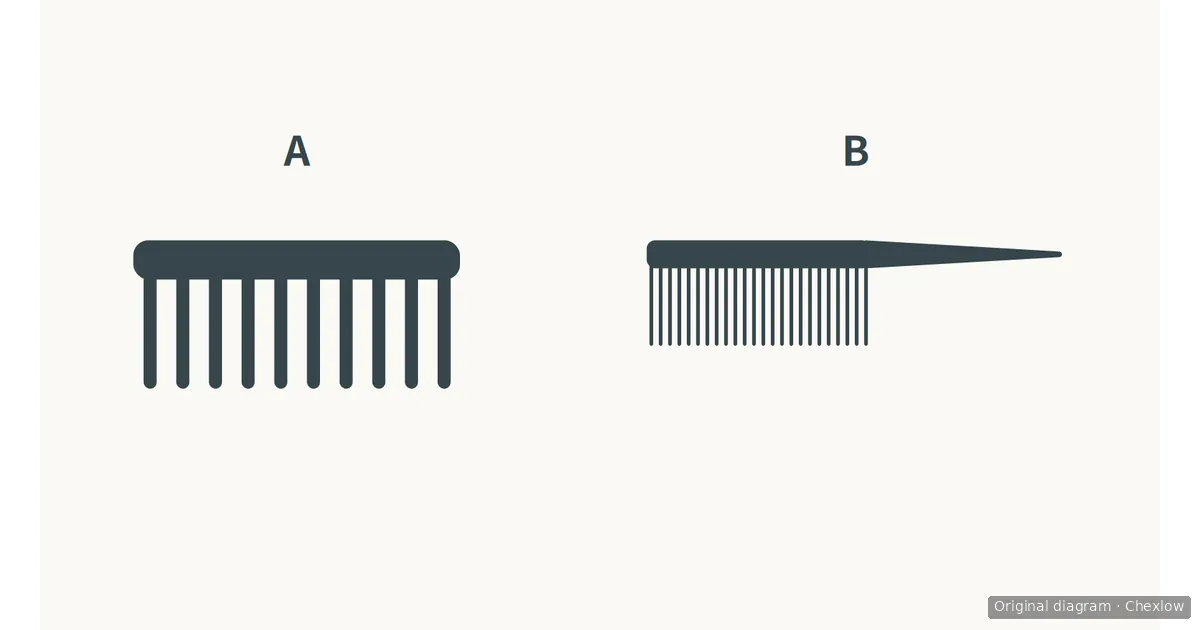
A highlights the widely spaced teeth; B shows the separate tail used for sectioning. These are generic shapes, not scale drawings or reproductions of the named products. The drawing does not establish material, heat resistance or wet-use suitability.
If your existing comb already handles one task, buy only for the missing one. Needing sections during detangling does not, by itself, mean you need a second comb.
Check wet-use permission and the detangling sequence
Wet or dry is a product check, not a distinction you can settle from the comb’s silhouette. Oribe explicitly permits both for its comb; Tangle Teezer’s instructions permit wet, damp or dry use for the Wide Tooth Comb described there. Check your shortlisted model rather than extending either permission to every comb.
Tangle Teezer gives a useful sequence for its tool:
- Divide the hair into sections. Work through one section at a time.
- Begin at the ends with the long teeth. Do not start the detangling pass at the roots.
- Work gently farther up the lengths. Progress until you can comb from root to end easily.
That guide also uses the comb’s short teeth for stubborn knots and shed hair. This step belongs to its particular design; it is not an instruction to substitute a fine-tooth tail comb. Keep the jobs separate when comparing products.
Check the listing before adding a second tool
Read the intended use, wet/dry directions and dimensions before choosing a finish or color. Ask whether the shape will be convenient to hold and whether it adds a function your current tool lacks.
Material names need the same care. Oribe identifies its comb as cellulose acetate resin. That is a material specification, not a heat rating. Permission to comb wet hair also does not establish compatibility with a hot tool.
If you intend to use a comb alongside a dryer or iron, look for instructions covering that use. A detachable comb attachment is a different purchase: check the appliance’s exact compatibility information rather than treating it as a handheld comb alternative.
If sectioning is preparation for heat styling and your next purchase is protection for the hair, continue with choosing a heat protectant for your application stage. Otherwise, the purchase can end with the one comb that solves your original problem.
Wie dieser Guide entstand
This article was written by AI for Chexlow, using Oribe and ghd product descriptions and Tangle Teezer’s usage guide. It compares combs by their intended tasks and keeps model-specific instructions separate from general buying judgments. The products were not tested for this article.
Original SVG diagrams created for Chexlow