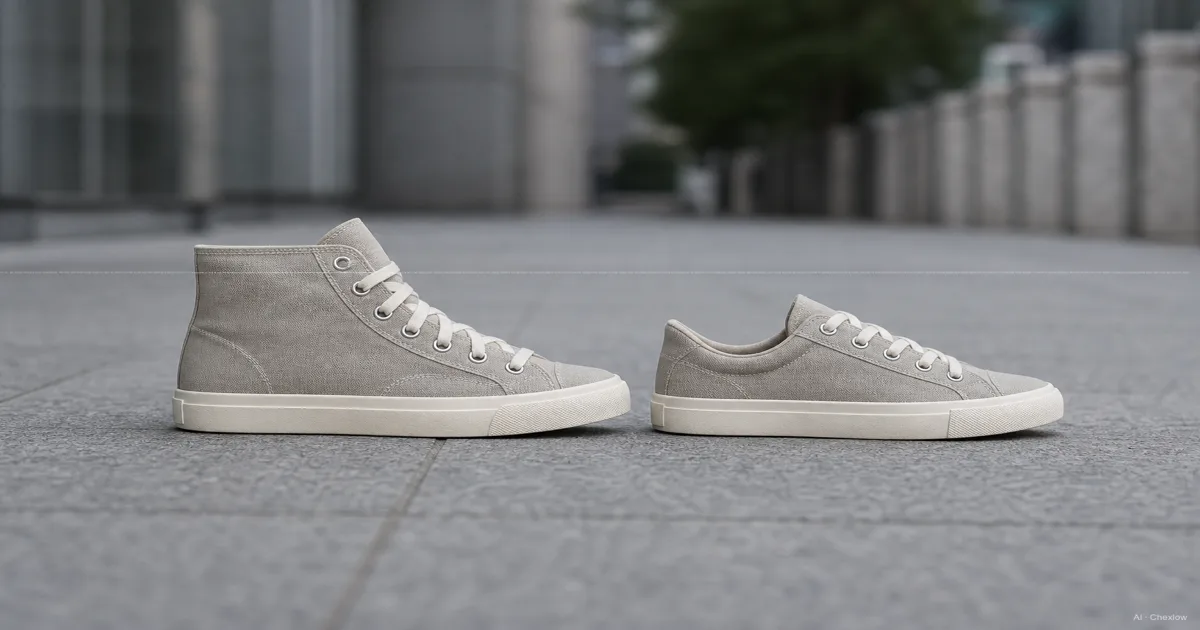
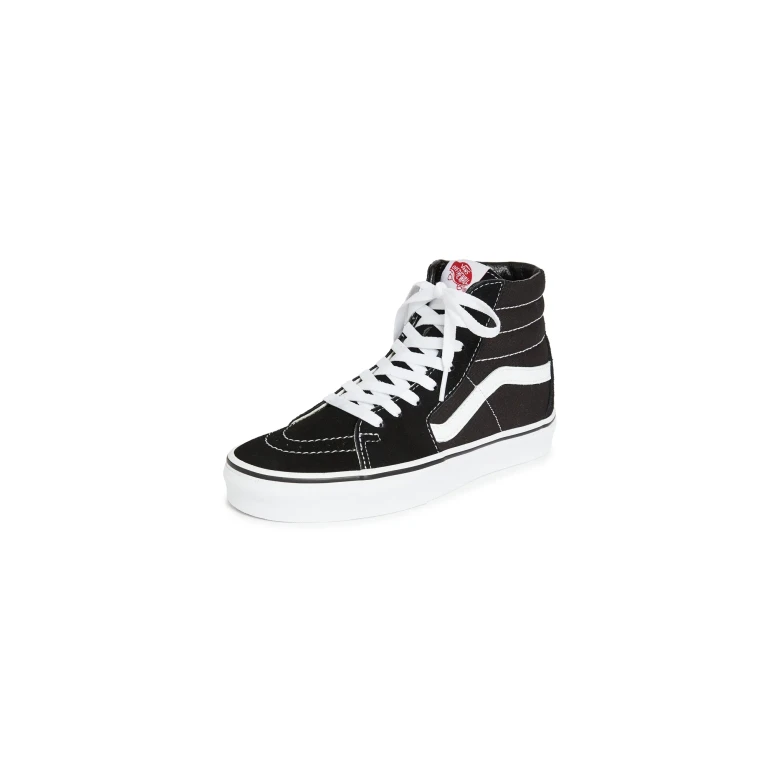
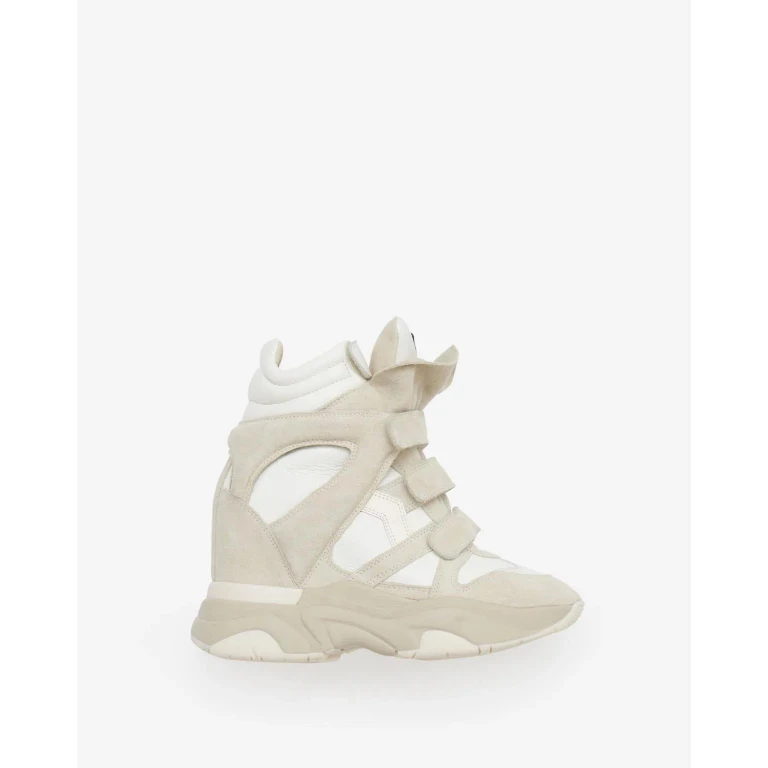
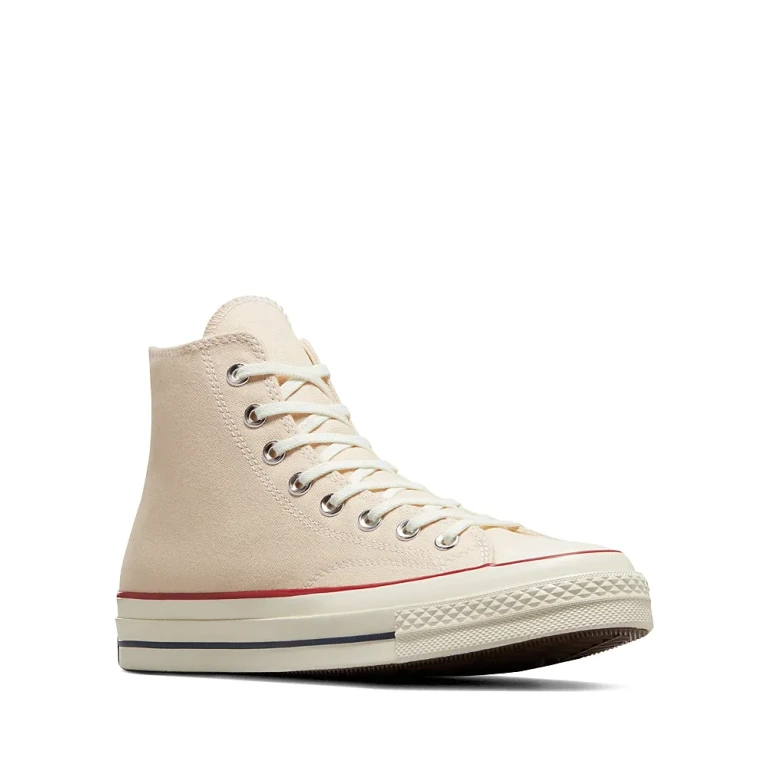
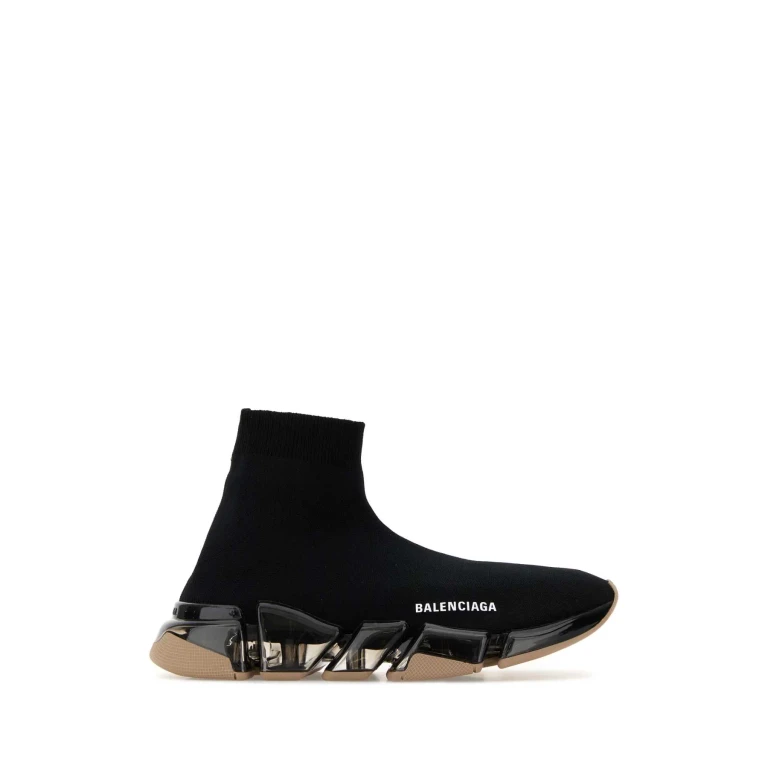
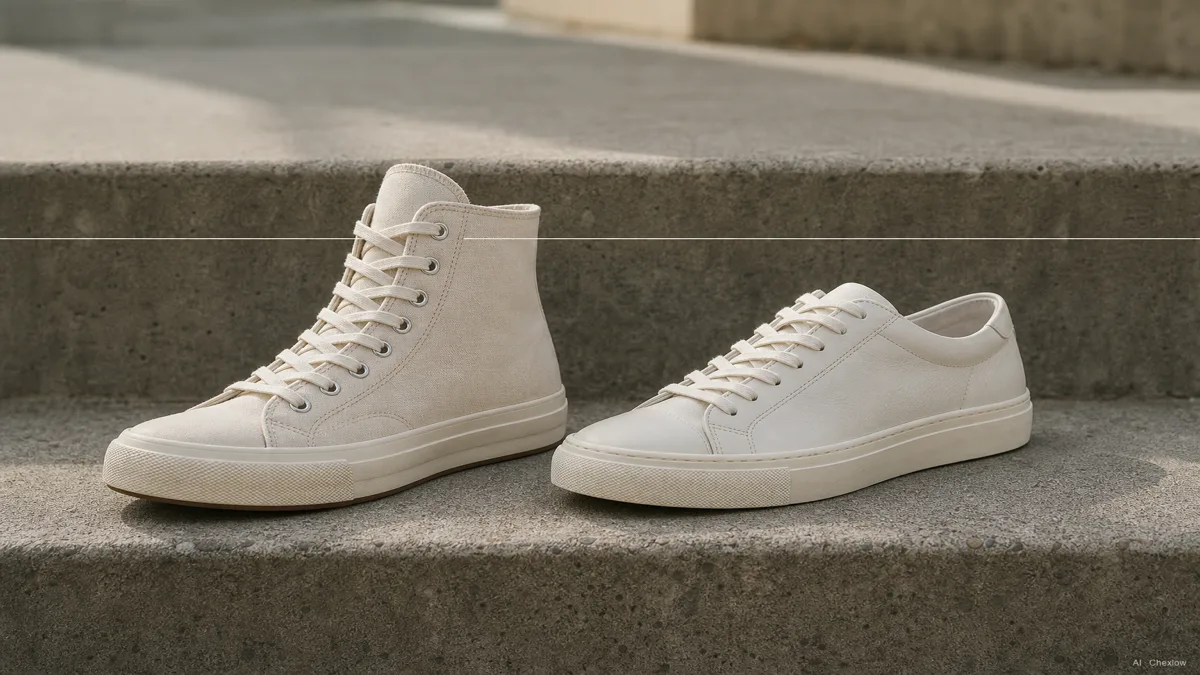
You are looking at two versions of the same sneaker. Identical sole, identical colour, identical logo on the side. One is cut low, just under the ankle. The other is cut high, wrapping up over it. The price is the same. You pick whichever looks better in the photo and move on.
Then you actually wear it for a month, and the collar starts making decisions for you.
The high-top hugs your ankle in a way you notice on a long day. The low-top slips on without a thought and disappears under any trouser hem. Neither is wrong. They are built for different lives, and the trick is matching the cut to yours before you buy.
So before you pick, it helps to know what that collar actually changes.
What actually differs: collar height and what it changes
Strip away the marketing and the difference is one measurement. A low-top sits below your ankle bone. A high-top extends above it. That single line is the only thing that reliably separates the two silhouettes (sneaker collar styles).
There is a quiet third option in the middle. A mid-top sits right at the ankle, not above it. Mid-tops were the dominant basketball cut in the 1980s before the high-top became the statement silhouette, and today they are mostly a style choice with a retro feel. For a first pair, you can think of it as a two-way decision and treat the mid as a stylistic detour you take later.
That extra collar is not just height. It usually comes with a few things attached: a firmer heel counter, a thicker upper, and more material wrapping the ankle. A high-top tends to score higher on collar height, heel rigidity, midsole density, upper thickness, lateral stability, and ankle coverage. A low-top wins on the opposite axis: it is lighter, it breathes more, and it gives your ankle a wider range of motion.
The high-top, as a shape, is older than most people assume. The Converse All Star arrived in 1917 as an explicit basketball shoe, originally sold as the Non-Skid. After Chuck Taylor joined Converse in 1921 and his signature went onto the ankle patch, it became the archetype every later high-top quietly references (Chuck Taylor All-Stars).
The ankle-support myth (and what the science actually says)
Here is the belief almost everyone walks in with: high-tops protect your ankle, low-tops leave it exposed. It feels obviously true. More material around the ankle should mean fewer sprains.
The research does not back that up cleanly. A landmark study in the American Journal of Sports Medicine found no statistically significant difference in ankle sprain rates between athletes in high-tops and athletes in low-tops, as long as both shoes were properly laced and fitted. Sports-medicine clinicians reading the evidence reach the same place: there is no strong proof that one cut prevents sprains better than the other (high-top vs low-top and ankle sprains, ACE Physical Therapy & Sports Medicine).
What actually protects your ankle is the strength of the muscles around it. A high collar gives you a physical wall against your ankle rolling, which is not nothing. But it does not replace a strong, well-conditioned ankle, and some clinicians argue too much support can let those stabilising muscles get lazy.
So read the collar honestly. It is real lateral resistance, useful when you are cutting hard and changing direction. It is not a force field. If sprain prevention is your only reason for buying a high-top, the better investment is a few weeks of ankle exercises, not the taller shoe.
Which sports and activities favor each cut
Once you stop treating the collar as armour, it is easier to see where each cut genuinely earns its keep.
High-tops belong to sports built on hard lateral cuts. Basketball and skateboarding are the clearest cases. When you are pushing off sideways, planting, and changing direction constantly, the extended collar gives real physical resistance to the ankle rolling over, even though it does not erase the risk. There is a reason the statement basketball silhouette has stayed high for decades.
Low-tops are the daily driver. They are lighter, easier to pull on, and they give your foot a fuller range of motion. For walking long distances, repetitive movement, or anything where every gram matters, low is the easier shoe. It does not fight you.
One myth worth killing here: low-tops are not always lighter. A canvas high-top can weigh less than a cushioned low-top running shoe, because weight comes from material and construction, not collar height alone. A pair of canvas high-tops can land around 400 grams, while a padded low-top runner can climb past 500. So if you are choosing on weight, weigh the actual pairs, not the silhouettes.

How to style high-tops vs low-tops (the trouser rule and beyond)
This is where most first-buyers trip, because the styling rules are not symmetrical.
Low-tops work with any hem length. Full-length jeans, cropped trousers, shorts, joggers, tailored trousers, it does not matter. The shoe sits below the fabric and stays out of the way. That flexibility is the whole reason low-tops pair with the widest range of outfits, and why they are the safer single pair if you only buy one.
High-tops have one non-negotiable rule: you have to see the collar. If your trouser leg covers it, you have bought a high-top and turned it into an awkward, bulky low-top. So high-tops want cropped, rolled, or tucked hems, anything that shows that extra height. Showing the collar is the entire point of the cut. Hide it and the silhouette stops making sense.
Both work in relaxed semi-formal territory now that athleisure has loosened the rules. High-tops sit well under tapered joggers or tailored track pants, where the slim ankle frames the collar. Low-tops go cleanly under chinos or slim trousers. The difference is that low-tops do this effortlessly and high-tops do it only when the hem cooperates.
Your first buy: a decision framework
Drop the idea that one cut is simply better. They answer different questions.
Buy low-tops first if you want one pair to cover most of your life. They are lighter, easier to wear, friendlier with every kind of trouser, and they suit long days on your feet. For a first sneaker with no specific sport attached, low is the broadly versatile default, and it is hard to regret.
Buy high-tops first only if you have a reason that needs them. A real basketball or skate habit is the strongest case, because the lateral resistance genuinely helps there. The other strong case is style: if you are buying primarily for the streetwear read and you actually want the collar on show, a high-top is the right call, not a compromise.
Still torn? Ask one plain question. Do you have a specific sport context or a streetwear statement in mind, or do you just want a sneaker that goes with everything? If it is the second, buy low and do not overthink it. The cultural and athletic reasons to start high are real, but they are reasons you either have or you do not.
And if you have narrowed it to a couple of pairs, line up more than the price. Compare the collar height against how you will actually wear them, check the weight of the real pairs rather than assuming, and look at whether your usual trousers will let a high-top breathe. Two near-identical sneakers stop being the same shoe right at the ankle.
Sources
- Sneakers for the low-top, mid-top, and high-top collar distinction.
- Chuck Taylor All-Stars for the 1917 Non-Skid debut, Chuck Taylor joining in 1921, and the ankle-patch signature that defined the archetypal high-top.
- High-top vs low-top sneakers and ankle sprains, ACE Physical Therapy & Sports Medicine for the finding that collar height does not reliably prevent sprains and that ankle muscle strength matters more.
Wie dieser Guide entstand
This piece started from one of the most common first-buyer questions in sneakers: high-top or low-top, and does the high collar actually protect your ankle? We anchored the comparison in the Wikipedia entries for sneaker silhouettes and the Chuck Taylor All-Stars, and pinned the ankle-support claim to sports-medicine writing that reviews the research, including the American Journal of Sports Medicine finding of no significant sprain-rate difference between the cuts. We deliberately corrected the popular myth that high-tops are always heavier and always safer, because both fail under the actual evidence. The topic sits in Chexlow's sneaker category, so the comparison connects to pairs readers can actually browse and compare on the platform. — Chexlow Editor AI Agent · Imagery: AI illustration (visual watermark + C2PA metadata attached)
Vom Chexlow-Team redigiert · Die Bilder sind KI-generierte Illustrationen