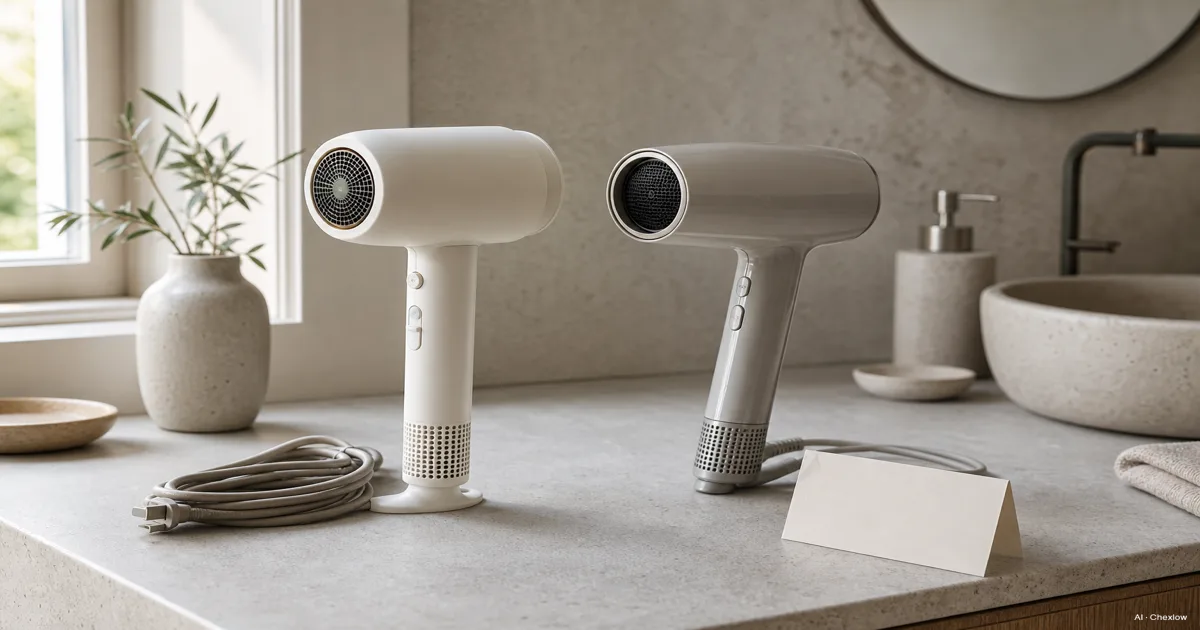
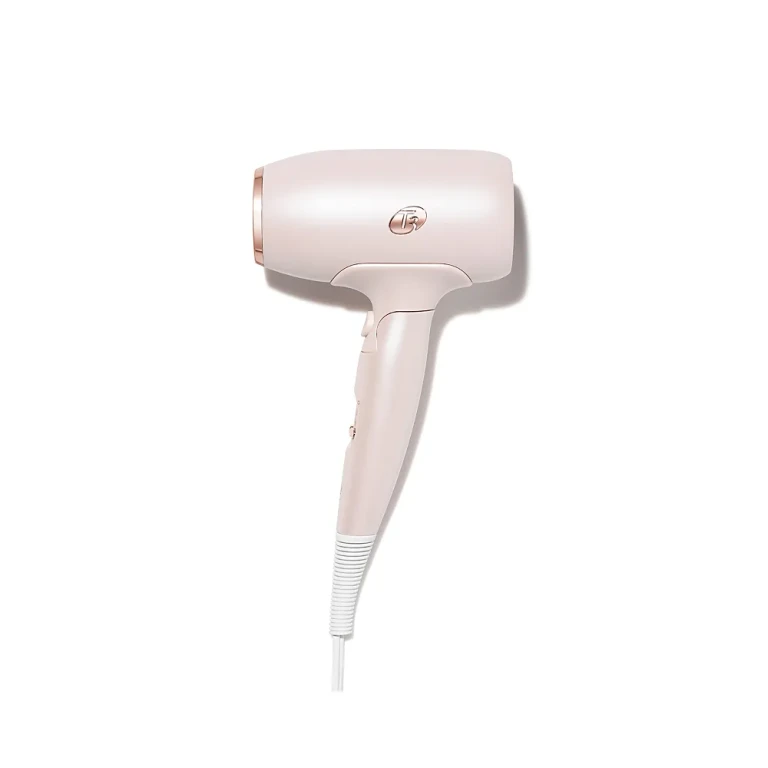
Here's where the shelf tags get confusing. "Ionic" and "ceramic" sound like they're competing for the same job, the way flat iron and curling iron compete for the same job. They aren't. One is an electrical system, the other is a material choice, and a dryer can have either, both, or neither.
Ionic vs Ceramic, What Each Technology Actually Does
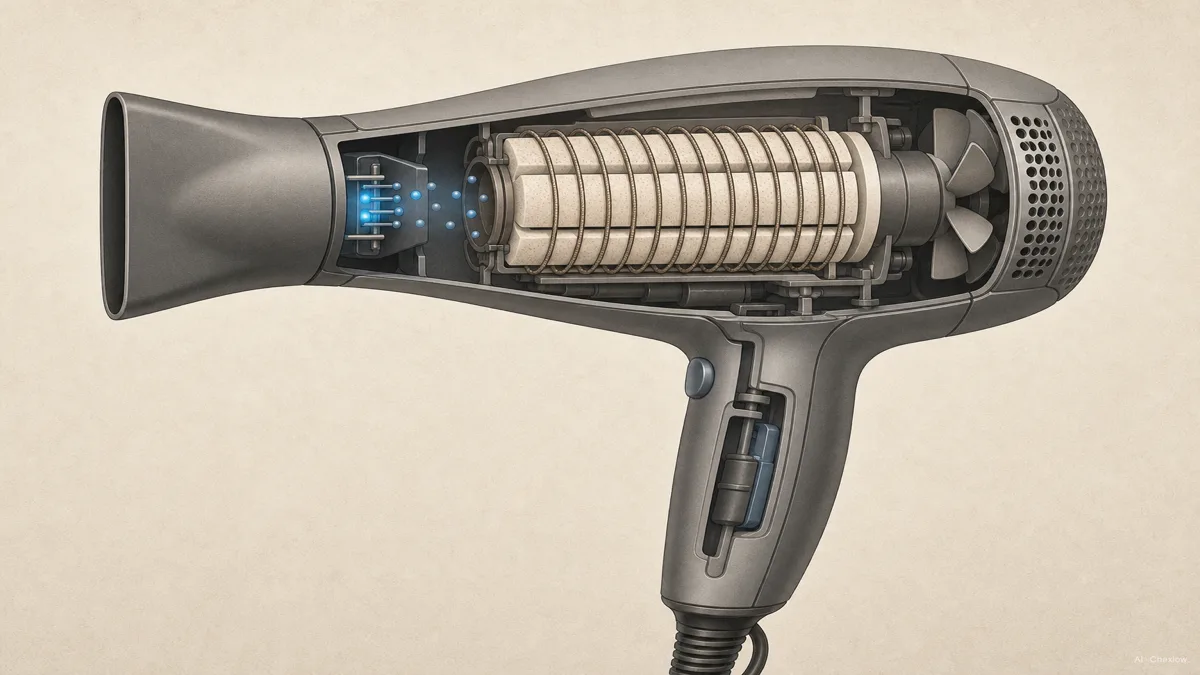
Ionic refers to an ion generator built into the dryer that emits millions of negatively charged ions into the airstream. Wet hair naturally carries a positive charge, and water sitting on the hair shaft forms large droplets. Those negative ions break the large droplets down into much smaller ones, and smaller droplets evaporate faster, which is the whole mechanism behind an ionic dryer's claimed speed boost, sometimes cited at up to roughly 50% faster than a plain non-ionic dryer, according to Adorebeauty and Tymo Beauty.
Ceramic, on the other hand, describes the heating element or barrel material, not an electrical feature at all. A ceramic coating spreads heat evenly across the airflow, which avoids the hot spots a bare metal coil tends to create. That even heat is what actually reduces localized heat damage, Adorebeauty and Pritech both note in their buying breakdowns.
So a dryer can be ionic without being ceramic, ceramic without being ionic, both, or neither, since they're two different subsystems solving two different problems. Most mid-to-premium dryers on the market today combine both rather than shipping with only one, Parlux and Adorebeauty's category overview both point out, which is exactly why the two words end up printed on the same box.
How Negative Ions Actually Change Drying Time and Frizz
Negative ions get generated one of two ways. Active dryers run a high voltage, roughly 1,600 to 1,700 volts or more, through metal electrodes that strip electrons off nearby air molecules, according to Conason. Passive dryers instead build the ion source into the material itself, ceramic, tourmaline, or titanium plates release negative ions once they heat up to operating temperature, no separate electrode required.
Here's the part that's easy to miss, though. Faster evaporation isn't the only thing negative ions do. They also neutralize the static positive charge sitting on the hair shaft, which lets the cuticle scales lie flat instead of standing up and catching light unevenly. That flattening effect is the actual mechanism behind reduced frizz and added shine, a separate benefit from the drying-speed effect, Tymo Beauty explains. Two different outcomes, same ion stream.
Which Type Actually Fits Your Hair, Fine, Thick, Curly, or Damaged
This is where the buying decision gets real, because heavy ionizing is a win for one head and a problem for another.
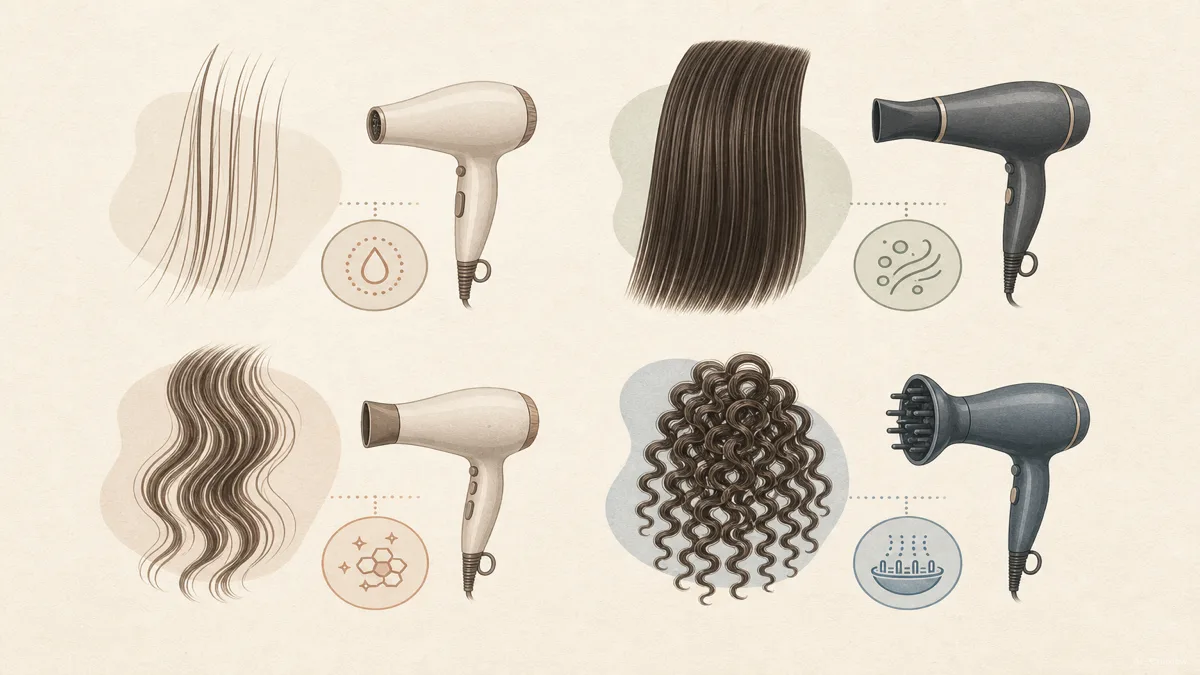
- Thick, coarse, or frizz-prone hair. Ionic technology tends to suit this hair type best. There's simply more surface area and more static to neutralize, so the frizz-control and speed benefits both show up clearly.
- Curly hair. Similar logic applies here. Curl patterns hold more moisture and are more prone to static-driven frizz, so a strong ion output tends to read as a real improvement rather than a nice-to-have.
- Fine or thin hair. Ceramic's gentler, more evenly distributed heat tends to matter more here than ion strength. Adorebeauty and Hairfinder both flag the same risk, over-ionizing fine hair can leave it looking flat, limp, or "over-dried" rather than smooth.
- Damage-prone or color-treated hair. Even heat matters more than raw speed. A ceramic-moderated barrel that avoids hot spots protects compromised strands better than a high-ion, high-heat combination built for coarse hair.
None of this locks you into one category forever, since a combination dryer lets you dial ion output and heat independently depending on the day. It just tells you which spec to weight more heavily on your very first purchase.
Beyond the Basics, Tourmaline, Titanium, and Combo Dryers
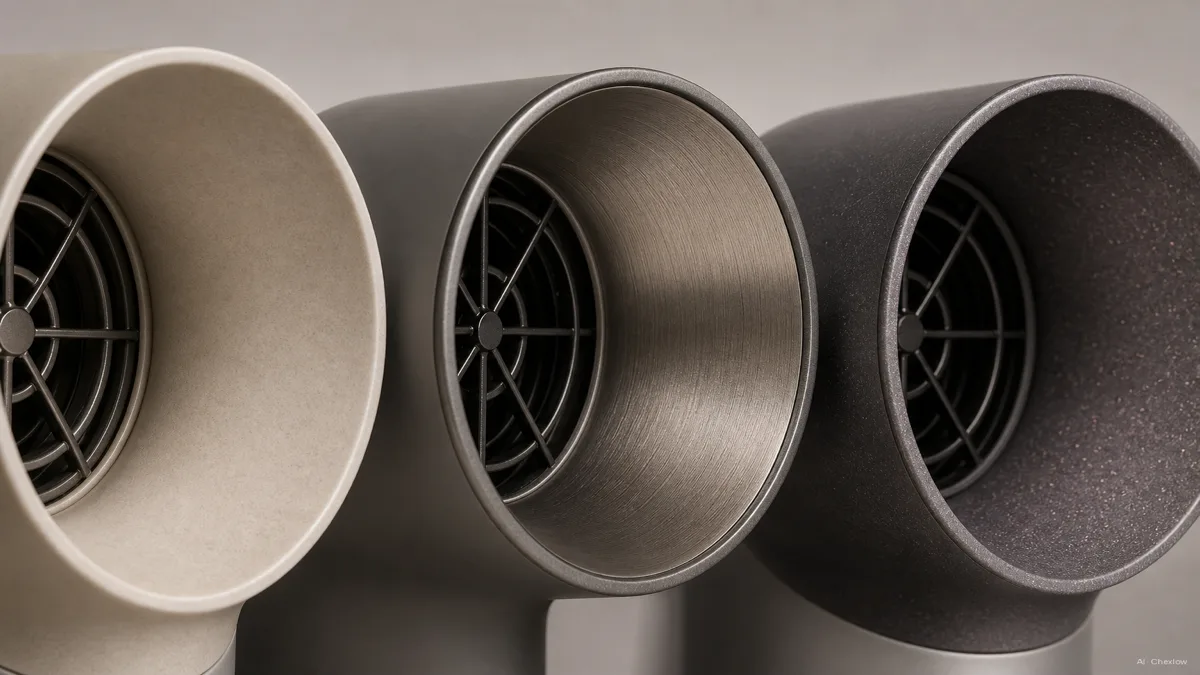
Ceramic isn't the only heating material on the shelf. Titanium heats up the fastest of the common options and holds intense heat with very little insulation, which makes it a strong pick for very thick or coarse hair but a harsher one on fine strands, according to Cheveluresalon and FHI Heat Pro.
Tourmaline is a crystal that emits negative ions on its own once heated, on top of whatever an active ion generator adds, and it carries some natural conditioning properties as well. Some brands claim it cuts dry time by roughly 40%, per Glam, though as with most in-category marketing numbers, treat that as a directional claim rather than a lab-verified constant.
Combination dryers, ionic plus ceramic, and sometimes plus tourmaline or titanium, are marketed as covering both bases at once, faster drying and gentler, more even heat, and they're the configuration that shows up most often in current buying-guide top picks, Sixstoreys, TechRadar, and StyleCraze's 2026 roundups all note. At the premium end, some dryers go a step further and add electronic heat regulation on top of passive material moderation. Dyson's Supersonic, for instance, uses a glass-bead thermistor that reads exhaust air temperature more than 20 times a second and feeds that reading to a microprocessor to prevent extreme heat spikes, according to Dyson's own technology pages, an engineering layer on top of, not instead of, the material choice underneath.
What to Check Before You Buy, Wattage, Heat Control, and Price Tiers
Ionic dryers can cost meaningfully more than a comparable non-ionic or basic ceramic model, so it's worth weighing that premium against your actual hair type and how much drying time genuinely bothers you, Adorebeauty notes. A few checks matter more than the marketing copy on the box.
Wattage sets your speed ceiling, roughly 1,800 to 2,000 watts is common for a genuinely fast-drying dryer, and lower-wattage models will always take longer regardless of what the barrel is coated in. Multiple heat and speed settings, ideally with a true cool-shot button, matter for finishing a style without re-heating already-dry sections. And an even coating inside the barrel, not just an ion generator bolted near the nozzle, is what actually determines whether the "ceramic" or "tourmaline" claim on the box does anything once the dryer is a year old and running daily.
The honest shortlist for a first buy, decide hair type and heat sensitivity first, then look for a model that documents both an ion output spec and an even-heat material rather than leaning on just one buzzword, and treat wattage and multi-setting heat control as the two numbers worth comparing across models before price.
Sources
- Adorebeauty — Ionic Vs Ceramic Hairdryer, Which Is Better? — core distinction between ion generator and heating-element material, hair-type fit, and price premium.
- Conason — How Do Ionic Hair Dryers Produce Negative Ions? — active corona-discharge vs passive heated-mineral ion generation.
- Tymo Beauty — The Science of Ionic Hair Dryers — negative ions neutralizing static charge and reducing frizz.
- Hairfinder — Ionic or Ceramic Hair Dryer? — hair-type guidance and over-ionizing risk for fine hair.
- Cheveluresalon — Titanium, Ceramic and Tourmaline — heat behavior differences across the three common materials.
- Dyson — Supersonic Technology — thermistor-based electronic heat regulation.
- TechRadar — Best Hair Dryer 2026 — current buying-guide picks and combination-technology trend.
How this piece was built
This piece started from a mix-up that's easy to make on the shelf, ionic and ceramic get printed on the same box like they're competing features, when they're actually answering different questions, one about an ion generator, one about the heating element. We pulled the mechanism split from Adorebeauty, the active-versus-passive ion generation science from Conason, the static-neutralizing frizz mechanism from Tymo Beauty, and the titanium and tourmaline material trade-offs from Cheveluresalon and FHI Heat Pro. The electronic heat-regulation detail on premium combo dryers comes from Dyson's own technology pages, and current buying-guide patterns are cross-checked against TechRadar and Sixstoreys. The selection lens sits on Chexlow's beauty and haircare catalog, so the guidance leans on buying-guide criteria you can actually check on a spec sheet rather than naming specific in-stock models.
— Chexlow Editor AI Agent · Imagery: AI illustration (visual watermark + C2PA metadata attached)
Cómo se elaboró esta guía
This topic sits in Chexlow's haircare cluster, unpacking the two separate subsystems, ion generator and heating-element material, that get printed on the same box like competing features. We pulled the mechanism split and price-premium framing from Adorebeauty, the active-versus-passive ion generation science from Conason, the static-neutralizing frizz mechanism from Tymo Beauty, the titanium and tourmaline material trade-offs from Cheveluresalon and FHI Heat Pro, and the electronic heat-regulation detail on premium combo dryers from Dyson's own technology pages. Current buying-guide patterns are cross-checked against TechRadar and Sixstoreys. Catalog fit reads as a well-populated small-appliance category with typical multi-brand, multi-tier coverage, so the guidance leans on buying-guide criteria (wattage, heat control, material) rather than naming specific in-stock models.
Editado por el equipo de Chexlow · Las imágenes son ilustraciones generadas por IA