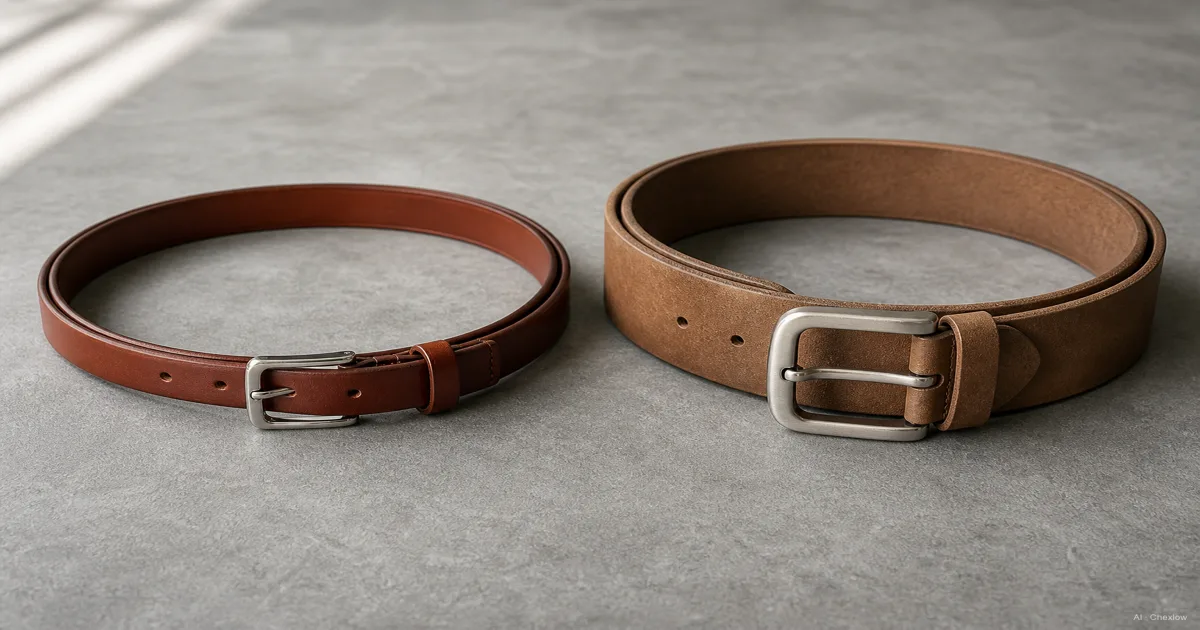


Start with the outfit, then choose a width
For conventional men's trouser belts, these are useful starting ranges, not dress-code laws:
- Suits and office trousers: look at 30–35mm.
- Jeans and relaxed outfits: compare 38–40mm.
Those ranges follow BeltUp's buying guide. For inch-labelled products, 1.25 inches is about 32mm, 1.38 inches about 35mm, and 1.5 inches about 38mm; compare the stated strap width, not the buckle's outer dimensions. Beltley's width guide uses these rounded equivalents.
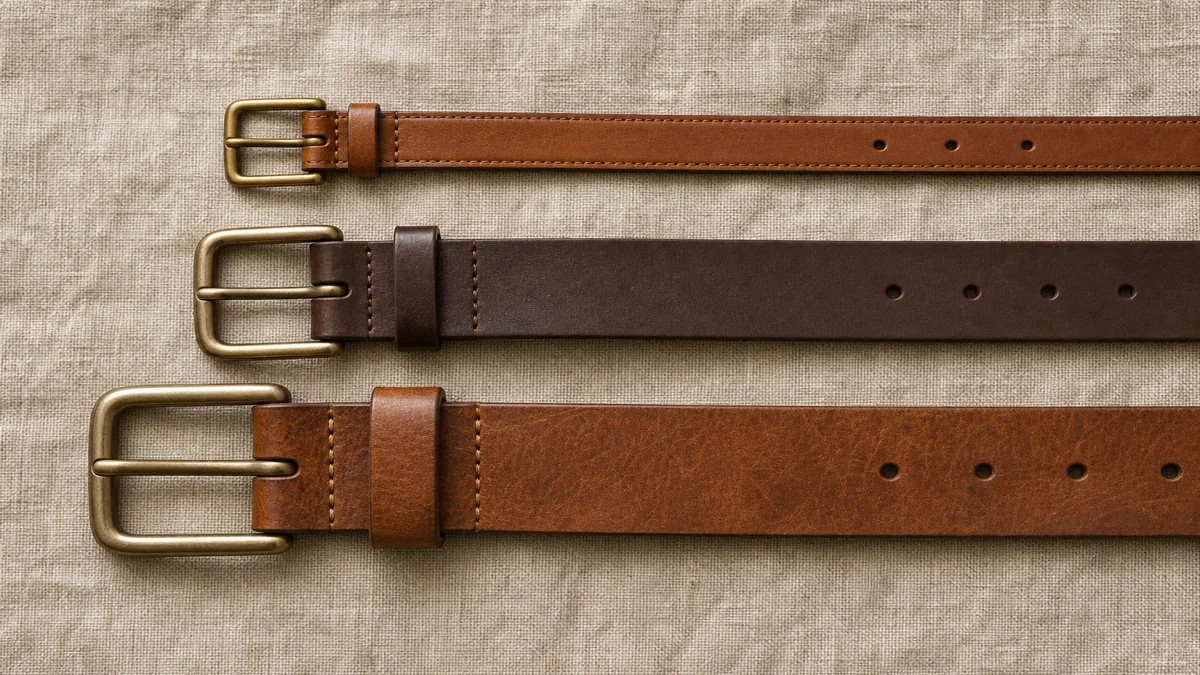
Use the illustration to compare proportions, not to measure a belt. Pick the trousers you will wear most often before choosing between the slim, middle and broad options.
Check what actually passes through your loops
A belt loop is the fabric carrier sewn onto the waistband. Its usable opening matters more than the trousers' label: “slim jeans” is not a measurement. Sewing.org's construction guide sizes loops around the belt and allows extra length for thick fabric.
Try this before ordering:
- Measure the opening: lay out the trousers and measure the clear opening between a loop's upper and lower attachments, in the direction the belt's width will occupy.
- Compare widths: compare that opening with the candidate's stated strap width. Check several loops, including the back.
- Try threading: if you can try the belt, pass it through every loop without folding it or pulling the stitching. Check the thicker tip too.
Treat the ruler reading as a shortlist filter; the actual threading check is more useful than choosing a universal clearance number. If a belt already fits these trousers comfortably, measure its width as a starting reference.
Black tie is a separate case. Classic tuxedo trousers use side adjusters or suspenders rather than a belt, as Suitsupply's black-tie guide explains. Check that waistband before shopping for a narrower dress belt.
Check the buckle and surface together
A small, flat buckle and smooth strap are conventional dress choices; a larger buckle or braided surface shifts the look toward casual. A frame buckle, with a pin passing through a strap hole, can appear in either category. These distinctions are described in The Art of Manliness's belt guide.
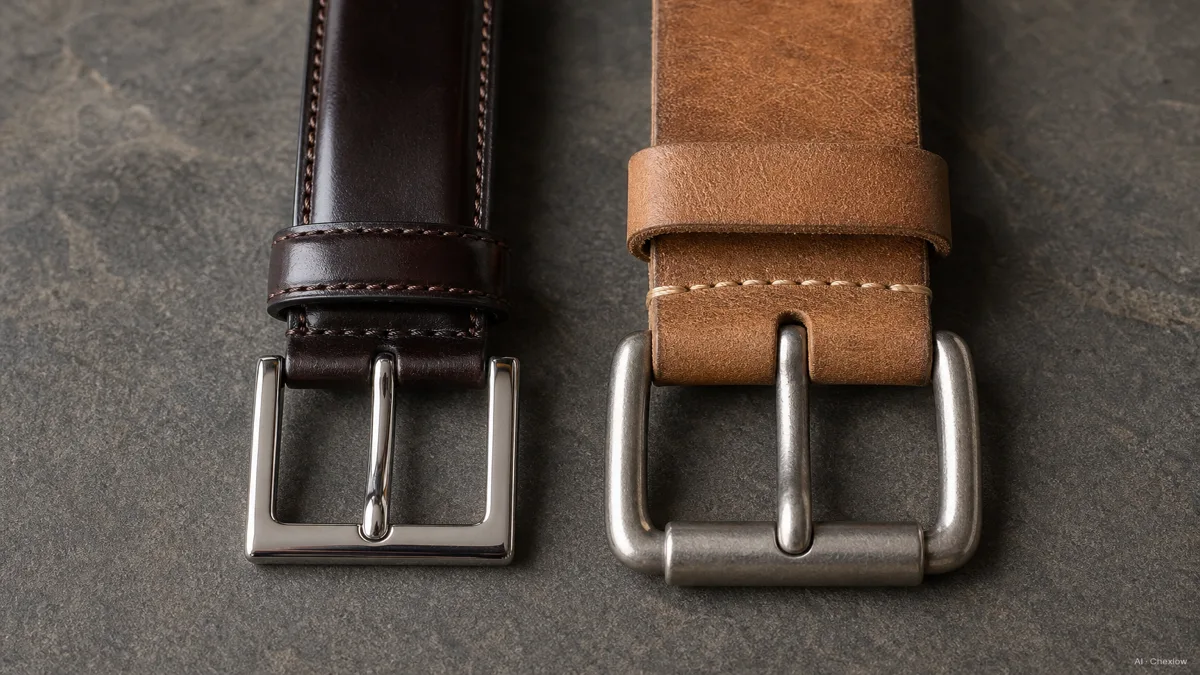
Compare the pictured buckles as well as the straps. For a belt you want to wear with a suit, inspect the whole front view rather than relying on “35mm” in the product name. Narrowing a heavily decorated belt would not resolve the decoration itself.
If you are deciding how the belt should fasten or whether its buckle can be changed, continue with belt buckle types and attachments.
Decide whether one belt is enough
Beltley identifies 35mm as a crossover width. Treat that as a candidate to try, not a promise that it suits every pair of trousers.
- Mostly suits: prioritise a restrained dress belt in the width your trousers accept.
- Mostly denim: compare casual belts after checking their width and thickness against your loops.
- Office trousers and jeans: try a plain 35mm belt with both complete outfits. If it fits both and you like both results, one belt can be enough.
- Different requirements: if the office trousers need a slimmer strap but you prefer a broader belt with denim, choose for each use instead of forcing one compromise.
Before paying, check length separately. Crockett & Jones's size guide measures from the buckle attachment to the middle hole, not along the entire belt. Use the specific maker's measuring method; for the wider first-buy checklist, see choosing a leather belt's size.
Sources
- BeltUp: widths by outfit
- Beltley: millimetres, inches and the crossover width
- Sewing.org: belt-loop construction
- The Art of Manliness: buckle and strap conventions
- Crockett & Jones: belt length measurement
- Suitsupply: classic tuxedo trousers
Comment ce guide a été conçu
Written by Chexlow's AI editorial team using belt makers' published guidance, Sewing.org's construction notes and the cited style and formalwear references. The article turns those sources into a width-selection checklist; outfit judgments are editorial guidance, not product testing.
Rédigé par l’équipe Chexlow · Les images sont des illustrations générées par IA