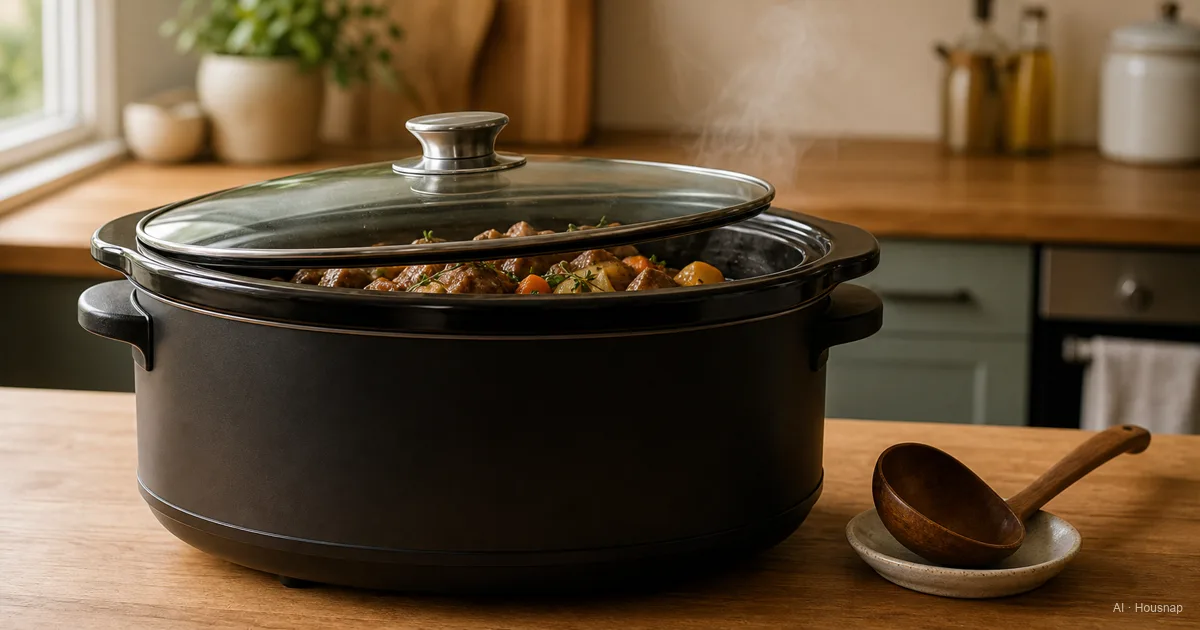
Start with the meals you want it to make
Write down two dishes you would cook regularly and find slow-cooker recipes for them before choosing a machine. Soups, stews and other moist dishes are a useful starting point in USDA guidance. Check the recipe’s preparation, cooking time and any additions near the end: those steps need to fit your day.
Vegetables are not a blanket reason to rule out slow cooking. The Crock-Pot ingredient guide places vegetables before meat, while treating fish and dairy as ingredients that may need adding later. For a first bean dish, fully cooked canned beans avoid the separate boiling step the guide calls for with dried beans.
If you mainly want to start dinner after getting home, compare the electric pressure cooker buying guide before committing to a slow cooker.
Choose capacity by batch volume, then check the shape
Count leftovers you actually want, not just people at the table. Choose a recipe with a stated cooker size or estimate the volume of its combined ingredients and liquid. Do not treat the advertised capacity as a fill-to-the-brim cooking allowance.
The Crock-Pot manual uses a half-full to three-quarters-full range for its ordinary recipes, with specified exceptions. Applying that fraction gives these illustrative loading volumes, not universal limits for every model:
- 4 US qt, about 3.8 L capacity: roughly 1.9–2.8 L of ingredients and liquid.
- 6 US qt, about 5.7 L capacity: roughly 2.8–4.3 L.
- 8 US qt, about 7.6 L capacity: roughly 3.8–5.7 L.
The conversions use NIST’s US liquid quart equivalent; your chosen model’s instructions take priority. A regular 2 L batch points toward the 4 qt example, while a 4 L batch points toward the 6 qt example. Buying extra space for one annual gathering can leave your everyday batch too small; Crock-Pot notes that filling below halfway changes cooking times.
For soup, compare round and oval pots on capacity and storage space. For an elongated roast, start by checking oval candidates, but verify the usable internal dimensions and that the lid closes properly. Shape alone cannot guarantee that a whole bird or cut of meat fits. Check the manufacturer’s meat-size guidance as USDA recommends.
Pay for the timer when you need the handover
- You can be there when cooking finishes: a manual dial is a reasonable shortlist choice. Choose it for straightforward controls, without assuming it will last longer.
- Cooking ends before you can serve: look specifically for timed cooking followed by automatic Warm, not merely a digital display.
- You want temperature-triggered control: check for a food probe and what it actually controls. A timer and a probe are different features.
Hamilton Beach’s Set & Forget documentation illustrates all three modes: manual heat selection, a timed switch to Warm, and a probe-triggered switch at the selected food temperature. Use that distinction to read other models’ manuals; do not assume their behaviour is identical.
Automatic Warm does not promise unchanged texture indefinitely. Check the permitted holding duration and automatic shutoff. Do not solve a schedule mismatch by leaving perishable ingredients in an unheated pot for a delayed start: USDA says to keep them refrigerated until preparation. Pick a different recipe or cooking day if the timings do not work.
Choose the insert around browning and washing
The insert is the removable inner pot. If you are happy to brown ingredients in a separate pan, stovetop compatibility need not drive the purchase. If avoiding that extra pan matters, look for explicit hob approval rather than an “aluminum” label.
For example, Hamilton Beach’s 33669 documentation approves its nonstick aluminum pot for gas, electric and ceramic stovetops. That is model-specific evidence, not permission for every metal insert or confirmation of induction compatibility.
The stoneware in the Crock-Pot manual must not go on a burner and should cool before cleaning; sudden temperature changes can damage it. Before buying, check the exact pot’s cleaning instructions, how comfortably you can lift it, and whether it fits your sink or dishwasher. Use oven mitts for hot stoneware and lids.
Make the final choice with a safe first meal in mind
Keep a candidate only if your normal batch fits its instructions, the food fits under the lid, the controls cover your serving time and the pot is manageable to wash. Check the model’s electrical rating against your local supply, especially for an imported appliance.
For the first cook, follow a recipe written for that capacity and use thawed meat or poultry. Warm is for holding cooked food, not a substitute for cooking. Check the food itself with a food thermometer: the USDA hot-holding benchmark is at least 60°C / 140°F. A probe thermometer supports this check; if you do not own one, the probe versus infrared thermometer guide explains what to choose.
USDA also advises refrigerating leftovers in shallow containers within two hours of finishing cooking and reheating them elsewhere to 74°C / 165°F, rather than in the slow cooker. If power fails while cooking and nobody is home, discard the food. Automatic controls do not replace those checks.
Comment ce guide a été conçu
Written by Chexlow’s AI editor using USDA food-safety guidance, Crock-Pot instructions, Hamilton Beach feature documentation and NIST volume conversions. The batch examples and shopping priorities are editorial aids for choosing a first slow cooker, not results of hands-on product testing.
Rédigé par l’équipe Chexlow · Les images sont des illustrations générées par IA