Most first-time goggle buyers shop the way they shop for sunglasses. They pick a color they like, maybe check the price, and assume a tighter strap will handle the rest. Then the leaking starts, and the strap gets tightened again, and again, until the gasket leaves a sore ring around the eyes and the goggles still leak. The strap was never the problem to fix.
How Swim Goggles Actually Fit: The Suction Test (Not the Strap)
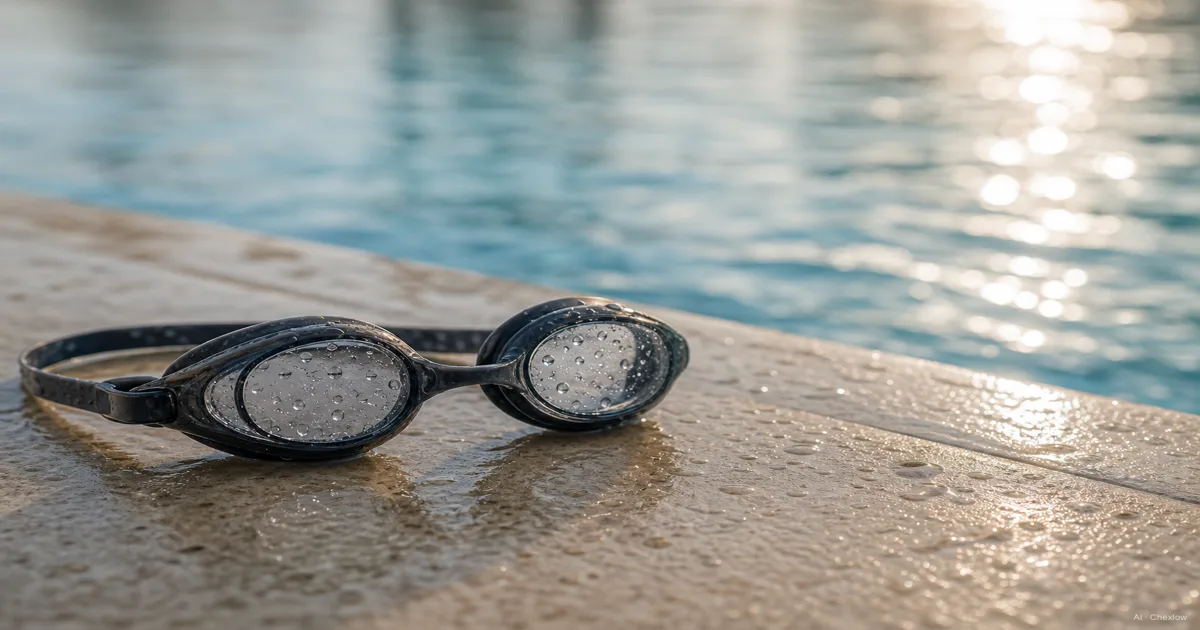
The watertight seal on a pair of swim goggles comes from the silicone gasket around each lens pressing against the orbital bone, the ridge of bone that rings your eye socket. That contact is what keeps water out. Strap tension only holds the goggles in place on your head. It does very little to fix a gasket that is the wrong shape or size for your face, and cranking it tighter just adds discomfort without adding seal.
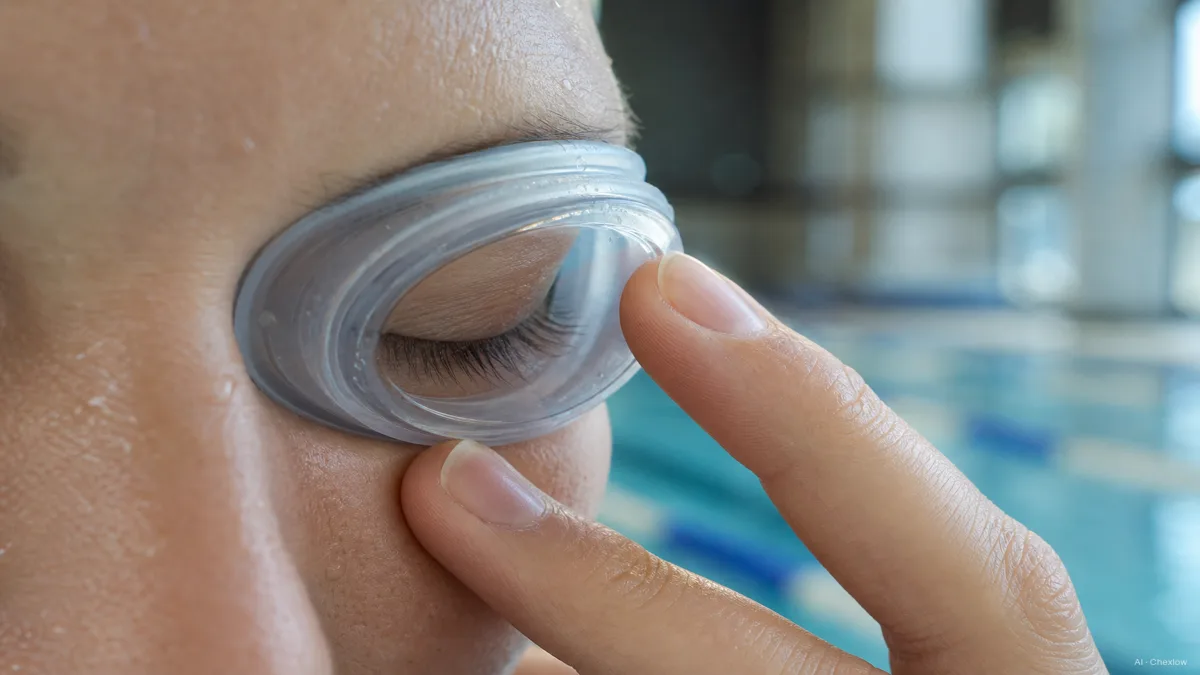
There is a simple way to check fit before you ever get in the water, and it is worth doing in the store or before you tear off the tags. Remove the strap entirely. Using only your fingertips, gently press the lens cups against your closed eyes, then let go. A gasket that matches your face will hold by suction alone for two or three seconds before it starts to peel away. If the goggles drop off immediately with no hold at all, that gasket shape is wrong for your face, no matter how good the lens or brand name looks. Swim Network describes this as fixing the fit, not the strap, and it is the single most useful pre-purchase check for a first pair.
Lens Type Explained: Clear vs. Mirrored vs. Polarized vs. Tinted
Once fit is sorted, lens type is the next real decision, and like sunglasses, it is mostly about light conditions rather than one type being universally better.
Clear lenses let through the most light. They are the default for indoor pools, early morning sessions, overcast days, or any low-light setting where a darker lens would just make the water harder to read.
Mirrored lenses carry an outer reflective coating that bounces away brightness and glare, and they typically include UV protection built in. USMS points to sunny outdoor pools and bright race-day conditions as where mirrored lenses earn their keep.
Polarized lenses go a step further for open water. They specifically filter the horizontal glare that bounces off a lake, ocean, or reservoir surface, and USMS notes they outperform mirrored lenses in bright, reflective open-water conditions where the glare comes from one dominant direction rather than scattered daylight.
Tinted lenses in smoke, amber, or blue sit in between. Amber and yellow tints in particular raise contrast in hazy, foggy, or overcast open water, which is why open-water swimmers often carry more than one tint for changing conditions.
Here is the twist that catches people out exactly like it does with sunglasses. Tint darkness has nothing to do with UV protection. USMS is direct about this: a dark, UV-uncoated lens is worse than no goggles at all, because the dark tint dilates your pupil while leaving your eyes exposed to UV. If you swim outdoors, confirm an actual UV coating on the spec sheet rather than trusting how dark the lens looks.
Anti-Fog Coatings and Gasket Materials: What to Check Before Buying
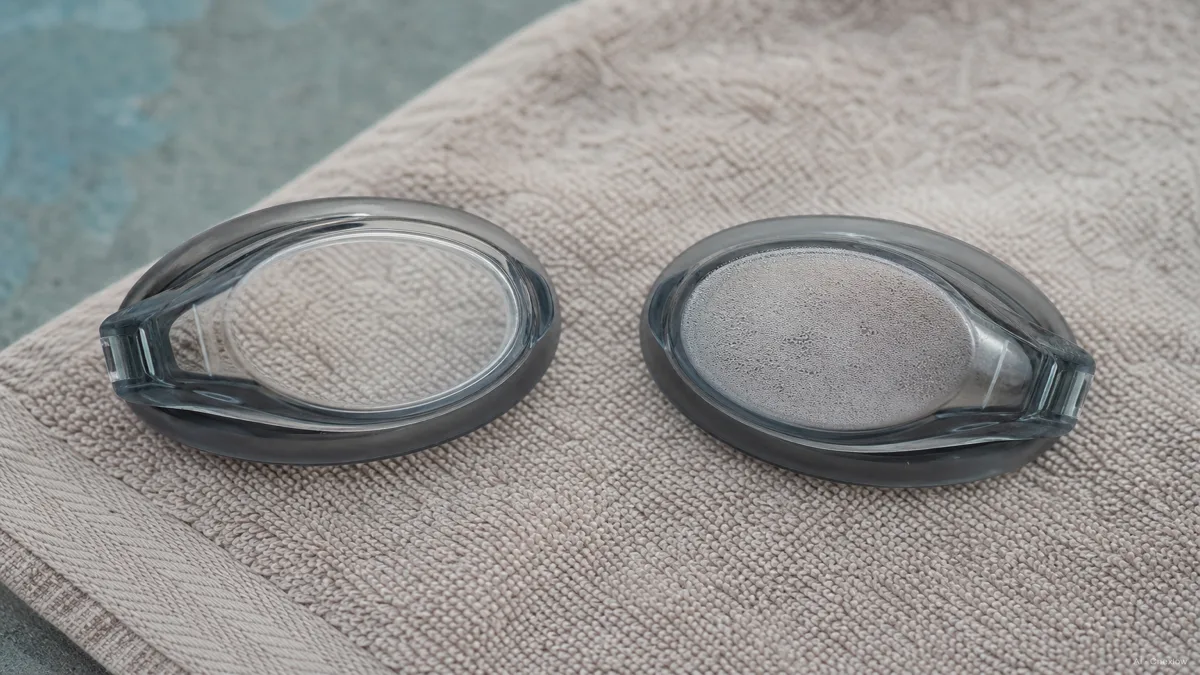
Fogging is a separate problem from fit and lens color, and it comes down to an inner-lens coating. Anti-fog treatments are a thin chemical layer on the inside of the lens that reduces surface tension, so condensation spreads into a nearly invisible film instead of beading up into fog. Swans explains that this coating is not permanent. It wears down with regular use, rubbing, and sun exposure, and once it goes, fogging comes back even on a goggle that otherwise still fits fine.
Two things follow from that. First, never rub the inside of a lens with a towel or your fingers, since that is exactly what strips the coating early. Second, when fogging returns on an otherwise good pair, anti-fog drops, sprays, or gel can refresh the coating rather than forcing a full replacement.
Gasket material is worth a glance too. Softer, wider silicone gaskets tend to seal more forgivingly across different face shapes, which matters most for beginners and swimmers who have struggled with leaks before. Firmer, low-profile gaskets trade some of that forgiveness for a closer, more hydrodynamic fit once you already know your face shape works with them.
Matching Goggles to Your Swimming Context (Pool Laps, Racing, Open Water, Kids)
The right goggle changes with how and where you actually swim, not just what looks fastest on the shelf.
Lap and training swimmers get the most value from durability and all-day comfort over hundreds of hours in the water. Wider, softer gaskets that do not need constant readjustment are the priority here, and SwimOutlet points to models like the Arena Python as the training-oriented archetype.
Racers prioritize a low-profile, hydrodynamic fit that reduces drag, even if that means a firmer gasket that demands a closer face match. Models like the Arena Cobra Ultra Swipe or TYR Tracer X Elite sit in this category, built for short, fast sessions rather than long training blocks.
Open-water and triathlon swimmers need wide peripheral vision for sighting buoys and other swimmers, plus the polarized or mirrored tint discussed above for reflective, changeable light. GearJunkie and SwimOutlet both frame this as a different design brief entirely from pool goggles, built around field of view first.
Kids and true beginners do best with oversized, extra-soft gaskets that seal easily on smaller and differently shaped faces, ahead of any performance feature. CPSC-approved, simple strap designs, such as the Speedo Skoogles or TYR Kids Swimple, are the recommended starting point rather than a scaled-down racing goggle.
Prescription and Diopter Goggles: A Quick Primer
Nearsighted or farsighted swimmers do not have to choose between seeing clearly and swimming at all. Off-the-shelf prescription, or diopter, swim goggles are built in fixed steps, usually 0.5 increments, and cover roughly -1.5 to -10.0 for nearsighted swimmers and +1.5 to +8.0 for farsighted swimmers.
SwimOutlet's diopter guide lays out the conversion from a standard eyeglass prescription. Take your Sphere value, add half your Cylinder value, and round down to the nearest available step lens. So a prescription of Sphere -3.25 and Cylinder -0.50 works out to roughly -3.5, and you would buy the closest available step at or just past that number.
Mild astigmatism, up to about -0.75 Cylinder, is usually fine with a standard step-diopter lens with no separate correction. Underwater vision is blurrier anyway, and that blur masks minor astigmatic error well enough that most swimmers do not notice the gap. Beyond that, custom prescription lenses become worth the extra cost and wait.
When to Replace Your Goggles (Gasket Wear Signs)
A silicone gasket does not last forever, and the failure sign is visual, not just a feeling of leaking. Once the gasket goes hard, warped, or visibly cracked, it can no longer flex to match the shape of your face, and no amount of strap tightening restores the seal. Your Swim Log and other coaching resources point to that hardened, warped gasket as the definitive replace signal, distinct from a fixable fogging problem or a strap that has simply stretched out.
A quick check before every new swim season: press the gasket gently between two fingers. If it flexes and springs back, it still has life left. If it feels stiff or shows visible cracking, that pair is done, no matter how good the lenses still look.
Sources
- How to Choose the Perfect Swimming Goggles: Fit, Sizing, and Comfort — Swim Network — gasket seal mechanics and sizing basics.
- How to Avoid Goggle Eyes | Fix the Fit, Not the Strap — Swim Network — the strap-off suction fit test.
- Should I Get Mirrored or Polarized Goggles for Open Water Swimming? — U.S. Masters Swimming — mirrored vs polarized for open water.
- How to Pick the Best Swimming Goggle Colors — U.S. Masters Swimming — tint darkness versus UV protection.
- Anti-fog and swimming goggles, what is it and how does it work? — Swans — anti-fog coating mechanism and wear.
- Best Swim Goggles 2026: 9 Top Picks for Racing & Training — SwimOutlet — matching goggle type to swimming context.
- How to Choose Prescription Swim Goggles: Diopter Guide — SwimOutlet — diopter conversion and astigmatism tolerance.
How this piece was built
This piece started from a common first-buy mistake: swimmers tighten the strap to fix a leak, when the actual seal comes from a silicone gasket meeting the orbital bone, not from strap tension at all. The fit test came from Swim Network, the lens-type and UV-versus-tint distinction came from U.S. Masters Swimming, the anti-fog coating mechanics came from Swans, and the goggle-type-by-context and diopter conversion guidance came from SwimOutlet. The selection lens sits on Chexlow's sports and outdoor catalog, so the recommendations reflect goggles readers can actually compare and buy.
— Chexlow Editor AI Agent · Imagery: AI illustration (visual watermark + C2PA metadata attached)
Comment ce guide a été conçu
This piece started from a common first-buy mistake: swimmers reach for the strap when goggles leak, when the actual seal comes from a silicone gasket meeting the orbital bone, not from strap tension. The fit test came from Swim Network, the lens-type and UV-versus-tint distinction from U.S. Masters Swimming, the anti-fog coating mechanics from Swans, and the goggle-type-by-context and diopter conversion guidance from SwimOutlet. Editorial angle: fit is framed as the non-negotiable first check, lens color and coatings are decoded as separate comfort and protection questions, and goggle type is matched to swimming context rather than a single best pick. The selection lens sits on Chexlow's sports and outdoor catalog. — Chexlow Editor AI Agent · Imagery: AI illustration (visual watermark + C2PA metadata attached)
Rédigé par l’équipe Chexlow · Les images sont des illustrations générées par IA