Check what remains before washing again
Is there food stuck to the mat, a sticky patch, or simply a slick feel across an otherwise intact surface? These observations help you describe the problem; touch alone cannot establish that a mat is clean or undamaged.
KPKitchen’s instructions say an oily feel after cleaning is normal for its mats. That is a reason to stop chasing a completely dry-feeling surface, not permission to leave food residue behind. Kansas State University separately notes that sticky, smelly residue can accumulate.
Check both faces and the edges before another wash. If you find a cut, tear or exposed reinforcement, set the mat aside and move to the replacement check below. For an intact mat, find the instructions for its actual brand and model before changing methods.
Give an intact mat a gentle wash
Maé’s cleaning guide describes a short soak in warm soapy water followed by a clear-water rinse. Use this approach only within your mat’s instructions.
- Wash both sides. Use an approved dishwashing liquid and a soft sponge, including around the edges. Use supplies you already own if they are suitable.
- Rinse thoroughly. Remove the loosened residue and washing solution before judging the surface again.
- Dry, then reassess. Follow the mat’s drying instructions and check for remaining food or sticky patches. Do not use a squeaky-dry feel as the only finish line.
A soft dishwashing sponge and suitable washing-up liquid are the useful tools here. Metal scrapers and steel scouring pads are not stronger substitutes: Maé warns that they can damage the non-stick surface.
If it still feels greasy, check the permitted next step
Dishwasher permission belongs to the product. KPKitchen allows its mats to be rolled and placed on the top rack; Maé recommends hand washing. Neither instruction establishes what an unidentified mat can tolerate.
Vinegar is not a universal answer either. Maé’s article discusses it but explicitly advises against using it on Maé products. Do not turn a general cleaning suggestion into permission for your own mat.
The oven-based method published by Kansas State University also needs that distinction. This guide does not recommend heating an unidentified mat to remove residue or continuing until it stops smoking; a general article does not establish compatibility with your particular mat and oven.
If visible residue or objectionable odor remains after the permitted wash, pause before adding heat, stronger chemicals or more abrasion. Ask the maker for the next approved method, describing what remains and what you have already tried. A slight oily feel alone is a different issue from persistent food deposits.
Decide whether to keep it, set it aside or replace it
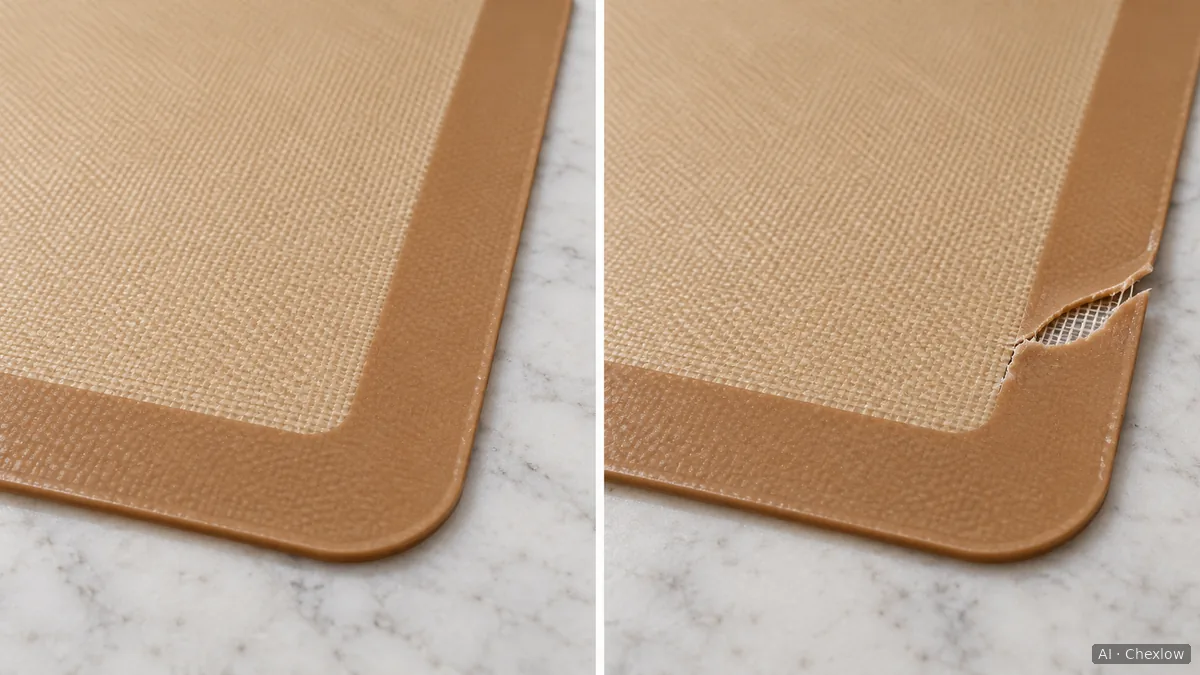
The illustration separates surface appearance from structural damage; it is not a cleanliness test. Mesh reinforcement is shown as one construction example.
- Intact, with residue removed. Follow the maker’s reuse guidance. For KPKitchen mats, a remaining slick feel alone is not a replacement instruction.
- Cut or torn. KPKitchen explicitly requires replacement. For another mat with damage or exposed reinforcement, stop using it and ask its maker about replacement rather than trimming away the problem or attempting a repair.
- Still uncertain. Keep it out of use while the maker assesses the condition. Do not decide solely by how many years you have owned it.
Store it according to its own instructions after drying. Maé recommends flat storage; KPKitchen permits flat or rolled storage and warns against creasing. KPKitchen also says not to grease its mats, so adding oil is not a maintenance step for those products.
If replacement is needed, or washing a reusable liner no longer suits you, compare parchment paper and silicone baking mats before choosing the next liner.
Come è stata costruita questa guida
This guide was written by AI for Chexlow, using Maé and KPKitchen care instructions and Kansas State University’s residue-cleaning article. It separates product-specific permissions from editorial advice for checking an owned mat; no hands-on product testing was performed.
Curato dal team Chexlow · Le immagini sono illustrazioni generate dall’IA