Check how the hanger supports the shoulders
Start with the hanger you already own. Suitsupply recommends a broad wooden hanger and explains that thickness helps preserve a jacket’s natural shoulder form. A narrow hanger left over from cleaning is not the support to copy.
Look at both the hanger’s overall width and the depth of its shoulder ends. As a practical fit check, hang the blazer and inspect it from the front and side: the shoulders should rest naturally, without the ends pushing out into the sleeves or leaving the outer shoulders visibly unsupported. This is a visual check, not a universal hanger measurement.
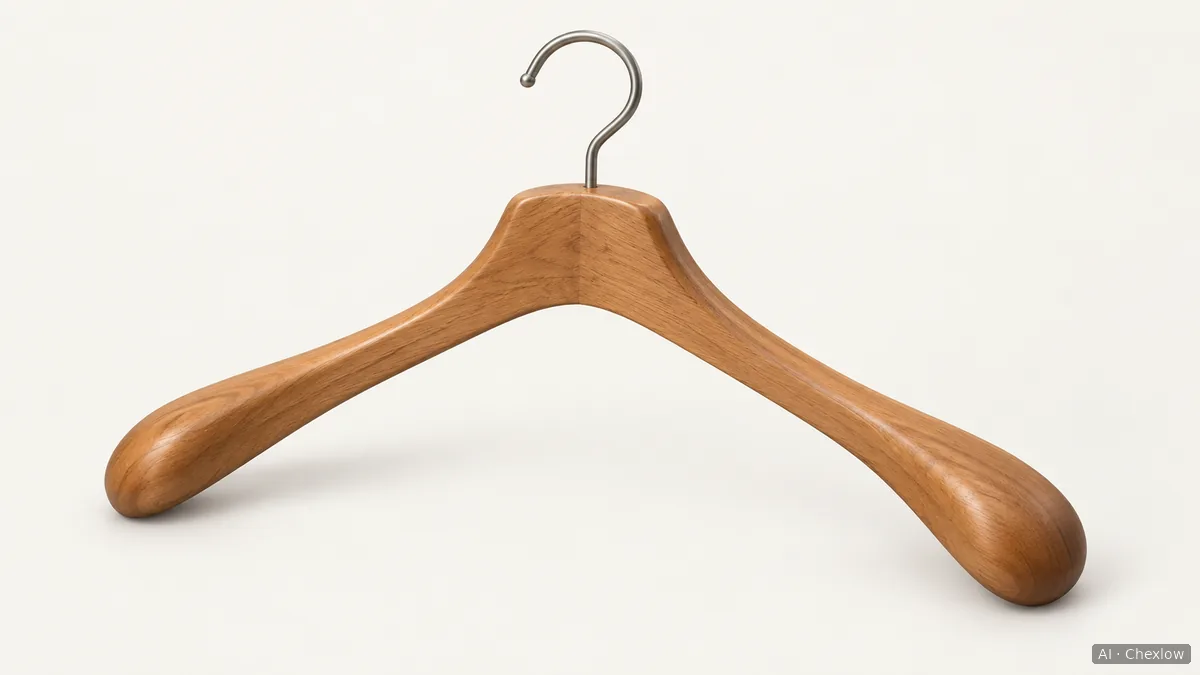
The illustration makes the hanger’s shape visible; it does not establish the right size for your jacket. Keep an existing hanger that supports it well. If it does not, compare broad-shouldered suit hangers rather than buying another blazer or an entire matching hanger set.
Let the worn jacket air before covering it
After taking it off, hang the blazer where air can reach it and neighbouring clothes do not press against it. Leave the cover off while it airs. Suitsupply’s guidance allows the fibres time to dry, rest and regain their shape; use dryness as the storage check rather than treating a fixed number of hours as a guarantee.
A normal day’s wear does not automatically mean another cleaning visit. BOSS advises washing only when needed and airing clothes between wears where appropriate. If the jacket has a stain or needs cleaning, read its own care label before choosing a method. General advice for washing wool is not permission to wash a tailored jacket.
Cover a dry blazer without squeezing it into storage
For covered storage, choose a breathable garment cover. Woolmark describes cotton or wool storage bags as breathable options and warns that vacuum bags can trap moisture and are unsuitable for delicate clothing. A 100% cotton garment cover is one useful option; reuse a suitable one you already have.
Check the cover with the jacket inside. It should accommodate the shoulders and full length without folding the hem or pulling the jacket tight. Hang it upright and leave enough room that adjacent garments do not flatten it. A cover cannot make a damp jacket ready to put away.
Before a seasonal break, clean the jacket according to its label and finish drying it before covering it. Woolmark also advises checking stored clothing for moisture and insects. Keep the jacket accessible for those checks rather than sealing it away and forgetting it.
If creases remain, check care permissions before adding heat
Better storage is the first adjustment; persistent creases are a separate finishing decision. Suitsupply advises against ironing a suit unless its care label permits it. Check the jacket’s instructions before either pressing or steaming, and ask the maker or a professional cleaner if the permitted method is unclear.
If home finishing is allowed and you actually need to buy a tool, the next question is whether a garment steamer or an iron suits the job. If the shoulder still looks misshapen on an appropriate hanger, or the fabric is damaged, seek an assessment rather than repeatedly applying heat.
Come è stata costruita questa guida
AI wrote this guide for Chexlow using Suitsupply’s suit-care guidance, Woolmark’s storage advice and the BOSS care guide. It focuses on storing an already-owned tailored jacket; the visual fit checks and purchase boundaries are editorial judgments, not results of hands-on testing.
Curato dal team Chexlow · Le immagini sono illustrazioni generate dall’IA