The two things that actually destroy leather jackets
Leather fails in two ways: it dries out and cracks, or it traps moisture and grows mold. Everything in jacket care is basically about managing those two extremes.
Cracking happens when the leather loses its natural oils — usually from heat, sunlight, or just being forgotten in a closet for years without any conditioning. Once cracks appear, you can slow them down but you can't fully reverse them.
Mold is the sneakier problem. It grows when leather stays damp — after rain, in a sealed plastic bag, or in a humid storage space. You often don't notice until you pull the jacket out and find white or grey patches that smell musty.
How often to condition — probably less than you think
Leather jackets don't need conditioning as often as shoes. Shoes flex and bend thousands of times a year; a jacket mostly just hangs there. For most people, conditioning once or twice a year is plenty.
If you wear the jacket frequently, live in a dry climate, or notice the leather starting to feel stiff or look dull, move to every three to six months. If it sits in a closet most of the year and you're in a humid environment, once a year is fine.
The signs that tell you it's time: the surface looks matte and lifeless, the leather feels rigid rather than supple, or you can see fine lines starting to form at the elbows and collar creases.
What to do right after rain
Here's the thing — a leather jacket getting wet isn't a disaster. What you do in the next hour is what matters.
First, blot the surface with a dry cloth. Don't rub; just press and lift to absorb surface moisture. Then hang the jacket on a wide hanger in a room with good airflow and let it air-dry at room temperature.
No hair dryer. No radiator. No direct sunlight. Heat forces moisture out too fast and can leave the leather stiff, warped, or cracked. It takes a few hours to dry naturally — that's fine.
Once it's fully dry, apply a thin layer of conditioner. Rain strips some of the leather's natural oils, and the conditioner replaces them. Skip this step and the jacket will feel noticeably stiffer after a few rain cycles.
If you're wearing the jacket regularly in wet conditions, a water-repellent spray applied every season adds a meaningful barrier without changing the look or feel.
Choosing a conditioner — wax-based vs oil-based
The same conditioners used for leather shoes work on jackets too, with one consideration: coverage. A jacket has a lot more surface area, so thin-spreading creams are easier to work with than thick waxes.
Oil-based conditioners (neatsfoot oil, mink oil) penetrate deeply and are good for dry or neglected leather. They can darken some leathers slightly, so test on a hidden seam first.
Wax-based creams add a light protective layer on top and often give a subtle sheen. These are the most popular choice for regular maintenance.
Avoid anything with silicone or petroleum distillates — they can clog the leather's pores over time and make future conditioning less effective.
Apply with a soft cloth in small circular motions. Let it absorb for 10–15 minutes, then buff lightly with a clean cloth. You don't need much — a thin, even coat is better than a heavy application.
Why the hanger matters more than you'd expect
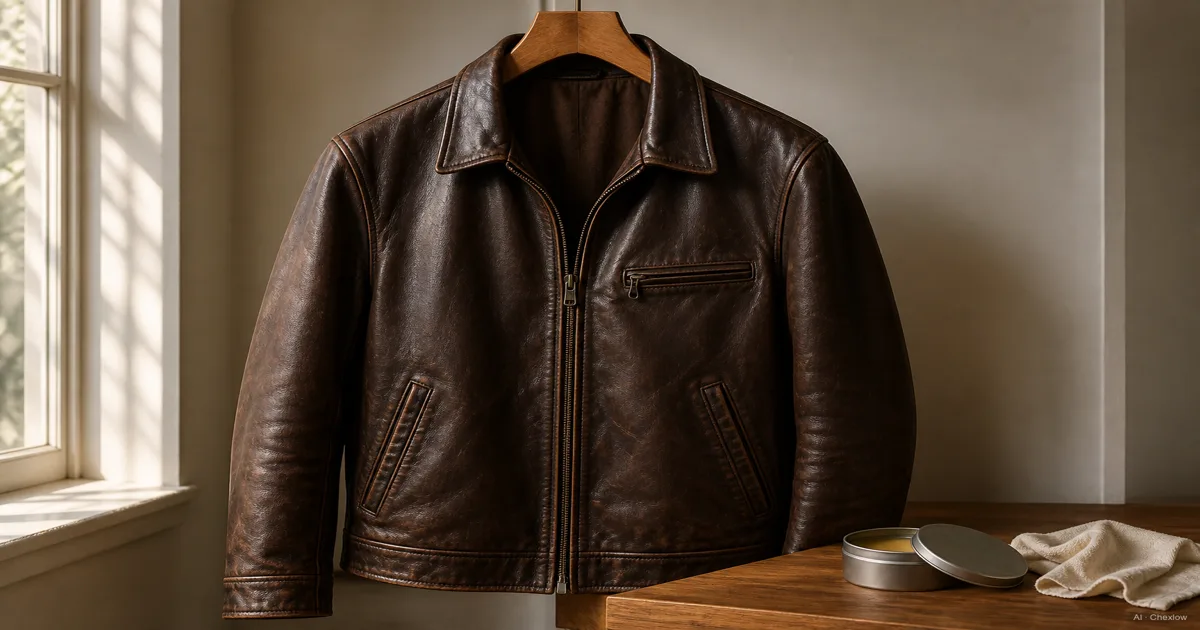
A leather jacket is heavier than most garments, and the shoulders carry all that weight. A thin wire hanger lets the shoulders droop and crease inward — do that for a season or two and those creases become permanent.
Use a wide, padded or cedar hanger that matches the jacket's shoulder width. The hanger should fill the shoulder seam without stretching it outward. Cedar also helps absorb moisture and keeps the storage area smelling clean.
Folding: when it's okay and when it's not
Long-term folding causes permanent creases. Leather doesn't snap back the way fabric does — pressure in the same spot repeatedly means a crease eventually becomes a crack.
For storage at home, always hang.
For travel, short-term folding is fine if you do it along the natural back panel seam rather than forcing a crease across flat areas. Tuck a piece of tissue or a soft cloth inside the fold to pad it slightly. Keep it folded for as few days as possible and hang it as soon as you arrive.
Storage environment: the details that matter
- No plastic garment bags. They trap moisture and create exactly the humid microclimate that mold loves. Use a breathable cotton or canvas cover instead.
- Away from direct light. UV fades and dries leather. A wardrobe or closet works; a hook by a window doesn't.
- Avoid heat sources. Radiators, vents, and sunny walls all accelerate drying. Aim for a consistent, cool temperature.
- Give it room. Leather jackets crushed between other garments develop creases. Leave a few inches of space on the rail.
Sources
- Nick's Boots — Leather Jacket Care Tips — conditioning frequency and general maintenance overview
- Angelus Direct — How to Clean and Condition Leather Jackets — application technique and product selection
- Buffalo Jackson — How to Store a Leather Jacket — hanger selection and storage environment
- LeatherCult — How to Protect Your Leather Jacket From Water Damage — rain treatment and water-repellent sprays
- Western Leather Goods — How to Prevent Mold on Leather — mold prevention and humidity management
- Wikipedia — Leather — material composition and tanning basics