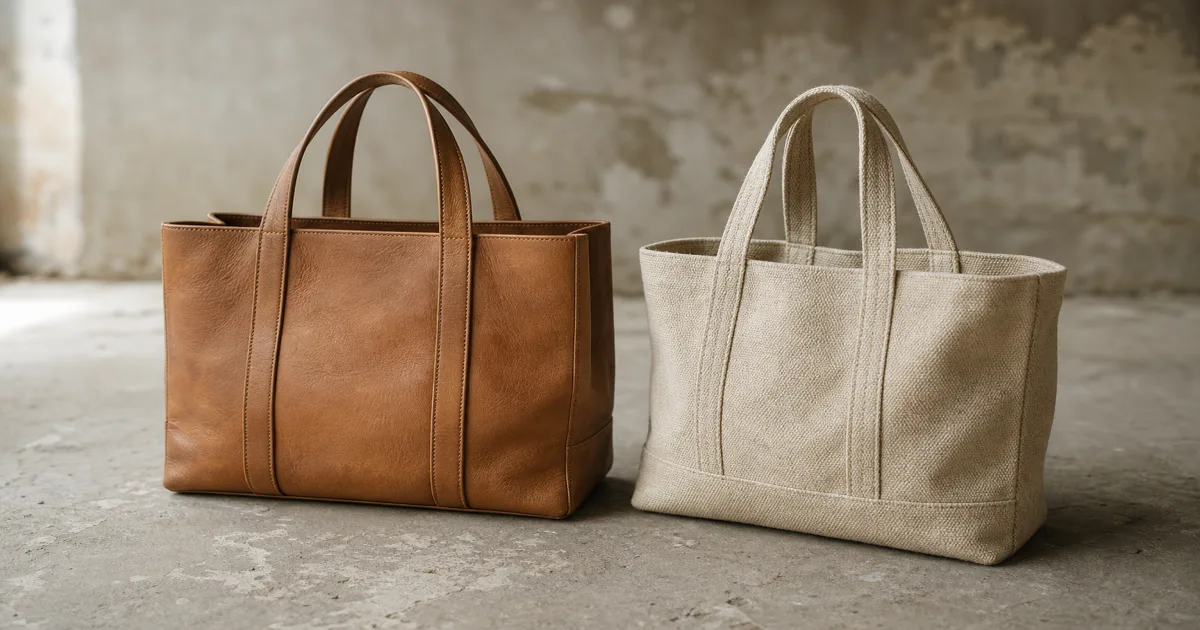



Pick the look, then check the construction
Start with the clothes you actually wear to work. If you prefer leather alongside your jackets and trousers, shortlist a leather tote. If a canvas bag suits your everyday clothes, start there. Treat this as a styling choice, not a rule about which professions allow which bags.
The next question is whether you want the bag to stand upright or fold against your body. Material alone cannot answer it: Cuyana describes its leather Classic Easy Tote as unstructured, while L.L.Bean specifies a double-layer base for its canvas Boat and Tote.
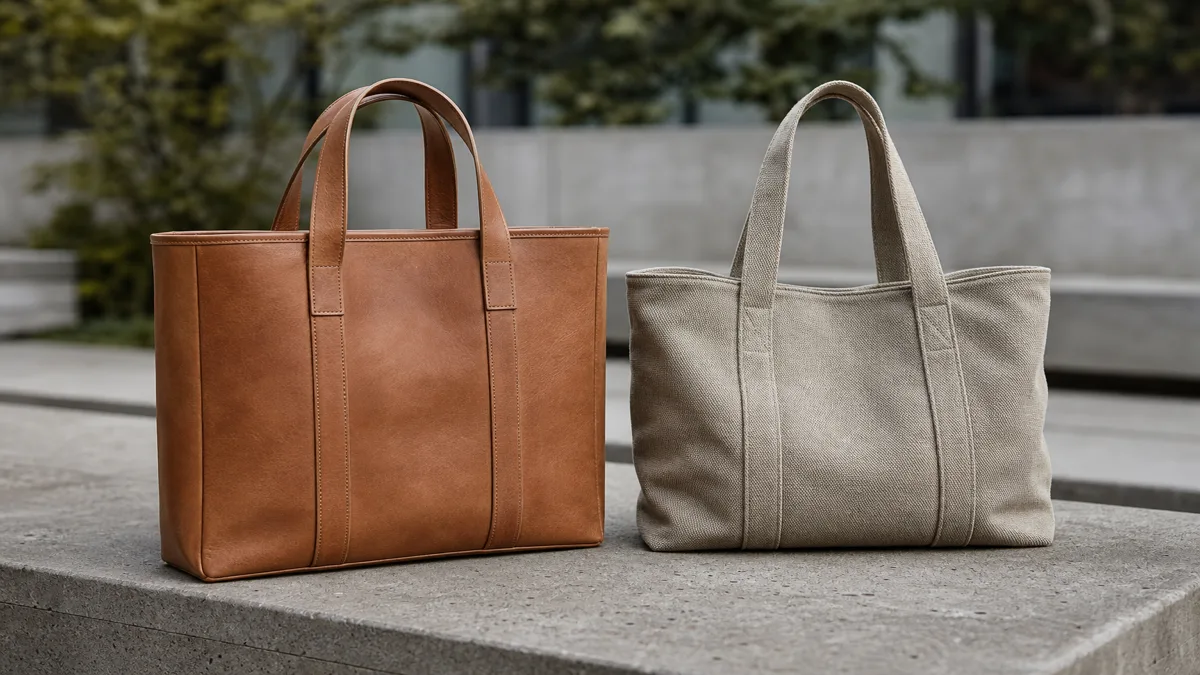
Use the illustration to compare the two looks, then inspect your actual candidates. If standing upright matters, ask for an unstuffed demonstration. Check the base, the opening and the handle attachments rather than assuming that leather supplies structure or canvas lacks it.
Put your workday inside the bag
Compare both candidates with the same contents. An empty-bag impression is not enough to choose something you will carry with a laptop, charger, bottle and lunch.
- Check the opening. Measure your laptop, including its usual case, and compare it with the usable compartment and entrance. Ask the seller for these measurements if only the bag’s outside dimensions are listed.
- Check the carry. Put your normal load inside, close the bag and try it over your usual coat. Notice whether the handles slip, pinch or leave too little room under your arm. Compare the complete weight, including any insert.
- Check access. Take out your laptop and keys without unloading lunch. Set the bag down and see whether its contents remain where you need them.
If the tote has no padded laptop compartment, consider a fitted padded sleeve. Check the sleeve’s inside dimensions against the computer, then its outside dimensions against the tote. Tomtoc’s Voyage-A10 specifications distinguish both measurements and describe its cushioning. Reuse a suitable sleeve you already own; a new one is not automatically necessary.
If both loaded totes feel awkward, reconsider the carrying style before spending more on a different material. The backpack versus messenger comparison explores that next choice.
Read the care label before choosing easy care
The illustration below shows conditioning and machine washing. Neither is a universal instruction. Check the exact bag’s care guidance before treating either material.
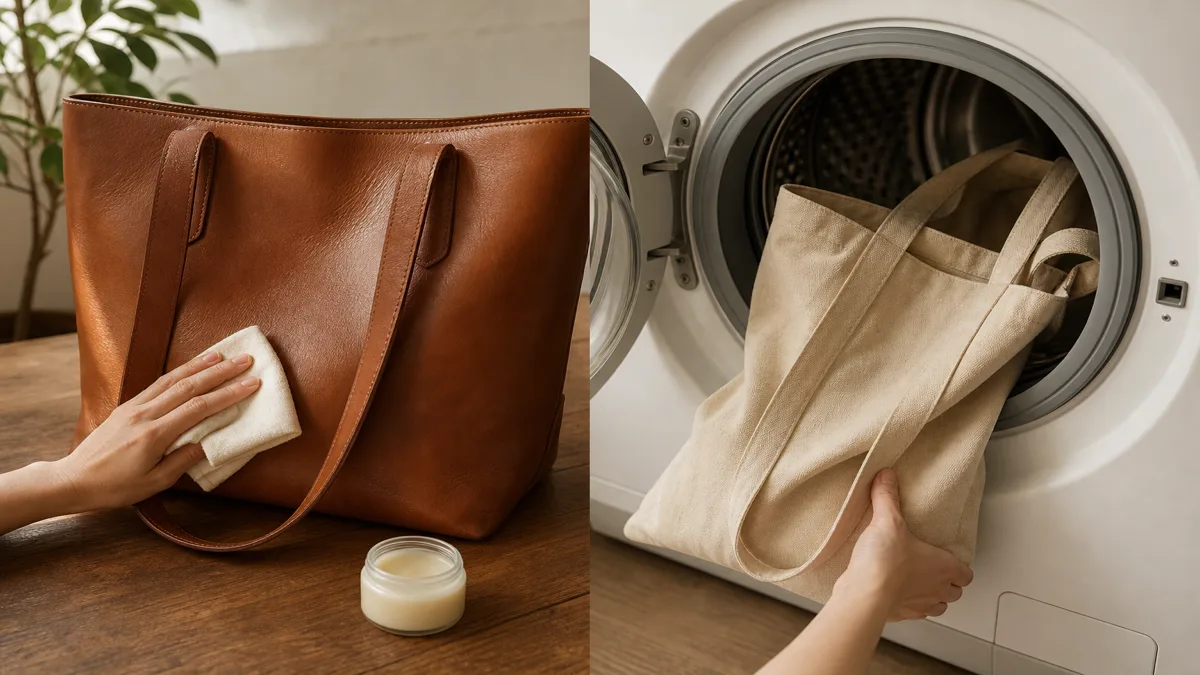
- Canvas. L.L.Bean specifies spot cleaning for the Boat and Tote. If machine washing is essential to you, choose a bag whose manufacturer explicitly permits it.
- Waxed fabric. Filson excludes waxed canvas and Rugged Twill from machine washing. Check this before treating a waxed finish as the convenient alternative.
- Leather. Identify the finish before buying care products. Coach gives its suede a moisture warning and separates its care from other leathers. Follow the bag maker’s instructions instead of adopting one conditioning schedule for every leather tote.
For a canvas bag with leather handles or trim, look for instructions covering the complete bag. Do not infer washability from the body fabric. For a rainy commute, ask what protection the finished bag provides, including its opening, rather than relying on the material name.
If you choose leather and want to plan its upkeep, continue with leather-bag handles and storage. Keep your particular bag’s care instructions as the deciding reference.
Choose the bag you can afford to use
Set an upfront limit that includes any sleeve or insert you actually need. Then compare expected use without assuming that leather lasts decades or that resale will recover a fixed share of the price.
For a hypothetical purchase-only calculation, a $300 bag carried 600 times costs $0.50 per use. A $100 bag carried 200 times also costs $0.50 per use. Those are assumed use counts, not predicted lifespans; cleaning and repairs would add to either total.
Ask about repair options for handles and closures before paying extra for longevity. A material label alone does not tell you whether a particular failure can be repaired.
- Choose leather when you prefer its appearance, the loaded bag is comfortable, and its care requirements and total purchase cost fit your plans.
- Choose canvas when its appearance works for you and the actual candidate offers the weight, price and cleaning method you want. Confirm each benefit rather than assigning it to all canvas bags.
- Keep looking if neither closes around your belongings or feels comfortable to carry. A more expensive material will not fix the wrong dimensions or handles.
Sources
- Cuyana Classic Easy Tote
- L.L.Bean Boat and Tote, Open-Top
- Tomtoc Voyage-A10 specifications
- Filson product-care guidance
- Coach material-specific care
Come è stata costruita questa guida
Written by AI for Chexlow, using manufacturer product specifications and care guidance from Cuyana, L.L.Bean, Tomtoc, Filson and Coach. The comparison turns those examples into checks for a first work tote; it does not report hands-on testing or predict the lifespan of either material.
Curato dal team Chexlow · Le immagini sono illustrazioni generate dall’IA