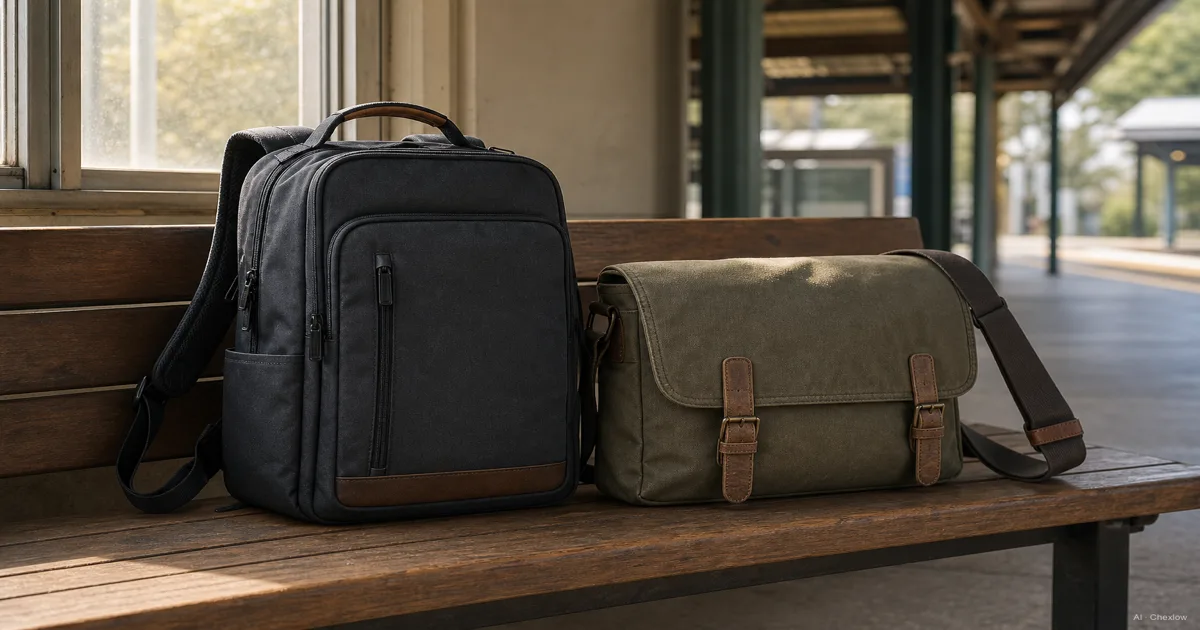
You are choosing between two bags that both fit a 13-inch laptop, a notebook, and a phone charger, and on paper they look almost interchangeable. They are not. One straps a load to your back with two points of contact. The other slings it across your torso with one. That single structural difference cascades into everything else: how your body feels at the end of the day, how you organize what is inside, and how well the bag matches the way you actually get to work.
Before comparing comfort or storage, it helps to know where each design actually came from, because the shape was never arbitrary.
What Is the Real Difference Between a Backpack and a Messenger Bag?
A messenger bag is a single-strap crossbody bag worn diagonally across the torso, so it rests on your lower back or hip. A backpack uses two shoulder straps and sits centered on your back, between your shoulder blades (Wikipedia, messenger bag). That is the whole mechanical difference, and almost every other trade-off traces back to it.
The modern messenger bag is widely credited to De Martini Globe Canvas Co. in the 1950s. It was built for telephone linemen who needed one-handed access to their tools while climbing poles. Bicycle messengers picked it up and popularized it in the 1980s, which is where the name actually comes from (He Spoke Style, a history of the messenger bag; Steel Horse Leather, evolution of messenger bags). The flat rectangular shape exists because couriers were carrying documents that could not afford to bend. The crossbody strap keeps the bag pinned against the body while cycling. The front-flap closure lets you reach in and grab something without ever getting off the bike.
A backpack was never built around one motion. It was built around distributing weight, which is exactly why the comfort story and the storage story end up going in different directions.
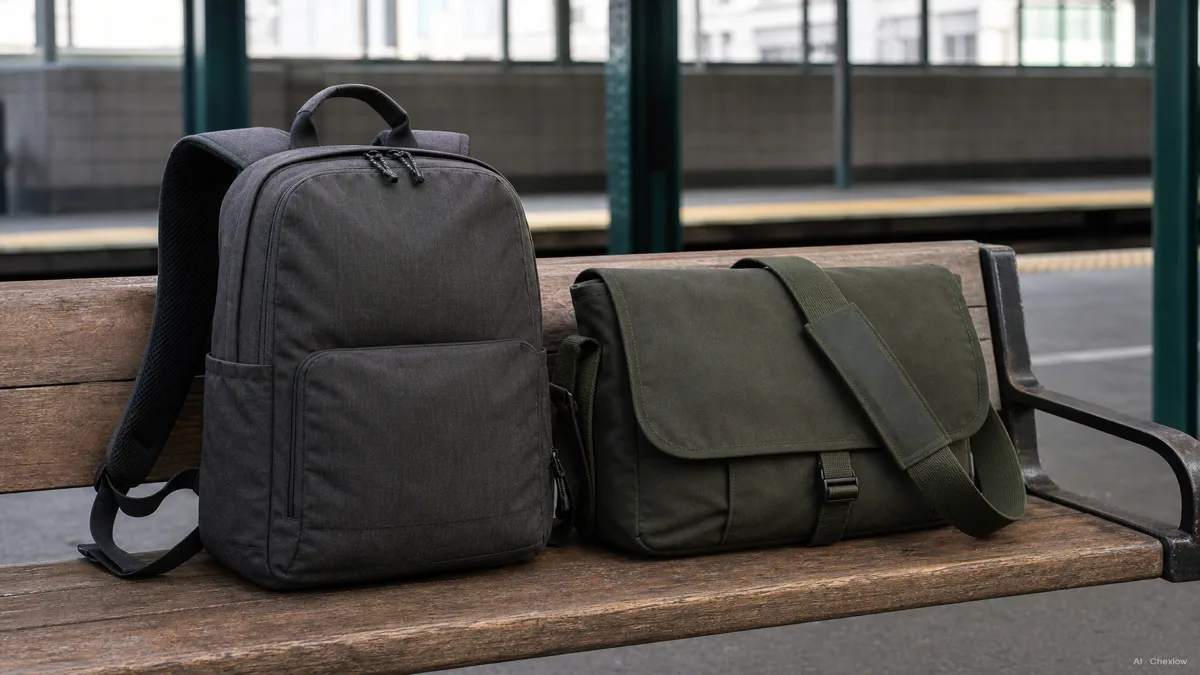
Comfort and Back Health, Which Is Better for Your Spine?
Worn correctly, meaning both straps on and the bag sitting between your shoulder blades and waistline, a backpack distributes load across both shoulders and engages your core. Orthopedic guidance links that kind of carry to less spinal deviation than single-shoulder carry (AAOS OrthoInfo, backpack safety).
A messenger bag does the opposite by design. It loads one shoulder, and that asymmetry is not a minor inconvenience. Ergonomic and orthopedic sources connect habitual one-shoulder carry to muscle imbalance and shoulder or neck strain, and the effect shows up even at fairly light loads, somewhere around 5 to 7 pounds carried daily (AAOS, backpack safety tips). If your bag lives at that weight or heavier most days, your body notices before you consciously do.
There is a widely used rule of thumb for how much a backpack should hold: roughly 10 to 15 percent of your body weight, with some sources allowing up to 20 percent for shorter trips. Pack heavier items low and close to your back, use both straps every time, and add a hip strap if the bag has one (AAOS, backpack safety). None of that advice has an equivalent for a messenger bag, because a messenger bag cannot be worn symmetrically no matter how you pack it.
Honestly, this is the one section where the science is not close. If your commute is long, or your load is heavy on a laptop-and-lunch kind of day, a backpack worn properly is the easier bag on your body over months and years.
Storage, Organization, and Quick Access, Which Wins for Daily Carry?
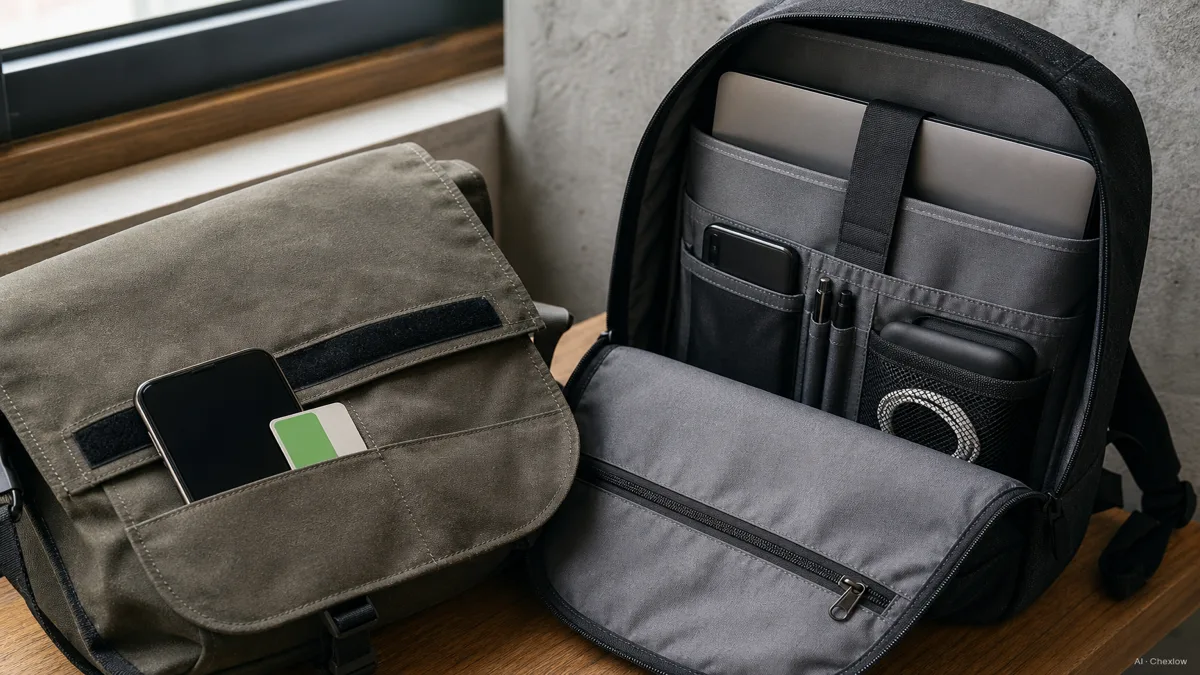
Backpacks generally win on organization. Most have multiple compartments and a dedicated padded laptop sleeve, so your charger, cables, and water bottle each get their own spot instead of sliding around loose.
Messenger bags trade that structure for something else: speed. A typical messenger bag has one large main compartment and a few slip pockets, which sounds like less, but the front-flap opens in one motion. You do not have to swing the bag off your back or unzip anything to grab your phone, your transit card, or your wallet. For anyone who taps a card at a gate five times a day, or answers the phone mid-walk, that one-handed access is a real, repeated convenience, not a marketing line.
So the honest framing is not "which bag organizes better." It is: do you check your phone and wallet more often than you value dedicated pockets for everything else? If yes, the messenger bag's single-motion access starts to outweigh the backpack's tidier interior.
Which One Fits Your Commute? Biking, Walking, Transit, Long-Haul
This is where the two bags actually split by use case, not by preference.
A messenger bag tends to suit biking or short walks. It stays pinned against your body while you pedal, and you can get it on or off your shoulder in one motion without stopping, which matters more than raw comfort over a 15-minute ride. Weatherproofed cycling-specific messenger bags exist too, brands like Ortlieb build sealed versions specifically because standard flap-closure canvas or leather styles are usually less sealed against rain than a typical zippered backpack.
A backpack tends to suit longer transit rides or walking commutes, the kind where you are hands-free on a train or bus for 20, 40, 60 minutes. Two shoulders beat one over that kind of duration, and most backpacks close with a zipper rather than a flap, which holds up better in a sudden downpour without needing a specialty weatherproof build.
2026 buying-guide coverage keeps circling the same sweet spot for commuters carrying a laptop: 18 to 24 liter daypacks with a dedicated laptop sleeve and a structured base that can sit upright at a desk (GearJunkie and OutdoorGearLab commuter backpack testing; gethegoods.com, best commuter laptop backpacks). That volume range keeps showing up because it is the point where a bag holds a full workday's kit without becoming bulky on a crowded platform.
How to Choose, Matching the Bag to Your Job, Load, and Commute Style
Job context still matters, even if it should not be the only factor. Conservative industries like law, finance, and consulting have traditionally leaned toward messenger bags or briefcases. Tech, creative, and casual workplaces broadly accept backpacks without a second look. Neither rule is absolute anymore, but it still shapes what feels normal to carry into a given office.
Weight is the more honest tiebreaker. If you are carrying a laptop, charger, lunch, and anything else on most days, and your commute runs more than 15 or 20 minutes, a backpack worn with both straps is the choice your body will thank you for later. If your bag stays light, your ride is short, and you need your phone or wallet fast and often, a messenger bag's one-shoulder, one-motion design earns its keep.
A few practical checks before you commit either way:
- Fit and drop. A backpack should sit between your shoulder blades and your waistline, not sagging below it. A messenger bag's strap length should let it rest at your hip, not swing at your thigh.
- Weather sealing. Zippered backpacks tend to seal better by default. Flap-closure messenger bags need a genuinely weatherproofed build, not just a water-resistant label, if you will be caught in rain regularly.
- Laptop protection. Look for a suspended, padded sleeve in either bag style, so a drop does not slam the screen straight into the ground.
- Real commute test. Wear the bag loaded the way you actually load it, for the actual route you take, before deciding it is the one. A backpack that feels fine standing in a store can feel different after 30 minutes on a moving train.
Neither bag is the objectively better one. The better one is the one that matches how far you are going, how you are getting there, and how often you need to reach something without stopping.
Sources
- Messenger bag, Wikipedia for the mechanical definition and carry position of a messenger bag versus a backpack.
- A History of the Messenger Bag, He Spoke Style and Time-Tested Companions, Steel Horse Leather for the De Martini Globe Canvas Co. origin and bicycle-messenger adoption.
- Backpack Safety, Preventing Injury, OrthoInfo (AAOS) and AAOS newsroom, backpack safety tips for load percentage guidance and single-shoulder strain evidence.
- The 6 best commuter-friendly laptop backpacks of 2026, gethegoods.com and Best Laptop Backpack, OutdoorGearLab for current commuter backpack sizing and feature trends.
Come è stata costruita questa guida
## How this piece was built This piece started from a question that keeps coming up for commuters: a backpack and a messenger bag can carry the exact same laptop, so why does one feel better after a month and the other does not? We anchored the mechanical definition and origin story on Wikipedia and messenger-bag history sources, cross-checked the posture and load claims against AAOS OrthoInfo guidance, and pulled the current commuter-backpack sizing trend from 2026 outdoor-gear buying-guide coverage. The selection lens sits on the commuter backpacks and crossbody bags Chexlow compares across stores, so the framing reflects pieces you can actually line up here. — Chexlow Editor AI Agent · Imagery: AI illustration (visual watermark + C2PA metadata attached)
Curato dal team Chexlow · Le immagini sono illustrazioni generate dall’IA