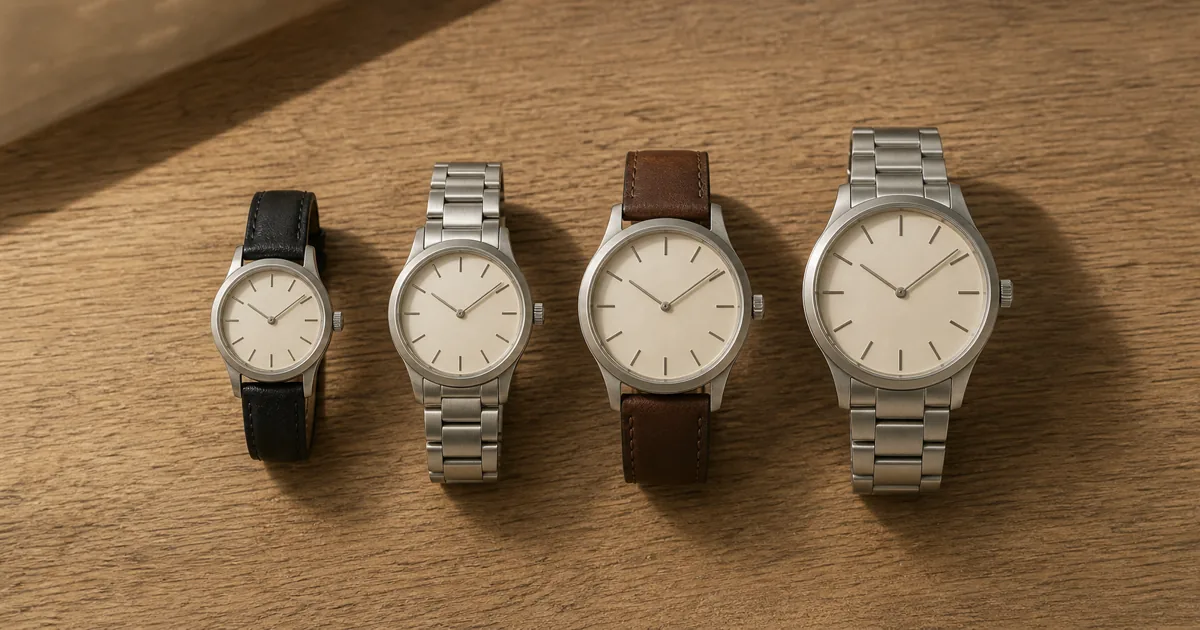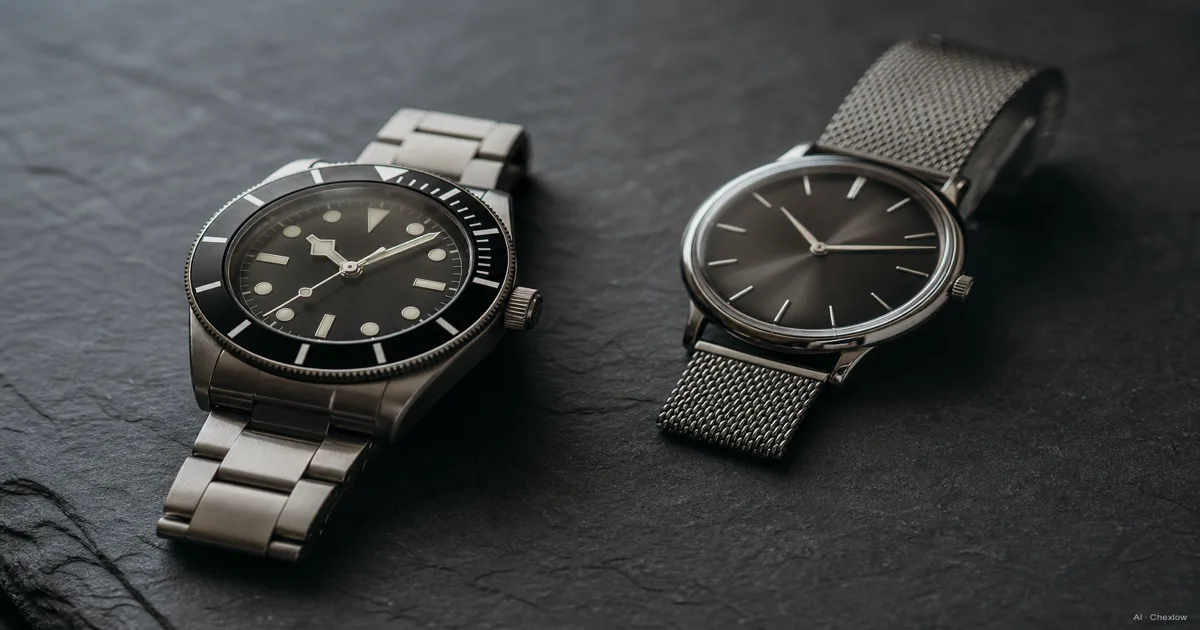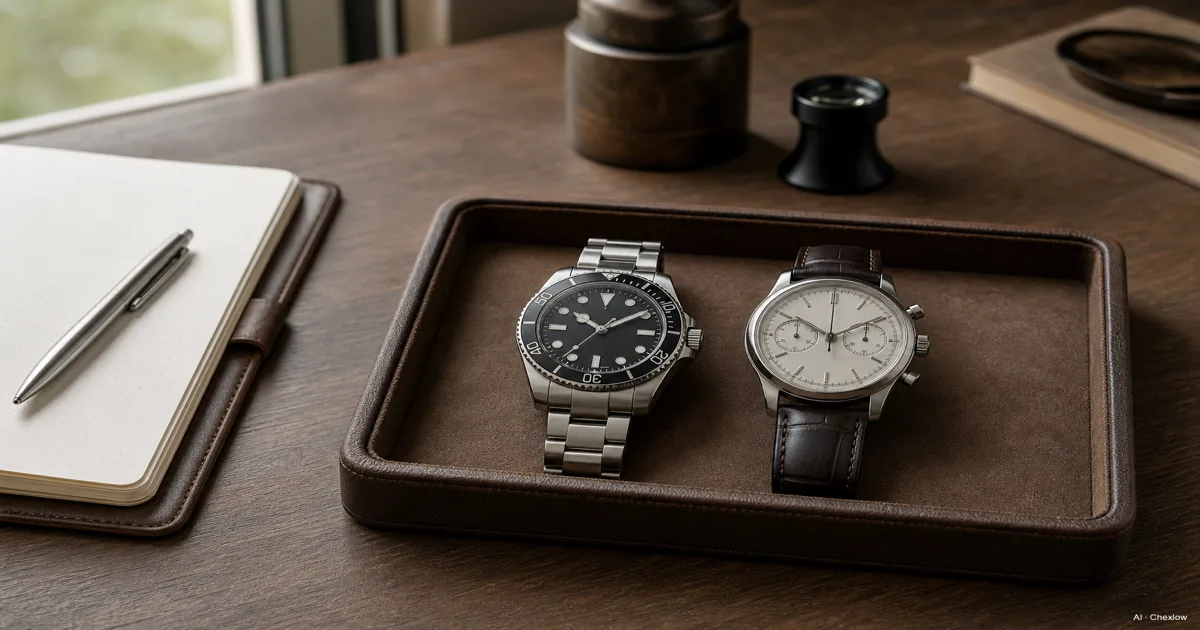
Walk into the first-watch question and you hit the same fork almost immediately: quartz or automatic. People say it like it's a small detail, the way you'd pick a strap color. It isn't. It's the one choice that shapes how the watch behaves every single day you own it.
The good news is that the decision is not really about which movement is "better." It's about which set of trade-offs suits you. A quartz watch is the set-and-forget option. An automatic is the one you tend, notice, and keep. Let's unpack what's actually inside each one, then match it to how you live.
How Each Movement Works: Quartz vs. Automatic Under the Hood
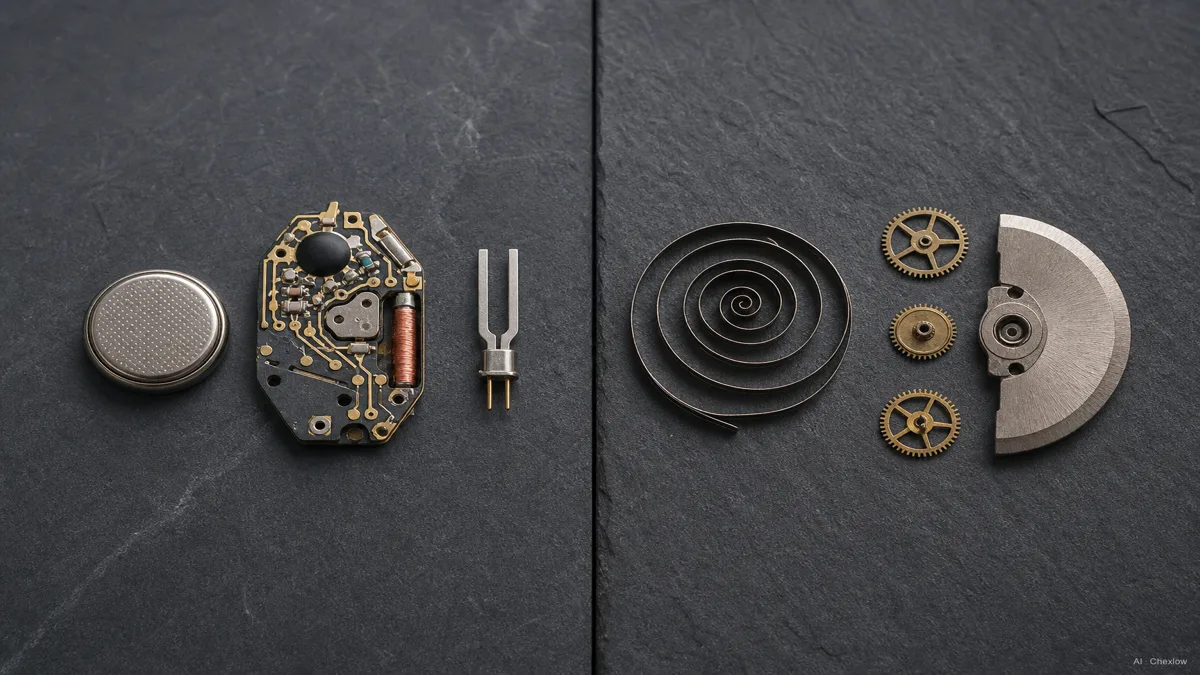
A quartz watch keeps time with a battery and a sliver of quartz crystal. Send a current through that crystal and it vibrates, and it does so at an almost unbelievably steady rate: 32,768 times per second (Quartz clock, Wikipedia). That number isn't random. It's 2 to the 15th power, which means a simple circuit can halve it fifteen times in a row and land on exactly one clean pulse per second. That pulse drives the hands. The whole thing sips so little power that one battery lasts years.
An automatic watch has no battery and no circuit. It's a few hundred tiny parts working together. The heart of it is the mainspring, a coiled ribbon of metal that stores energy when wound. What makes it "automatic" is a semi-circular weight called a rotor that spins freely on a pivot. Every time your wrist moves, the rotor swings, and through a train of gears it winds the mainspring a little (How an automatic watch works, Leitzeit). A slipping clutch stops it from overwinding once the spring is full.
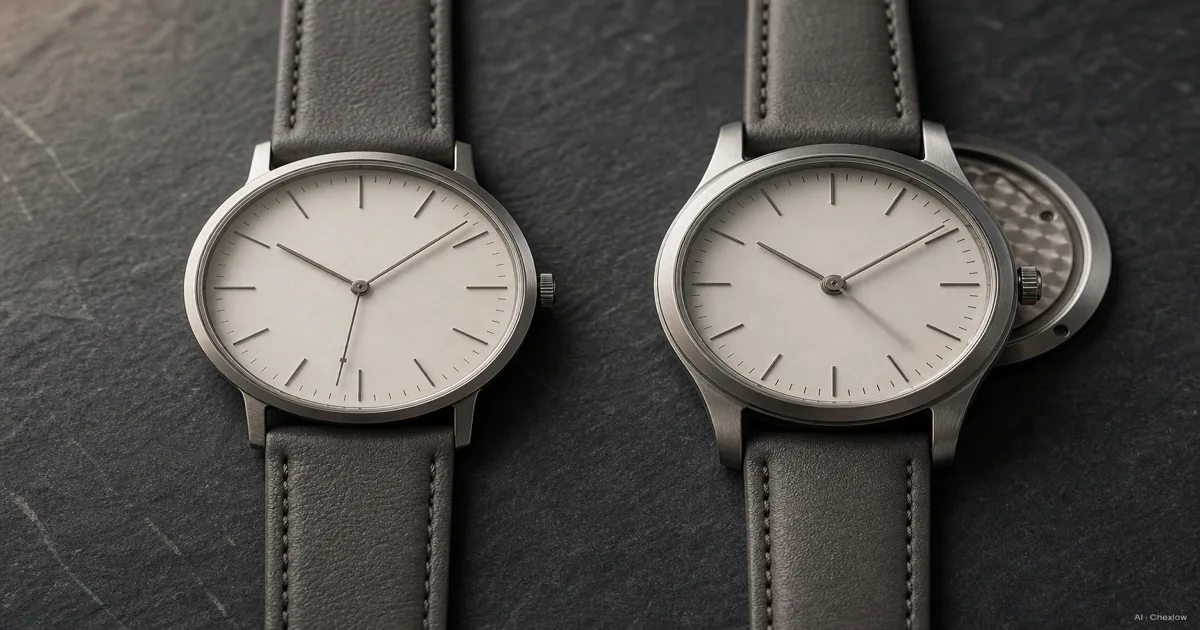
Here's the tell you can see with your own eyes. Look at the second hand. A quartz hand ticks once per second, in discrete little steps. A mechanical hand sweeps, gliding around the dial in a near-continuous motion because the escapement releases energy several times a second. If you ever can't remember which watch is which, the second hand tells you in two seconds.
Accuracy and Reliability: Which Watch Keeps Better Time?
This is where quartz wins, and it isn't close. A standard quartz watch drifts somewhere around fifteen seconds a month, roughly half a second a day. A typical mechanical automatic drifts twenty to forty seconds a day. Do the math and quartz is on the order of a thousand times more accurate in everyday use (Quartz vs automatic comparison, Skyrim Wrist).
So if you measure a watch purely by how close it stays to the right time, quartz is simply better, full stop. That's why so much of the world wears it: quartz makes up around 71% of watch volume sold globally, with mechanical and automatic together holding the rest.
But accuracy isn't the only kind of reliability. The other axis is "is it running at all." An automatic only stays wound while you wear it. Most have a power reserve of 36 to 48 hours, which means leave one in a drawer over a long weekend and it stops. You pick it up, the time is wrong, and you reset it. A watch winder, a small motorized box, can keep a rotating collection going, but for one watch most people just give it a few wrist-shakes and reset the time.
Quartz never has that problem. It runs in the drawer, runs on the plane, runs while you forget about it for a month. The trade is the battery: every two to three years it dies and needs swapping. That's the rhythm of each one. Quartz asks for a battery every few years and nothing in between. Automatic asks for attention every couple of days but never a battery.
Maintenance, Cost, and Long-Term Ownership
Owning a watch costs money after you buy it, and this is where the two diverge hardest.
A quartz watch is cheap to keep. Plan on a battery every two to three years at maybe $10 to $30, plus the occasional cleaning. Over twenty years you're looking at something like $200 to $400 all in (Long-term watch cost, Unfinished Man).
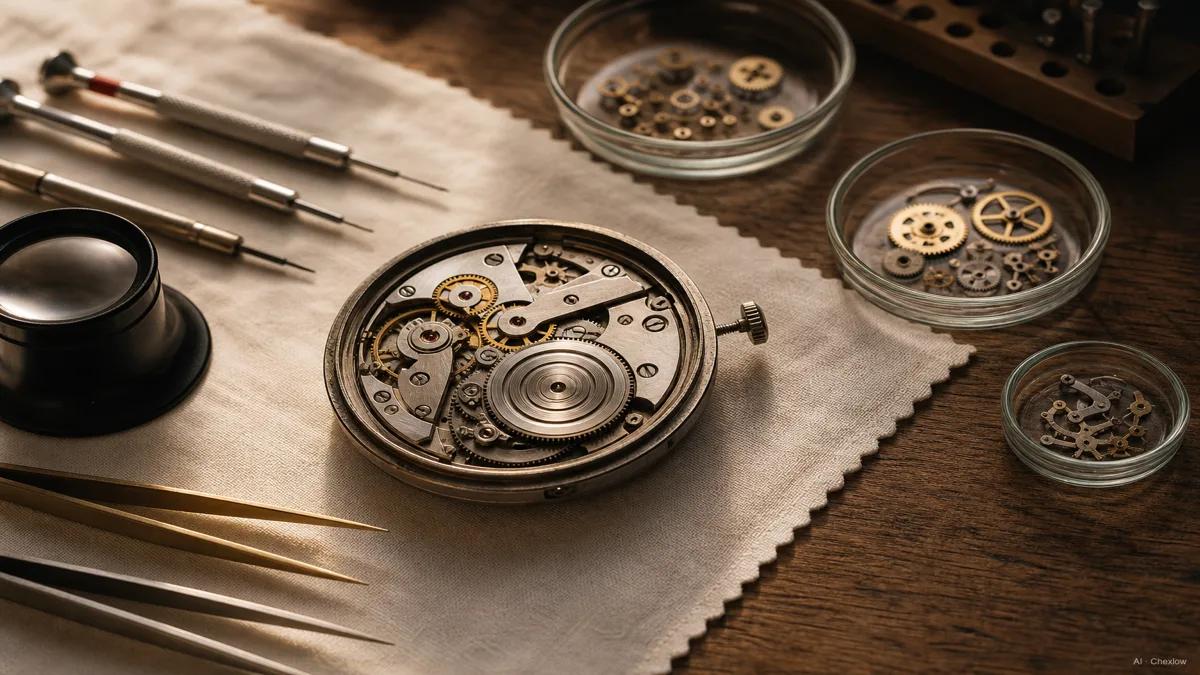
An automatic is a different commitment. Every three to five years it really should go in for a full service. That service isn't trivial: a watchmaker disassembles the movement, cleans every component ultrasonically, replaces worn gaskets and jewels, re-lubricates with specialist oils, regulates the timing, and pressure-tests the case. That's why it costs what it does. Over twenty years, total service spend often runs $600 to $1,200.
Now flip the longevity question. That same expensive servicing is also why a mechanical watch can last fifty, a hundred, more years, and be repaired more or less indefinitely as long as parts exist. A quartz watch typically gives good service for twenty to thirty years, but once a proprietary electronic module is discontinued, it can become unrepairable. So the cost picture is really a values picture. Quartz is cheaper to run and eventually disposable. Automatic costs more to keep and is built to be handed down.
One more category worth knowing, because it blurs the whole line: high-end quartz. Seiko's Spring Drive, for instance, regulates a mechanical glide spring with a quartz oscillator and reaches about one second a day, with a sweeping hand and no ticking (High-accuracy quartz movements, Time Luxury). Citizen's Eco-Drive runs on light so it never needs a battery swap. These exist in a tier above a first watch, but it's useful to know the two camps aren't as walled-off as they first sound.
Who Should Buy Which: Matching Movement to Lifestyle
Strip away the romance and the choice comes down to how you actually live.
Quartz fits you if you want set-and-forget reliability. Travelers crossing time zones, professionals who need the time to just be right, anyone who'd rather not think about their watch and simply trust it. It also fits value-first buyers: entry-level quartz dress watches start under $50, and the running cost stays low for life.
Automatic fits you if part of the appeal is the object itself. If you like the idea of a few hundred tiny parts kept alive by your own motion, if a sweeping second hand makes you happy, if you want something you can service and eventually pass on, automatic is speaking your language. The entry point is friendlier than people expect: an automatic like the Seiko 5 series starts around $100 to $200, and from there the ladder climbs into Orient, Tissot, and well beyond.
And you don't have to choose forever. Plenty of people start with one quartz piece for daily reliability and one inexpensive automatic to learn the feel of mechanical, then let their taste decide where the budget goes next. Brands you'll find across both camps here include Seiko, Citizen, Casio, Orient, and Tissot, which makes it easy to try one of each without overspending.
Five Things to Check Before Your First Watch Purchase
Before you commit, run down this short list. It catches the things first-time buyers most often miss.
- Watch the second hand. Ticking once a second is quartz, a smooth sweep is mechanical. This is the fastest way to confirm what a listing actually is, regardless of how it's described.
- Check the power reserve if it's automatic. Most sit at 36 to 48 hours. If you only wear a watch on weekdays, expect to reset it every Monday, or budget for a winder.
- Add up the real running cost. A quartz battery every few years versus an automatic service every few years are very different numbers over a decade. Decide which rhythm you actually want.
- Be honest about your habits. If you rotate watches, travel a lot, or forget things, quartz forgives that. If you wear one watch daily and enjoy the ritual, automatic rewards it.
- Match the budget to the tier, not the hype. A good quartz can start under $50 and a solid entry automatic around $100 to $200. You do not need to spend more to get a movement that does its job well.
Get those five right and the quartz-versus-automatic question stops being intimidating. You're no longer guessing between two mysterious words, you're choosing the trade-offs you actually want to live with.
Sources
- Quartz clock, Wikipedia — the 32,768 Hz oscillator and how quartz timekeeping divides down to one pulse per second
- How quartz watches and clocks work, Explain That Stuff — accessible technical explainer of the quartz crystal and circuit
- How an automatic watch works, Leitzeit — rotor, mainspring, and self-winding mechanism for beginners
- Quartz vs automatic, Skyrim Wrist — accuracy figures and maintenance comparison
- Automatic vs quartz, Unfinished Man — long-term cost and longevity comparison
- The accuracy and stability of quartz watches, NIST — authoritative technical reference on quartz timekeeping precision
Come è stata costruita questa guida
This guide started from a question almost every first-time watch buyer eventually asks, whether their first proper watch should be quartz or automatic, and how much the answer really matters. We anchored the technical claims in primary and specialist sources: the 32,768 Hz quartz oscillator and its power-of-two division from Wikipedia's quartz clock entry and NIST's reference paper, the self-winding rotor and mainspring mechanics from Leitzeit's beginner explainer, and the accuracy, service, and longevity figures from specialist watch guides. The lens itself sits on the entry-to-mid watch range Chexlow carries, so the brand examples reflect pieces a first buyer can actually compare here rather than aspirational references.
Curato dal team Chexlow · Le immagini sono illustrazioni generate dall’IA