
Most people meet raw denim through a photo. Someone posts a pair they have worn hard for a year, and the fades look almost designed, like the lighter areas were placed on purpose. The natural next thought is that it must take some secret routine to get there.
It does not. The fades come from one simple fact about how raw denim is dyed.
Why raw denim fades at all
Indigo does not soak into cotton the way most dyes do. It mostly clings to the outside of each yarn and leaves the core white (Indigo dye, Wikipedia). This is called ring dyeing, and it is the whole reason raw denim fades the way it does.
Every time the fabric bends or rubs, a little of that surface indigo flakes away and the white core underneath starts to show. Wherever you bend the fabric most, you lose the most color. Wherever the fabric just sits still, the indigo stays deep and dark.
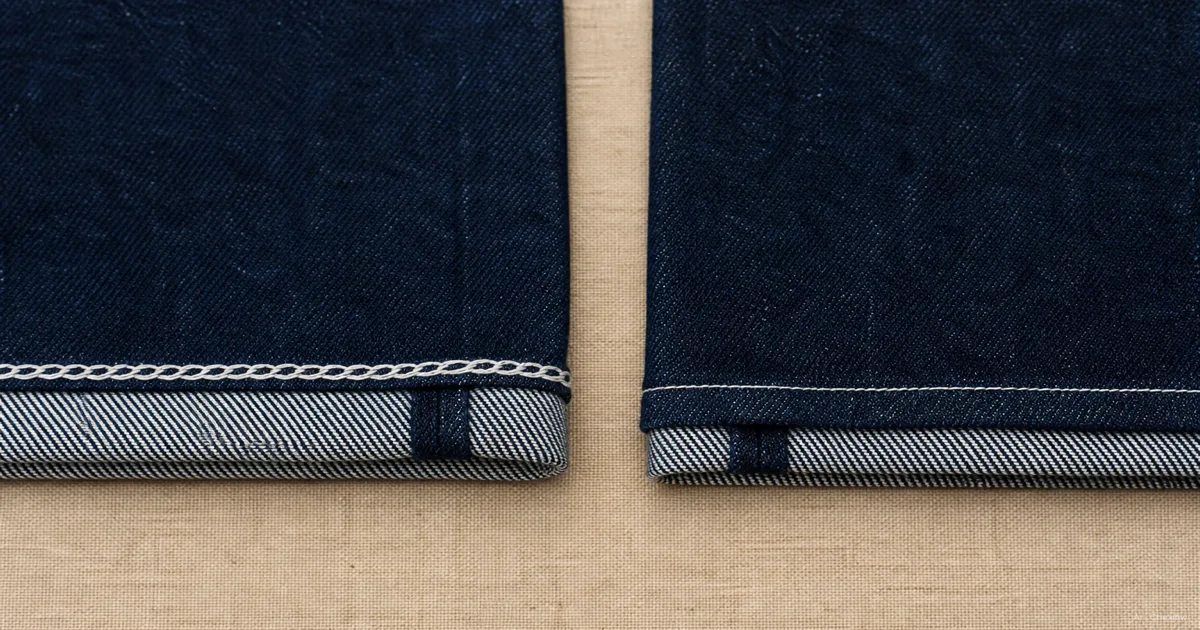
So a fade is really a map of friction. The high-contrast areas are the places your body folds the denim over and over: the backs of the knees, the front of the hips, the hem where it hits your shoes. The dark areas are the places that barely move.
Raw denim shows this most clearly because nothing has been washed out yet. Pre-faded jeans will still pick up some wear marks, but rarely with the same high-contrast, personal pattern, because the factory already removed much of the indigo that your own movement would have lifted slowly and in your own places.
The four fades worth knowing by name

Denim wearers have names for the main fade patterns. They are not jargon for its own sake; each name points to a specific place and a specific cause.
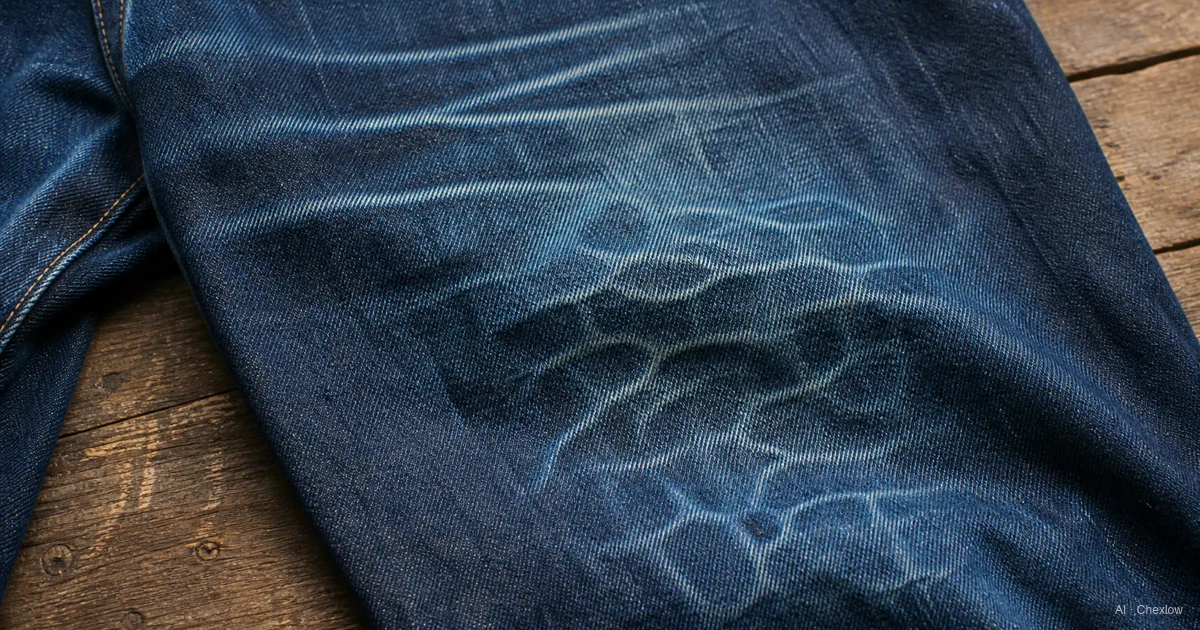
Honeycombs are the web of light creases behind your knees. Sit down and your knee folds the denim into a grid of small diamonds, and over months those fold lines lose indigo while the recessed parts stay dark. The result looks like a honeycomb, which is where the name comes from. Deep, high-contrast honeycombs are one of the first things experienced wearers look for, because they show up sharpest on denim that is worn often and washed rarely (Denim fades explained, Heddels). Wash on a normal schedule and you still get honeycombs, just softer and lower in contrast.
Whiskers are the lines that fan out from the hip and crotch area toward the thigh, like the whiskers on a cat. They form where the fabric creases when you sit and stand all day. Higher-rise, slimmer cuts tend to produce sharper whiskers because the fabric is pressed against you more firmly.
Stacks are the folds of fabric that pile up above the shoe when the inseam is a little long. As those folds sit and rub against your ankle, they fade into horizontal ladders just above the hem. Some people leave length on purpose to grow stacks; others find them messy. Both are fine. It is a look, not a rule.
Atari is the sharp fading along edges and seams, the outseam down the leg, the belt loops, the pocket edges, the hem. The word is borrowed from Japanese denim culture and describes the crisp high-contrast line that forms where a raised seam catches the most friction (What is atari, Heddels). Strong atari is what makes a worn pair read as three-dimensional rather than just lighter.
You do not have to chase any of these. They appear on their own if you simply wear the jeans. But knowing the names helps you read other people's denim, and read your own as it develops.
Habits that make a good fade

A good fade is mostly a side effect of wearing the jeans a lot and washing them rarely. That is the honest summary. A few habits make the difference between a flat fade and a sharp one.
Wear them often, early. The first three to six months set the basic pattern. Denim that is worn most days in that window builds clean, high-contrast creases. Denim that sits in a drawer fades softly and evenly, which is the opposite of what you want.
Hold off on the first wash, but do not turn it into a contest. There is an old habit of going six months or a year without washing to deepen the contrast. It does sharpen the fades, but it also lets sweat and bacteria weaken the cotton, and the smell stops being charming. A reasonable first wash somewhere between two and six months gives you most of the contrast without wearing the fabric thin.
When you do wash, wash gently. Cold water, turned inside out, mild detergent, and hang it to dry rather than tumbling it. A hot tumble dry is one of the quickest ways to blur fades you spent months building, because the heat and tumbling lift indigo more evenly across the whole pair and can shrink the fabric too.
Let your own life make the pattern. Cycling, driving, sitting cross-legged, carrying a phone in the same pocket, all of it shows up eventually. You do not need to fold the denim a special way. The most personal fades come from not trying.
The myths that ruin a first pair
A few popular ideas do more harm than good, especially on a first pair.
The biggest one is never washing. People hear that washing kills fades and take it literally. Skipping washes for too long does not just smell bad; the salts and bacteria in trapped sweat actually break down cotton fibers, so the denim wears out faster than it fades (How often to wash raw denim, Heddels). A pair that blows out at the crotch in eight months never gets the chance to fade properly.
Another is the freezer trick. Putting jeans in the freezer is supposed to kill odor-causing bacteria without washing. It mostly does not work; the cold knocks bacteria back for a while but does not remove the oils and salts that cause both the smell and the fiber damage. A proper wash is still the answer.
A third is forcing creases by hand, folding, clamping, or roping the denim to fake sharper lines. It can work, but on a first pair it usually produces fades that look staged rather than earned. The patterns that age best are the ones your body made without thinking about it.
And one quiet myth: that heavier denim always fades better. Heavyweight denim does throw sharper, more textured fades, but it also takes much longer to break in and can be genuinely uncomfortable in summer. For a first pair, a mid-weight is easier to actually wear every day, and a fade you wear is always better than a fade you admire in a drawer.
So how do you actually start
If you want to build fades you will be proud of, the recipe is short. Get a pair of raw denim that fits well, in a cut you will reach for, at a weight you can wear daily. Then wear it, often, for the first few months, and resist the urge to wash it on week two.
Wash it gently when it genuinely needs it, hang it to dry, and let your knees, hips, and hem do the rest. In a year you will have honeycombs and whiskers that are unmistakably yours, and you will start reading other people's denim differently too.
When you are choosing that first pair, fade potential mostly tracks two things you can compare directly: whether the denim is raw rather than pre-washed, and its weight in ounces. Put a couple of candidates side by side on those two points, along with fit and price, and you will have a pair worth fading.
Sources
- Indigo dye, Wikipedia for ring dyeing and why indigo sits on the surface of the yarn.
- Denim, Wikipedia for the definition of dry (raw) denim.
- What is atari, Heddels for seam-edge fading terminology.
- How often should you wash your jeans, Heddels for the case against never washing.