Start with the job you do most
A first utensil does not have to cover every recipe. Pick the task you want it to make easier.
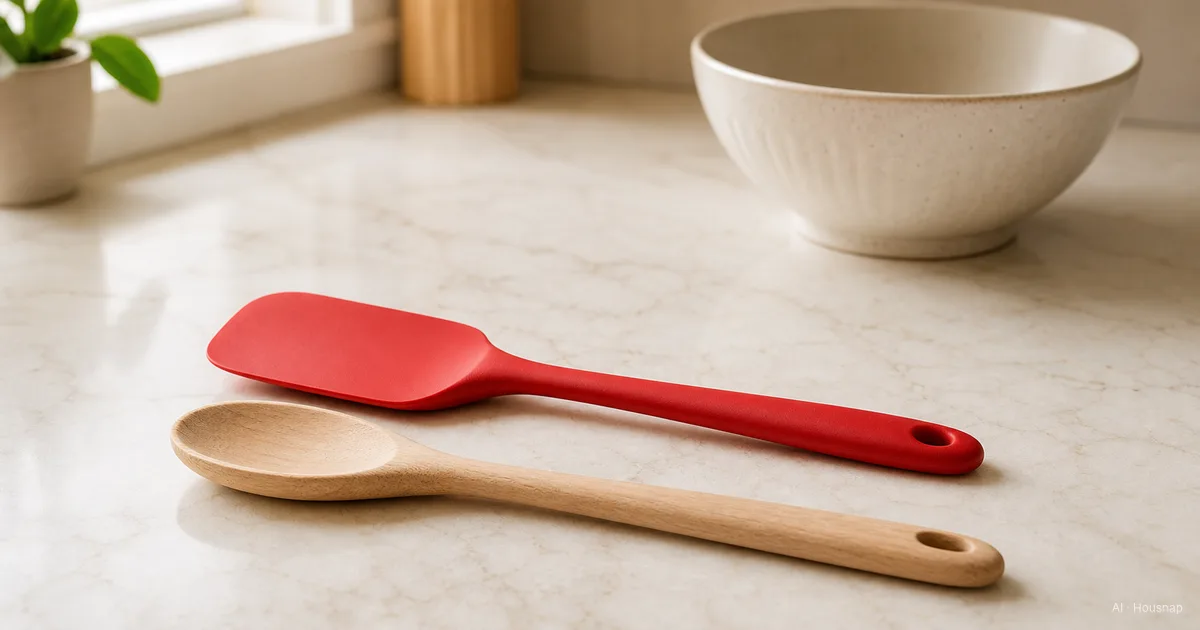
- Batter and bowl scraping. Choose a flexible silicone scraper. Folding means gently bringing an airy mixture into a denser one; a spatula can sweep underneath and turn the mixture over. Gentle movement still matters. King Arthur Baking explains the technique.
- Firm stirring and pan sauces. Consider a wooden cooking spoon, especially one with an edge shaped for scraping. Le Creuset specifically recommends its wood scraping spoon for deglazing, or loosening browned residue with liquid. Its utensil guide also describes silicone tools that stir thick batter.
So do not treat silicone as “baking only” or wood as the only material for sauce. Compare the working edge and stiffness of the actual tools.
Check the utensil and the pan separately
A material name is not a heat rating. Le Creuset lists 250°C/482°F for its silicone tools; OXO lists 600°F for this small spatula's head and neck. Those are product-specific examples, not limits to apply to every silicone scraper.
For its nonstick pans, Le Creuset recommends silicone or wood. It also says not to leave its silicone utensils in a pan while cooking. Check the relevant care instructions, including the handle, rather than assuming the head's rating covers the whole utensil.
If the pan itself is still undecided, work through nonstick versus stainless steel for your first pan before choosing tools to go with it.
Choose a shape you can use and a design you will clean
For silicone, look for an edge that bends against a bowl with enough support behind it to stir. A one-piece exterior can still surround a reinforcing core: GIR describes that construction and dishwasher compatibility for its spatula. If you want fewer parts to wash, this is a useful starting point.
A detachable head is a different cleaning routine, not an automatic reason to reject a spatula. Le Creuset's wooden-handled Signature model allows the head in the dishwasher, while the handle must be hand-washed. Check whether your chosen model is designed to come apart.
For wood, prioritize a comfortable grip and a working edge suited to your pan over an unsupported “best wood” ranking. Le Creuset advises against soaking its wood tools and calls for washing and towel-drying; its Revolution Wood range arrives wax-coated. Follow the supplied care directions, rather than adding an automatic overnight oil treatment before first use.
Buy one now; add the second for a specific gap
- Baking comes first. Start with the silicone scraper; add wood if you later want a firmer stirring edge.
- Stirring comes first. Start with the wooden spoon if hand-washing fits your routine; add silicone when scraping bowls becomes a frequent job.
- Both jobs are already routine. Buying one of each is reasonable. You do not need a large utensil set to make that decision.
Before paying, check the head width against your usual bowl or saucepan and the handle length against its depth. If shopping online, look for dimensions and cleaning instructions, not just a material label.
If the missing job is gripping and turning pieces of food, consider how to choose kitchen tongs instead of buying a second mixing tool for that purpose.
Sources
- King Arthur Baking: folding cake batter
- Le Creuset: utensil uses
- Le Creuset: care and use
- OXO: small silicone spatula
- GIR: spatula construction
- Le Creuset: removable-head spatula
Come è stata costruita questa guida
Written by AI for Chexlow, using manufacturer product and care information from Le Creuset, OXO and GIR, plus King Arthur Baking's folding guidance. The task-based buying advice is an editorial synthesis, not a hands-on product test.
Curato dal team Chexlow · Le immagini sono illustrazioni generate dall’IA