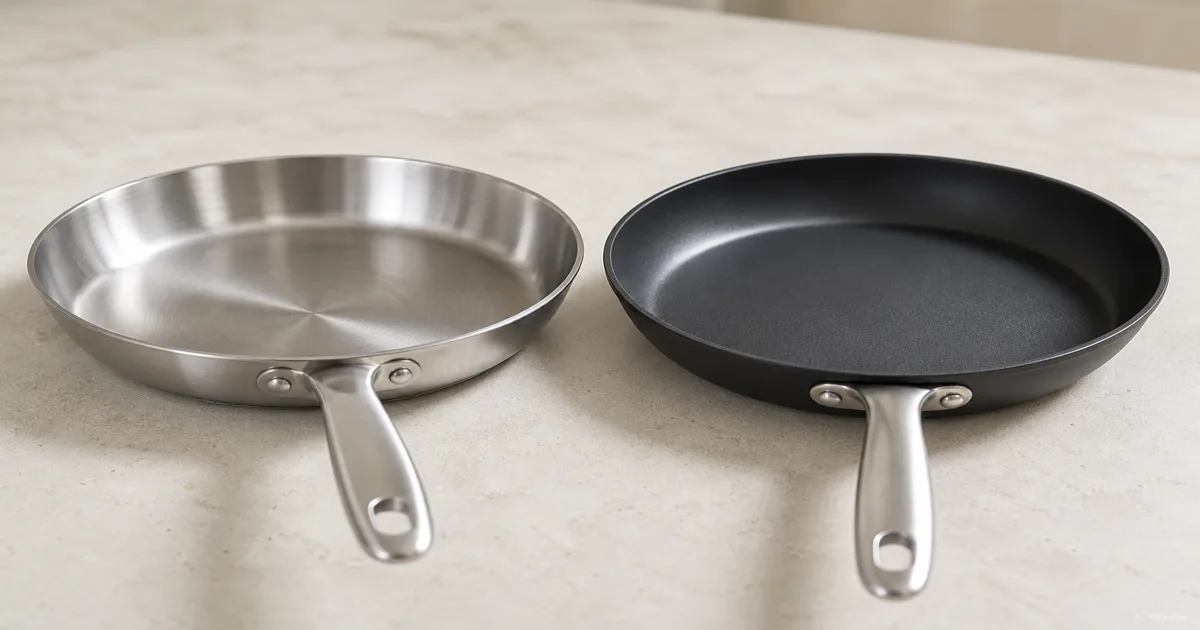


Choose for the meal you make most
Think of three meals you actually cook, rather than a kitchen you hope to build someday.
- Mostly eggs, pancakes or delicate fish? Start with a nonstick frying pan for easier release.
- Mostly meat with a pan sauce? Start with uncoated stainless steel.
These uses align with All-Clad’s pan guide; choosing which matters most is your decision. If breakfast is daily and steak is occasional, prioritise breakfast. If learning to make a sauce after searing is the point of the purchase, stainless makes sense even for a beginner.
Compare the cooking habits, not just the heat claims
Nonstick can brown food. Tefal’s coated Start’Easy pan, for example, is designed for searing. “Nonstick cannot sear” is too broad; permission to brown food is not permission to overheat the coating.
For coated pans, start with low-to-medium heat and follow the model’s instructions, as in All-Clad’s care guide. Do not heat PTFE cookware empty: BfR warns that overheating can release hazardous gases. Treat ceramic nonstick as a separate coating with its own instructions, not as uncoated metal.
With stainless, you take more responsibility for release. Le Creuset advises preheating, adding fat and waiting before turning. For a first attempt, follow your pan’s preheating directions, add oil, then give the food time to release rather than forcing it loose. More heat is not automatically the answer.
Stainless also suits a different finish: add stock or another suitable liquid to the browned residue after cooking to start a sauce. That residue is called fond. If you enjoy that step, it is a useful reason to choose stainless.
Check the actual pan before buying
“Stainless steel” on the box does not necessarily mean an uncoated cooking surface. All-Clad makes bonded stainless pans with nonstick interiors. Check the interior description first; a steel exterior does not cancel the coating’s care limits.
Construction is another question. Le Creuset’s three-layer design sandwiches an aluminium core between steel layers to spread heat. Read the construction details instead of treating weight or the word “stainless” as proof of even heating.
- Hob. Confirm compatibility for the exact model, especially on induction.
- Oven. Check the pan, handle and lid limits, plus whether use under a broiler is allowed. Neither material name grants unlimited oven use.
- Size and handling. Compare the flat cooking area with your usual portion, the base with your hob’s requirements, and the handle with your storage space. If possible, lift and tilt the pan before buying.
All-Clad explicitly says compatibility and oven limits vary by product. If those details are missing, ask for the instructions before ordering.
Choose the upkeep you can live with
A nonstick purchase includes looking after its surface. Use a suitable silicone or wooden tool, let the pan cool, and wash gently; All-Clad’s care guidance explains these precautions. If you already have a suitable tool, keep using it. If you need one for stirring eggs or sauces, a heat-rated silicone cooking spatula is a supporting purchase, not a reason to buy a whole utensil set.
Unsure which shape suits your cooking? Compare silicone spatulas and wooden spoons, checking the individual tool’s temperature rating and care instructions.
Do not budget around a promised number of years. Tefal says coating life depends on use and frequency, and a scratched coating cannot be reapplied at home. Uncoated stainless avoids that coating issue, but still needs care; cool it before washing rather than putting a hot pan under cold water.
Start with one pan that passes the checks above. Add nonstick later if delicate breakfasts remain a nuisance; add stainless if making sauces from browned residue becomes a regular interest. “One of each” is an option, not an entry requirement.
Come è stata costruita questa guida
AI wrote this Chexlow guide using manufacturer information from All-Clad, Le Creuset and Tefal, plus BfR guidance on PTFE overheating. It compares first-pan choices by meals, technique and upkeep; the buying priorities are editorial judgments, not product-test results.
Curato dal team Chexlow · Le immagini sono illustrazioni generate dall’IA