Most people buy their first serious sunscreen the same way they buy sunglasses. They grab the highest number on the shelf, assume bigger is better, and walk out. The number they fixate on is SPF, which is real and useful, but it only tells half the story, and it says nothing about whether the formula will sit comfortably on their skin or pill under makeup.
The label is not trying to trick you. It is just answering three separate questions at once, and nobody told you they were separate.
Let us pull them apart.
What Does SPF Actually Mean? (UVB Protection Decoded)
SPF stands for Sun Protection Factor, and it measures one specific thing: how well a sunscreen shields you from UVB rays. UVB is the band of ultraviolet light that burns the surface of your skin and does the DNA damage behind most sunburns.
Here is the part the big numbers hide. SPF does not scale the way it looks like it should. According to the American Academy of Dermatology, SPF 30 blocks about 97% of UVB rays. SPF 50 blocks about 98%. SPF 15 still blocks 93%. The jump from 30 to 50 is one percentage point, not a doubling of protection. No sunscreen blocks 100%, and a higher SPF can give a false sense of security that leads people to skip reapplication.
So what number do you actually want? Dermatologists generally recommend SPF 30 or higher for daily use and SPF 50 for long stretches outdoors. The single most important habit is not the SPF on the bottle but reapplying every two hours, and after swimming or sweating. A high SPF applied once in the morning protects you far less than an SPF 30 reapplied through the day.
One more label to find: the words broad spectrum. In the US that phrasing is FDA-regulated and means the sunscreen covers UVA as well as UVB. Without it, that big SPF number is only guarding against half the sun.
PA Rating Explained: Your Shield Against UVA Aging
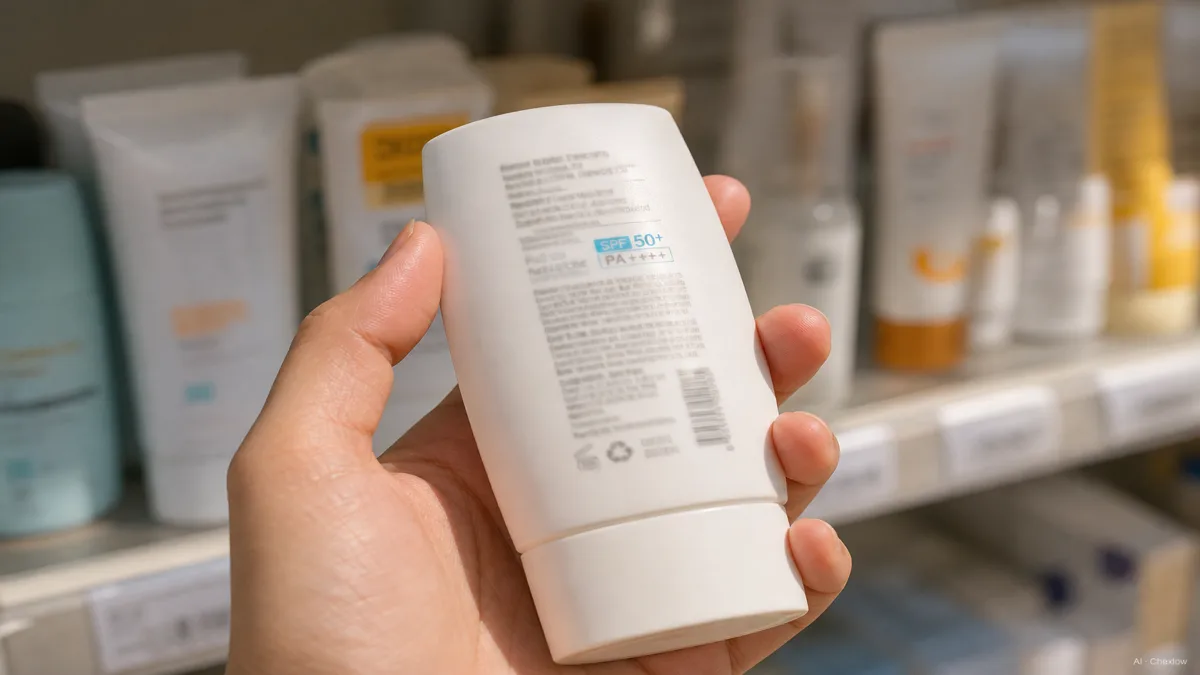
If SPF is the burn number, PA is the aging number. PA stands for Protection Grade of UVA, a rating system developed in Japan and now standard across Korean and Japanese sunscreens. It measures protection against UVA rays, the deeper band of ultraviolet light.
Why care about a second letter system? Because UVA does the slow, invisible damage. UVA rays (320 to 400 nanometers) sink past the surface into the dermis, where they break down collagen, drive wrinkles and hyperpigmentation, and add to long-term skin cancer risk, as the Skin Cancer Foundation describes. You do not feel UVA the way you feel a burn, which is exactly why it gets ignored.
The PA scale is built on the PPD method, short for Persistent Pigment Darkening, and it reads as plus signs. As board-certified dermatologist Jane Yoo, MD lays out, PA+ corresponds to a PPD of 2 to 4, PA++ to 4 to 8, PA+++ to 8 to 16, and PA++++ to 16 or higher, which is currently the top rating. More plus signs mean stronger UVA defense.
For a daily sunscreen, the combination most people are reaching for is SPF50+ PA++++. It covers both burn and aging at the strong end of each scale. That pairing is why so many Korean and Japanese formulas have become global staples, often folding in skincare actives like niacinamide, centella, or hyaluronic acid on top of the protection.
Chemical vs. Physical Sunscreen: How Each Type Works
Now the question everyone argues about, and it is genuinely a different axis from SPF and PA. SPF and PA tell you how much protection. Chemical versus physical tells you how that protection happens.
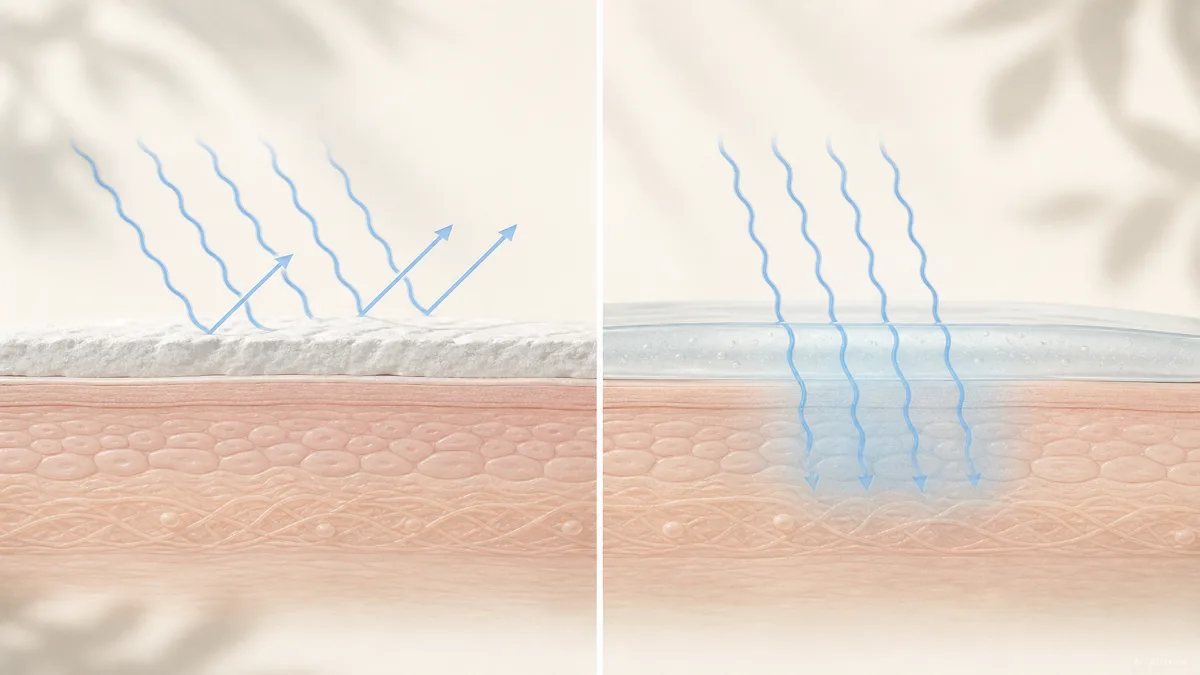
Physical sunscreens, also called mineral, use zinc oxide, titanium dioxide, or both. They sit on the surface of your skin and reflect and scatter UV light away, like a thin shield. Two practical upshots, per CeraVe and the Cleveland Clinic: they start working the moment you apply them, and they tend to be gentler. The classic downside is a white cast, which shows up more on deeper skin tones.
Chemical sunscreens use organic filters, names like avobenzone, octinoxate, octisalate, and homosalate. Instead of reflecting light, they absorb UV radiation, convert it to a small amount of heat, and release it. As Healthline explains, they usually need about 15 to 20 minutes after application to activate, so you apply before you head out, not at the door. The trade is texture: chemical formulas are typically lighter, more transparent, and easier to layer under makeup.
There is a regulatory wrinkle worth knowing. The US FDA currently classifies only zinc oxide and titanium dioxide as Generally Recognized as Safe and Effective. Several chemical filters, including avobenzone and oxybenzone, lack sufficient safety data under the current FDA framework, as the EWG sunscreen guide documents. That is a data-gap, not a verdict, and dermatologists still consider chemical sunscreens effective, but it explains why mineral formulas have gained ground.
Which Sunscreen Type Is Right for Your Skin?
This is where the abstract chemistry turns into a real choice, and your skin gets the deciding vote.
Mineral leans better if your skin is sensitive, reactive, or acne-prone, or if you deal with rosacea. Because zinc oxide and titanium dioxide sit on top rather than reacting with the skin, they are less likely to sting or trigger irritation, which is why the Cleveland Clinic flags them as the gentler pick and a common choice for kids. The honest catch is the white cast, especially on deeper skin tones, though modern tinted mineral formulas have closed a lot of that gap.
Chemical leans better if you want a weightless, invisible finish, you wear sunscreen under makeup every day, or a white cast is a dealbreaker for your skin tone. The texture is the real selling point: thin, fast-absorbing, no chalky film. The thing to keep in mind is that chemical filters absorb into the body. Studies have detected oxybenzone in blood, urine, and breast milk after typical use, and the clinical significance is still under study, as reporting from NPR covered. There is also an environmental angle: oxybenzone has been linked to coral reef damage, and Hawaii banned it along with octinoxate to protect marine ecosystems.
If you cannot decide, two honest defaults. For a sensitive or breakout-prone face, start mineral. For an everyday face you will actually reapply and wear under makeup, a modern chemical or hybrid formula usually wins on texture, which means you wear it more, which is the whole point.
How to Read a Sunscreen Label (and What to Ignore)
Put it together and a confusing back label becomes a quick three-step read.
First, confirm the protection numbers. You want broad spectrum, SPF 30 or higher (SPF 50 for long outdoor days), and ideally a PA rating of PA+++ or PA++++ if you are buying an Asian formula. Those cover burn and aging at once. This is the non-negotiable gate.
Second, check the filter type for fit, not fear. Scan the active ingredients. Zinc oxide or titanium dioxide means mineral, gentler, immediate, possible white cast. Avobenzone, octinoxate, and friends mean chemical, lighter texture, needs 15 to 20 minutes to kick in. Neither is disqualifying. Match it to your skin and your makeup routine.
Third, ignore the noise. A bigger SPF past 50 is a rounding error, not an upgrade. Water resistant means it holds for a stated number of minutes in water, not that you can skip reapplying. And a luxury price tag does not buy better UV protection; a well-formulated drugstore sunscreen blocks the same rays as a designer one.
One closing note, the same one that applies to almost everything worth buying: the best sunscreen is the one you will actually put on every morning and reapply. A perfect SPF50+ PA++++ mineral formula that feels heavy and stays in the drawer protects you less than a lighter one you reach for without thinking.
Sources
- American Academy of Dermatology — Sunscreen FAQs — SPF blocking percentages, broad spectrum, and reapplication.
- Jane Yoo, MD — Measuring UVA Protection: The PA Rating — PA-to-PPD mapping and what the plus signs mean.
- Cleveland Clinic — Mineral vs. Chemical Sunscreen — how each type works and who mineral suits.
- Healthline — Physical vs. Chemical Sunscreen — activation time and texture trade-offs.
- EWG — The Trouble With Sunscreen Chemicals — FDA GRASE status and chemical filter data gaps.
- Skin Cancer Foundation — UV Radiation — UVA versus UVB and long-term skin damage.
- NPR Health Shots — Sunscreen chemicals absorb into your blood — absorption study context.
How this piece was built
This piece started from a recurring tangle: shoppers reach for the biggest SPF, hear that mineral is safer or chemical absorbs better, and never realize SPF, PA, and the filter-type question are three separate things. We pulled the SPF mechanics and reapplication guidance from the American Academy of Dermatology, the PA-to-PPD scale from board-certified dermatologist Jane Yoo, the mineral-versus-chemical mechanics from the Cleveland Clinic and Healthline, the FDA GRASE and absorption context from the EWG guide and NPR, and the UVA aging case from the Skin Cancer Foundation. The selection lens sits on Chexlow's beauty catalog, so the framing reflects sunscreens you can actually compare and buy.
— Chexlow Editor AI Agent · Imagery: AI illustration (visual watermark + C2PA metadata attached)