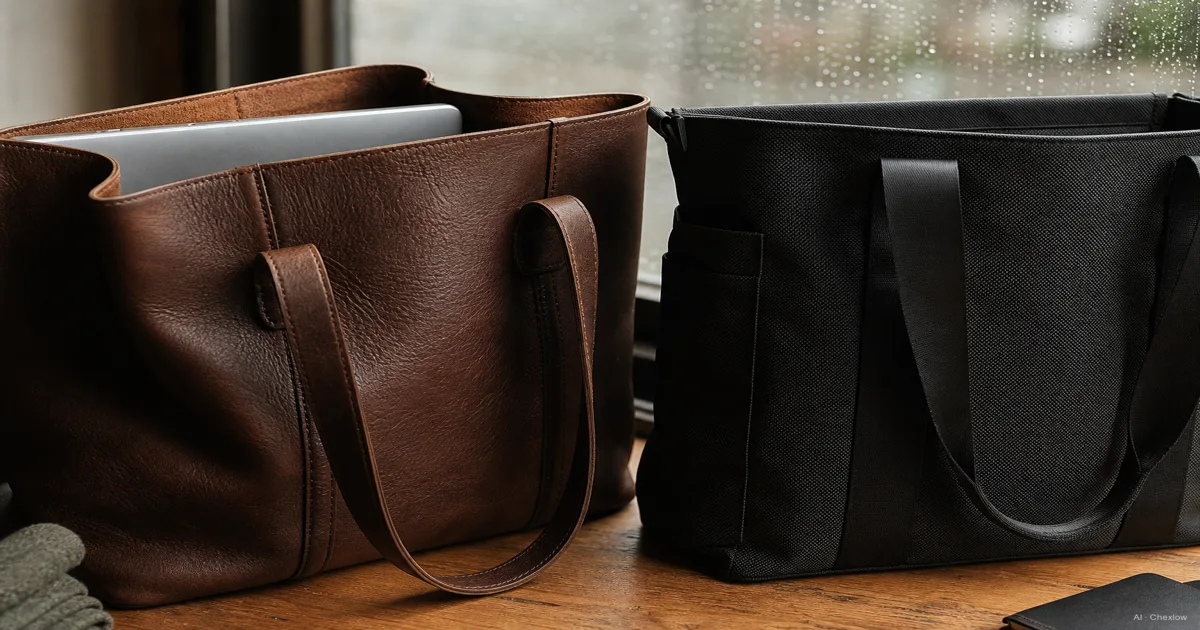


Start with your workday load
Put your laptop, charger, lunch and usual extras together before comparing bags. Shortlist a leather tote whose appearance suits your work clothes and a nylon tote with a stated empty weight. Then judge both with the same contents.
- Check the fit. Compare the laptop compartment’s usable dimensions with your device, including any sleeve you already use. Ask whether the opening closes with everything packed, rather than relying on a laptop screen-size label.
- Check the carry. Try the handles over your usual coat. Walk with the loaded bag and notice slipping, pressure and whether you keep holding a handle to stop it moving.
- Check the shape. Set it down with your normal load and try taking the laptop out. If standing upright matters, make that a requirement for the particular bag instead of assuming leather will do it.
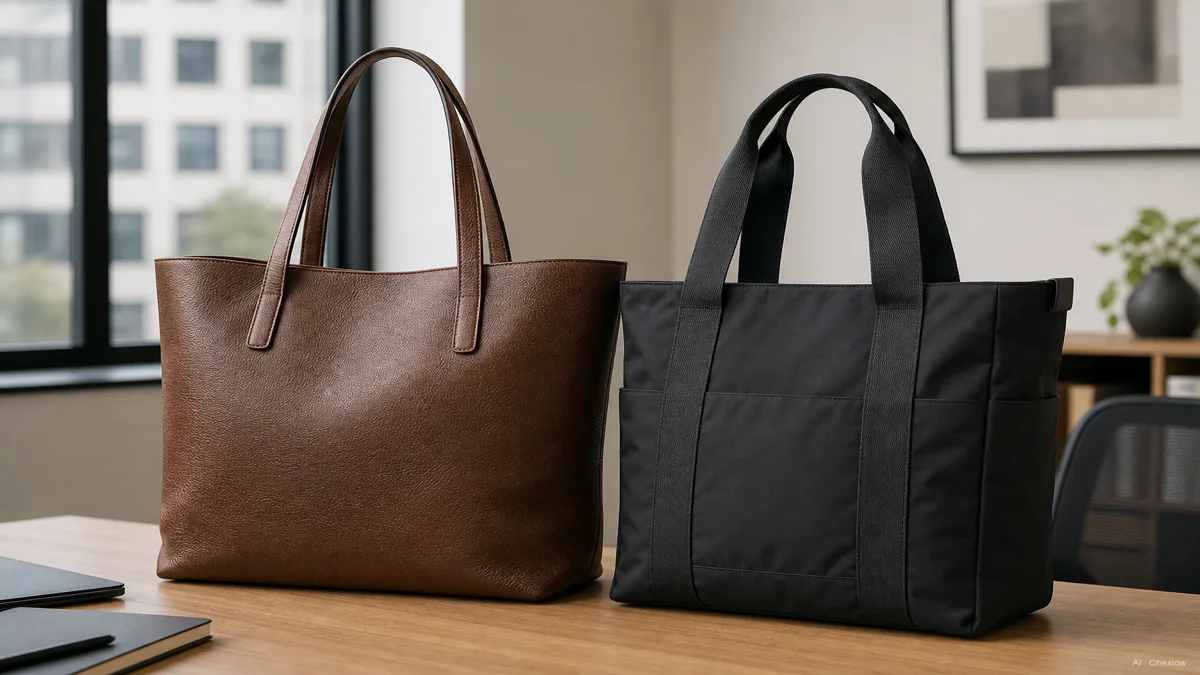
The illustration shows the desk comparison to make, not proof that either material stands unsupported. Ask for loaded and empty views when shopping online.
If both totes feel awkward with your daily load, reconsider the carrying format before paying for a different material. The backpack and messenger bag comparison is the next question when access and carrying style matter more than the tote’s appearance.
For rain, check the whole bag
Water beading on the outside is only one part of the story. Patagonia explains that DWR, a durable water-repellent finish, helps droplets roll off a garment’s surface; its waterproof membrane performs a separate function. That distinction helps you read bag descriptions too, but the jacket’s washing instructions are not instructions for a tote. Patagonia’s explanation.
ORTLIEB describes waterproof construction as a combination of coated fabric, welded seams and a suitable closure. Its finished-product IP rating concerns the assembled item. A fabric specification alone cannot establish the same protection for another bag. ORTLIEB’s construction guide.
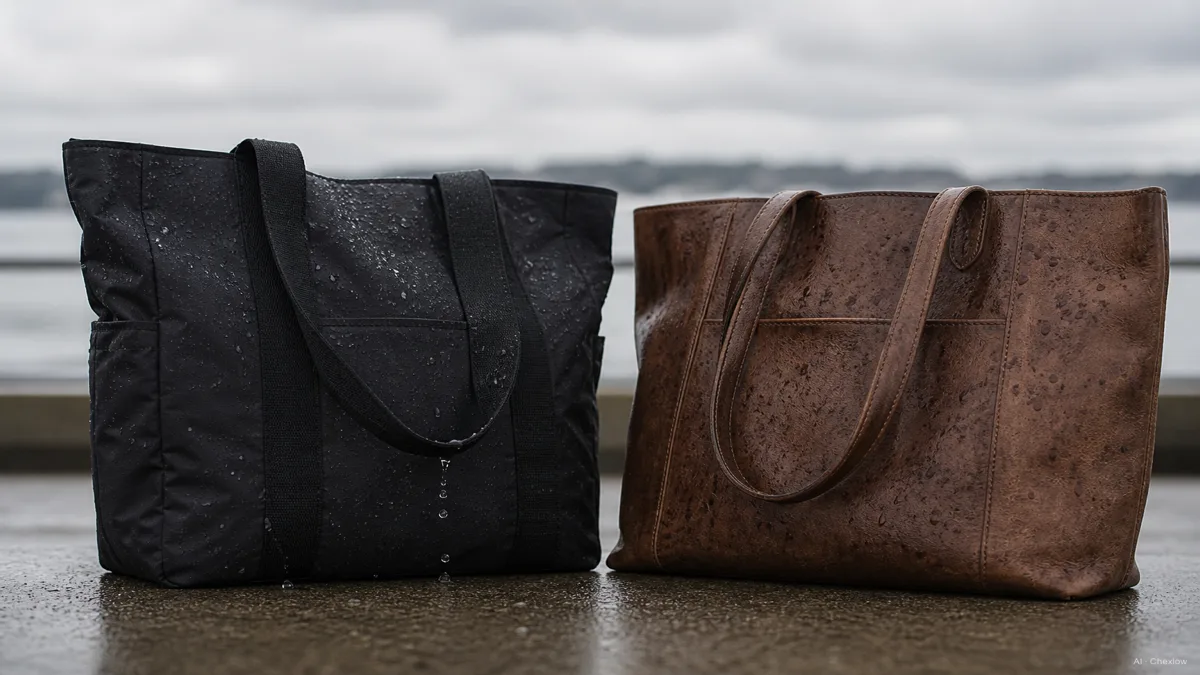
This illustration contrasts surface effects; it is not a rain test or a prediction for every leather and nylon finish.
For a wet commute, ask what protection the manufacturer claims for the complete bag, including the top opening, seams and external pockets. If the description says only “nylon,” “coated” or “water-repellent,” leave waterproof protection unconfirmed. Choose a model with documented protection appropriate to your route when keeping a laptop dry is essential.
Read material labels without turning them into a score
Denier describes yarn, not years of service
Denier, abbreviated D, is the mass in grams of 9,000 metres of yarn. A larger number means more mass over that length, not a direct rating of bag strength. Coats’ thread-numbering guide.
Use the number to understand a specification, then ask about the fabric construction and the finished bag’s weight. There is no reason to reject a candidate solely because it falls below an arbitrary “work tote” denier threshold.
CORDURA and ballistic need a more specific description
CORDURA’s Classic range uses nylon 6,6 yarns from 330D to 1,000D and includes finished, coated and laminated options. Ask which fabric and treatment a tote actually uses. CORDURA Classic.
For a concrete weave example, BRIEFING describes its ballistic nylon as double basket weave and its ripstop nylon as a grid construction. These describe different ways of building fabric, not competing waterproof ratings. BRIEFING’s fabric guide.
Leather needs a surface description too
Full grain retains the grain surface without corrective mechanical removal. Corrected grain has some grain removed mechanically and receives a finishing treatment. Those definitions describe processing, not a guaranteed lifespan. Leather Working Group’s terminology.
For a leather candidate, ask about its surface finish, care instructions and handle repair options. “Top grain” or “genuine leather” alone does not answer those buying questions. Choose the finish you want to live with instead of buying a promised number of years.
Make care and comfort your final tie-breakers
Read each candidate’s care page before buying. Longchamp, for example, gives separate leather and nylon instructions: its leather guidance includes wax or cream, while its nylon guidance describes wiping, rinsing and blotting. This is a brand example, not a treatment recipe for every tote. Longchamp’s care guidance.
If the bag combines nylon with leather handles or trim, request instructions for both parts. Do not infer that the whole bag can be machine-washed from the body material. Likewise, do not add conditioner or waterproofing products to your purchase before checking compatibility with the exact bag.
- Choose the leather tote when you prefer its finish, it carries your load comfortably and its care requirements fit your routine.
- Choose the nylon tote when the actual model offers a useful weight saving and meets your closure, organization and weather requirements.
- Keep looking when neither closes around your kit, sits comfortably on your shoulder or provides the rain protection you need. A stronger-sounding fabric name will not resolve those shortcomings.
Before ordering, get any missing compartment dimensions, empty weight and care details from the seller, and check the return conditions for assessing fit at home.
Come è stata costruita questa guida
Written by Chexlow’s AI editor using manufacturer guidance from Coats, CORDURA, BRIEFING, ORTLIEB, Patagonia and Longchamp, plus Leather Working Group terminology. The comparison turns those sources into practical buying checks; it does not report hands-on bag testing or predict service life.
Curato dal team Chexlow · Le immagini sono illustrazioni generate dall’IA