Find the right release before pulling
Start with the model number and the manual’s dispenser-cleaning page. Follow its preparation instructions and identify whether you have an ordinary removable drawer or an automatic dosing system with a detergent reservoir. If the release or removable parts do not match the instructions, stop and ask the manufacturer.
The release is not always in the same place. Samsung’s illustrated drawer uses an internal release lever, while Electrolux describes a side release on some machines, including Auto Dose and Soft Water types. Neither example is a reason to force a drawer that will not move. Samsung’s drawer instructions
Soaking permission also varies. Electrolux explicitly allows full immersion of the AutoDose drawer described in its guidance and distinguishes this from some other manufacturers’ designs. Treat that as a specific exception, not permission to submerge any automatic dispenser. Electrolux’s removal and cleaning guide
Wash the removable parts, keeping track of each insert
Before removing an insert, note its position or take a photo. Remove only the caps, compartments or guides identified in your manual. For example, Samsung’s illustrated procedure removes the softener compartment and optional liquid-detergent guide; Whirlpool explicitly says inserts depend on the model.
For the removable drawer covered by Whirlpool’s cleaning guidance, wash the parts under warm running water and use a soft brush if residue needs help coming away. Whirlpool specifies hand washing, not a dishwasher.
A small soft-bristled cleaning brush is useful only if your instructions permit brushing and water alone leaves buildup. Reuse a suitable brush you already have; Samsung’s recess-cleaning example uses an old toothbrush. There is no need to buy a complete appliance-cleaning kit.
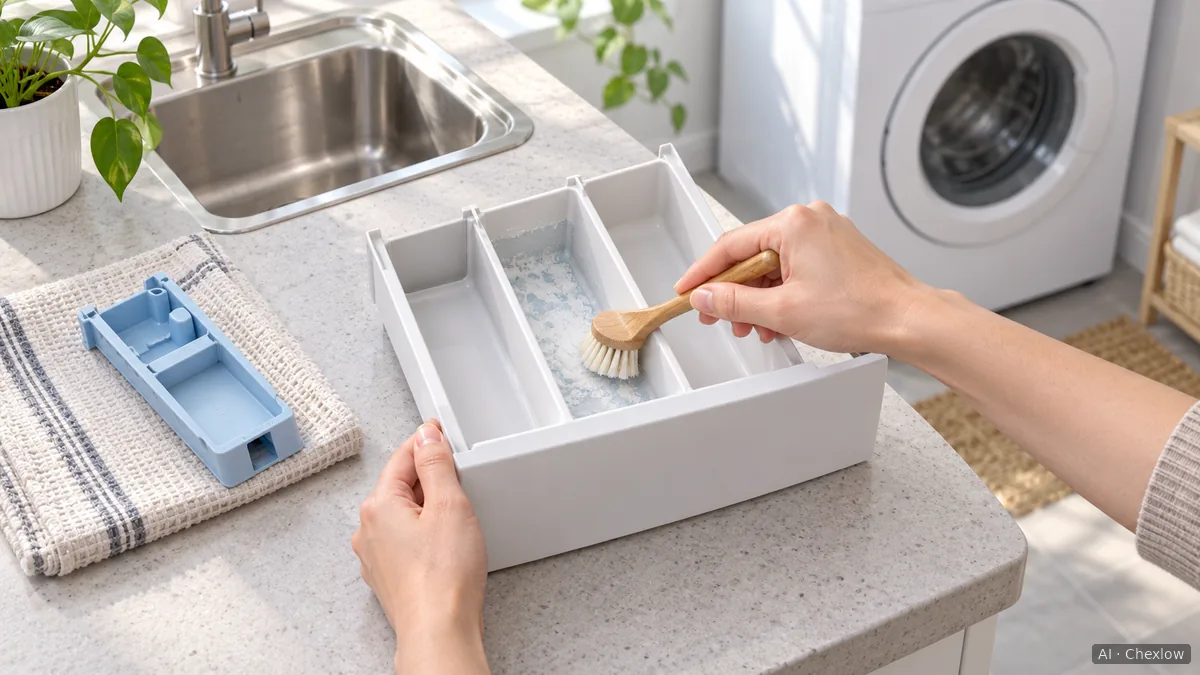
This is a generic removable drawer, not a model-specific release diagram. Keep your own manual beside you when identifying parts.
Clean the accessible recess and refit the parts
The recess is the opening the drawer slides into. Electrolux explains that water enters through the dispenser to flush detergent into the drum, so cleaning the loose drawer alone can miss buildup around the opening. Its guidance draws attention to the water-supply holes on the underside of the opening’s top surface and to the softener lid and siphon tube, the passage involved in dispensing softener.
Cleaning products are a model-check point. Whirlpool allows mild soap, water and a soft cloth or sponge for the housing in its guide; Electrolux says not to use detergents or bleach on the drawer or inside the housing. Follow the instructions for your appliance rather than combining the two methods.
Keep this task to accessible surfaces and the parts the manual identifies. Do not remove panels or dismantle water, drain or electrical components. If reaching residue would require that work, leave it for service.
Refit every permitted insert in its original position, then return the drawer as instructed. Samsung’s procedure finishes with a rinse cycle with no laundry in the drum to remove remaining detergent. Use the finishing procedure specified for your model rather than automatically substituting a hot maintenance wash.
If detergent still remains, change the question
After the prescribed cleaning and finishing procedure, note which compartment still contains residue and whether the drawer has been correctly reassembled. Check the manual’s detergent type, compartment and dosing instructions before repeating the cleaning.
- Residue returns despite correct cleaning and assembly. Give support the model number, a photo of the affected compartment and the steps already completed. Drawer cleaning has not established the cause of the dispensing failure.
- A part is damaged, the drawer will not seat or water leaks. Stop this cleaning procedure and contact the manufacturer. Electrolux notes that severe dispenser blockages can cause leaks, but that does not establish the cause of your leak.
- The drawer is clear but clothes feel soapy. The next question concerns detergent use and rinsing in the wash routine. Scrubbing the drawer again does not answer it.
Detergent left behind is a reason to inspect and follow the correct cleaning procedure, not by itself a reason to buy another washer.
Come è stata costruita questa guida
This guide was written by AI for Chexlow using Samsung, Whirlpool and Electrolux support pages. It separates their differing cleaning permissions and limits the task to accessible, user-removable dispenser parts; the instructions for the reader’s exact model take precedence.
Curato dal team Chexlow · Le immagini sono illustrazioni generate dall’IA