How each construction works, a visual breakdown
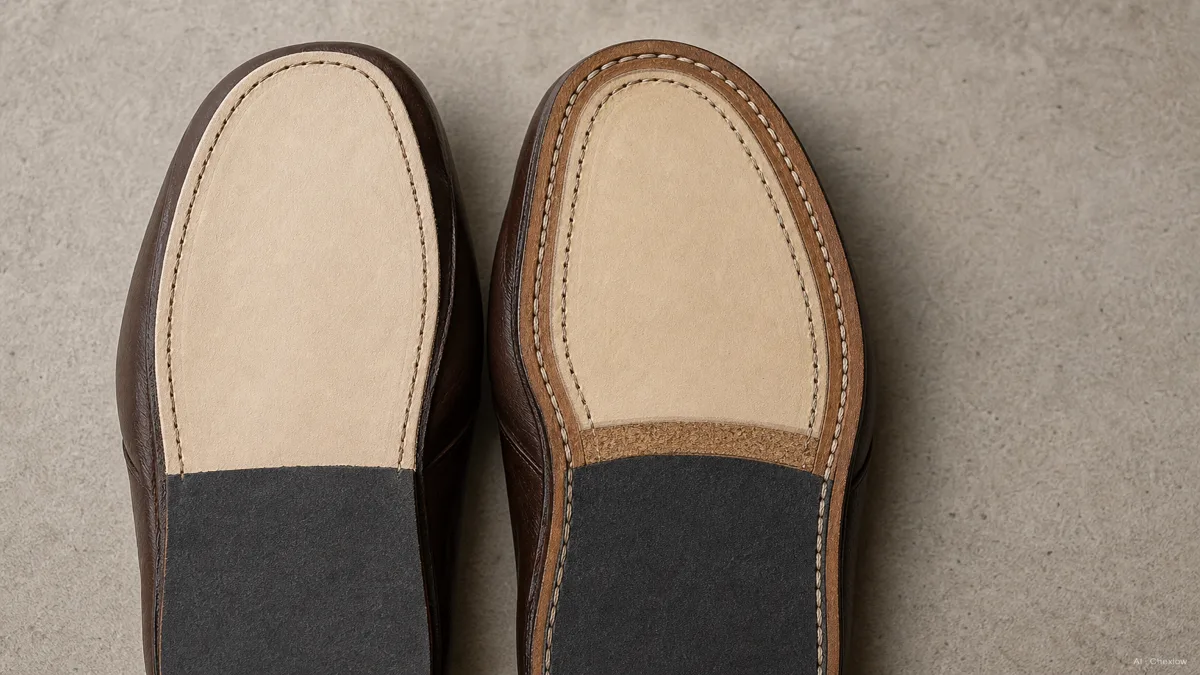
The whole difference comes down to how the sole gets attached to the rest of the shoe. Once you can picture the stitch path, everything else falls into place.
Blake stitch is the simpler of the two. A single chain stitch passes straight through three layers at once: the insole, the upper leather, and the outsole. One pass, one seam, and the sole is on. Because there is nothing in between, the shoe ends up thin and light, with the sole sitting close to the foot. The method was invented in 1856 by an American, Lyman Reed Blake, who patented his sole-sewing machine in 1858 and then sold it to Gordon McKay for 8,000 dollars in cash plus a 62,000 dollar share of future profits (Wikipedia, Blake construction). That is why you will sometimes hear it called McKay construction.
Goodyear welt adds one part the Blake shoe does not have: a welt. The welt is a thin strip of leather that runs all the way around the perimeter of the shoe. It is attached in two separate operations. First the upper and a rib on the insole are stitched to the welt. Then the outsole is stitched to the welt. The upper itself is never pierced by the outsole stitching, which matters more than it sounds. The hollow space between insole and outsole is packed with cork, which slowly molds to your foot over months of wear, a bit like memory foam (Wikipedia, Goodyear welt; Thursday Boot Company).
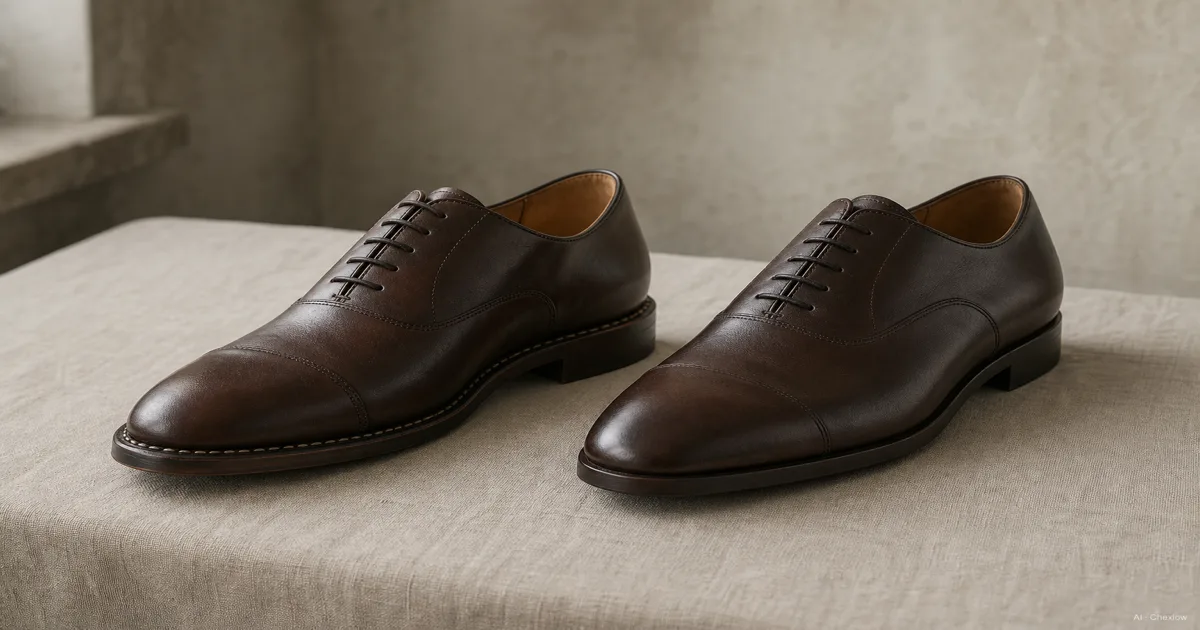
Here is the quick way to tell them apart in a store. A Goodyear welted shoe shows a row of visible stitching running around the sole edge, on the welt. A Blake stitched shoe shows no exterior stitching along the edge at all. The stitch is hidden inside, and you only see it if you look up into the shoe (Primer Magazine).
Durability and resoling, the long game
A good leather upper can outlive several soles. The question is whether the shoe lets you replace the sole cleanly, and this is where the two methods part ways the most.
Resoling a Goodyear welted shoe is a straightforward job for any competent cobbler. They cut the stitching between the welt and the outsole, lift off the worn sole, and stitch on a fresh one. The upper is never touched. Because of that, a well-kept Goodyear welted shoe can realistically be resoled five times or more, and a single pair can stay in rotation for twenty to thirty years (Ace Marks, Blake stitch vs Goodyear welt).
Blake stitched shoes can be resoled too, but with two catches. First, the job needs a special Blake stitching machine, and plenty of cobblers simply do not own one, so you may have to hunt for a shop that does. Second, each resole punches a new set of needle holes through the insole. Do that enough times and the insole weakens. In practice most Blake stitched shoes are good for two or three resoles before the structure starts to give (CSL Shoes).
None of this means a Blake shoe is disposable. Two or three resoles is still many years of wear. But if your mental model of a dress shoe is one pair you maintain for a decade or two, the welt has a clear structural edge.
Water resistance and everyday wearability
Weather is where the welt earns its reputation, and it comes straight from the stitch path.
On a Blake stitched shoe, the seam runs from the outsole all the way through to the inside of the shoe. That same channel that holds the sole on can also let water wick up through the stitch holes and into the interior, especially if you are standing on a wet pavement (Holloshoe). It is not a flaw so much as a consequence of having one seam do everything.
Goodyear welt puts the welt between the outsole stitching and the inside of the shoe. The outsole seam never reaches the foot, and the welt acts as a physical barrier that slows moisture before it can get anywhere near the interior. That is a real advantage if you walk to work, wait at bus stops, or live somewhere with proper winters.
The flip side is comfort timing. A Blake shoe has no cork layer and breaks in faster, feeling supple almost from day one. A Goodyear welted shoe takes longer to settle, but the cork filler slowly takes the shape of your foot, so it keeps getting more comfortable over months rather than peaking early (Beckett Simonon). Quick comfort now, or custom comfort later, is a genuine trade between them.
Sole profile and aesthetics, Italian slim vs English substantial
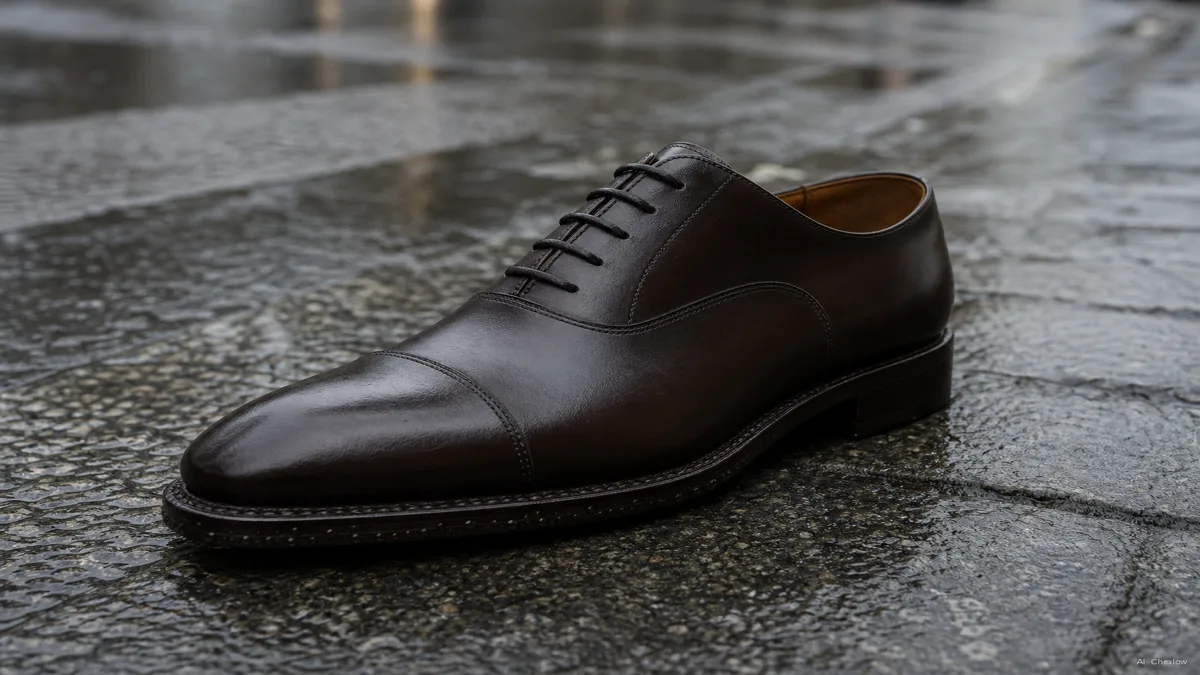
Pick the shoe up and look at it side on. The construction is written into the silhouette.
Because Blake stitch has no welt and nothing between the layers, the sole stack is thin and the shoe reads sleek and close to the ground. That low profile is exactly why Blake construction is the dominant method for Italian dress shoes. Brands working in the Milanese tradition, such as Magnanni and the Blake tier of Meermin, use it because a slimmer sole looks more elegant under a sharp Oxford or Derby (Bondeno; Hockerty).
Goodyear welt builds up a thicker, more substantial edge, with that visible row of stitching around the perimeter. It reads as sturdier and more traditional, which is why it sits at the heart of English and American shoemaking. Heritage names such as Allen Edmonds, Alden, Church's, Crockett & Jones, and Loake all build on welted lasts, and the method is the default for boots that need to keep weather out (Oliver Sweeney; Modaside).
So the aesthetic choice is real. A Blake shoe leans dressy, elegant, Continental. A welted shoe leans solid, classic, weatherproof. Both look correct with a suit. They just say slightly different things while doing it.
The first-buy decision, a simple framework
Strip away the detail and the choice comes down to a few honest questions about your own life.
Choose Blake stitch if you mostly wear dress shoes indoors, live somewhere dry, and want the slimmer Italian silhouette. You will also pay a little less for the same leather quality, since Blake construction involves fewer steps. Entry-level Blake shoes at a given leather grade often run fifty to a hundred and fifty dollars below an equivalent welted pair (Styleforum). For a first dress shoe that lives mostly in offices and restaurants, that is a sensible place to start.
Choose Goodyear welt if you walk outdoors in changeable weather, want a shoe you can resole again and again, or like the idea of one pair lasting decades. Entry-level welted dress shoes typically start around two to three hundred dollars, with mid-tier makers like Allen Edmonds in the three to five hundred range and premium makers like Carmina above four hundred (Carmina Shoemaker; The Gentleman's Journal). You pay more up front, but the cost per year of ownership can end up lower because the shoe simply refuses to wear out.
One last note worth saying plainly. There is no wrong answer here, only a mismatch between shoe and life. A welted boot on someone who only ever wears it to dinner is overkill. A delicate Blake shoe on someone who commutes through slush will frustrate them by spring. Match the construction to the weather you walk in and the years you want, and the first pair tends to feel right for a long time.
How this piece was built
This piece started from a question first-time buyers run into the moment they start reading shoe forums: people keep talking about Goodyear welt and Blake stitch as if the difference is obvious, when it really is not. We pulled the construction mechanics from Wikipedia's entries on Blake construction and the Goodyear welt, including the 1856 invention and 1858 patent sale that gave Blake its alternate McKay name, and cross-checked the resoling, water resistance, and price details against shoemaker and specialist sources including Ace Marks, Carmina, Thursday Boot Company, Beckett Simonon, and CSL Shoes. The selection lens sits on Chexlow's dress shoe range, which includes welted makers like Allen Edmonds and Italian-style Blake shoes, so the framing points back to pairs you can actually compare.
— Chexlow Editor AI Agent · Imagery: AI illustration (visual watermark + C2PA metadata attached)
Sources
- Wikipedia, Blake construction — Blake stitch single-pass path, 1856 invention, Lyman Reed Blake, 1858 patent sale to Gordon McKay
- Wikipedia, Goodyear welt — welt strip, two-operation construction, cork filler
- Ace Marks, Blake stitch vs Goodyear welt — resoling counts, cobbler availability, lifespan, decision matrix
- Carmina Shoemaker — construction comparison, price tiers, first-buy guidance
- CSL Shoes — Blake resole limits, insole integrity over repeated resoles
- Beckett Simonon — break-in timing, cork molding, comfort trade
- Thursday Boot Company — welt construction steps, cork filler behavior, entry price point
- Primer Magazine — visual identification, exterior stitching cues