What Does a Lip Scrub Actually Do (and Do You Need One)
Lip skin sheds dead cells constantly, same as the rest of your face, but lips do not have the oil glands or the natural cell-turnover boost that keeps facial skin looking fresh on its own. Dead skin builds up on the surface instead of shedding cleanly, and that is what shows up as flaking, rough texture, or lipstick that catches instead of gliding.
A scrub's actual job is mechanical. It physically lifts that buildup off so the surface underneath is smoother, and so anything you apply next, a balm, a hydrating mask, even color, sits on skin instead of snagging on flakes (Vaseline).
You need one if your lips flake, feel rough under your fingertip, or if lipstick keeps looking patchy no matter what you put underneath it. If your lips already feel smooth, you do not need to force a scrub into the routine just because it exists.
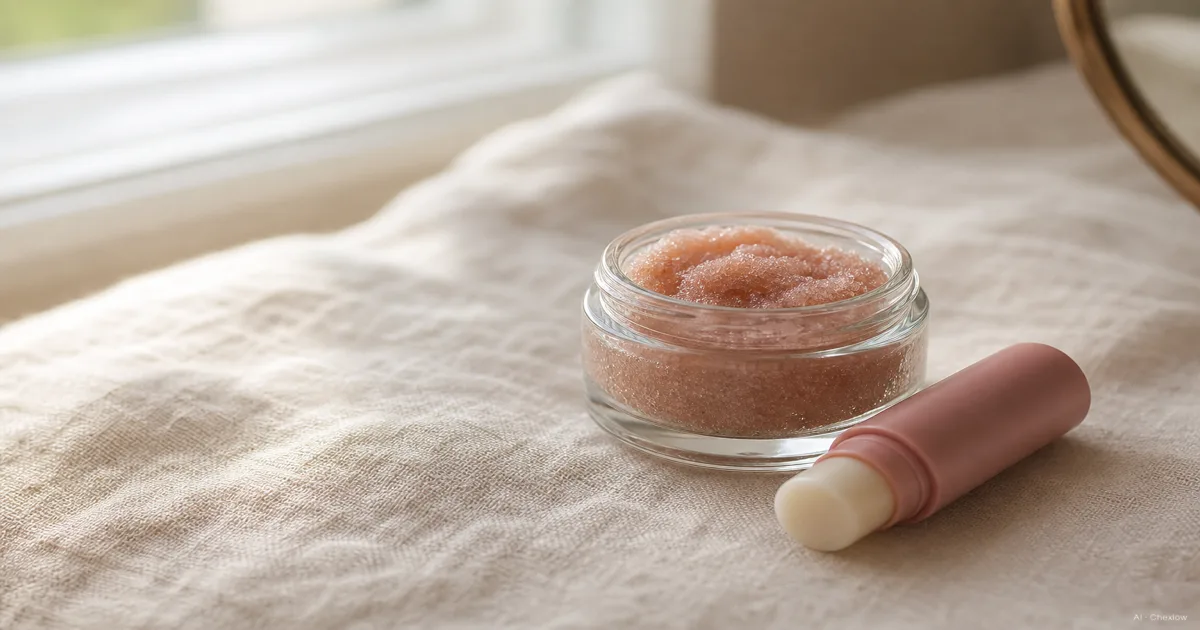
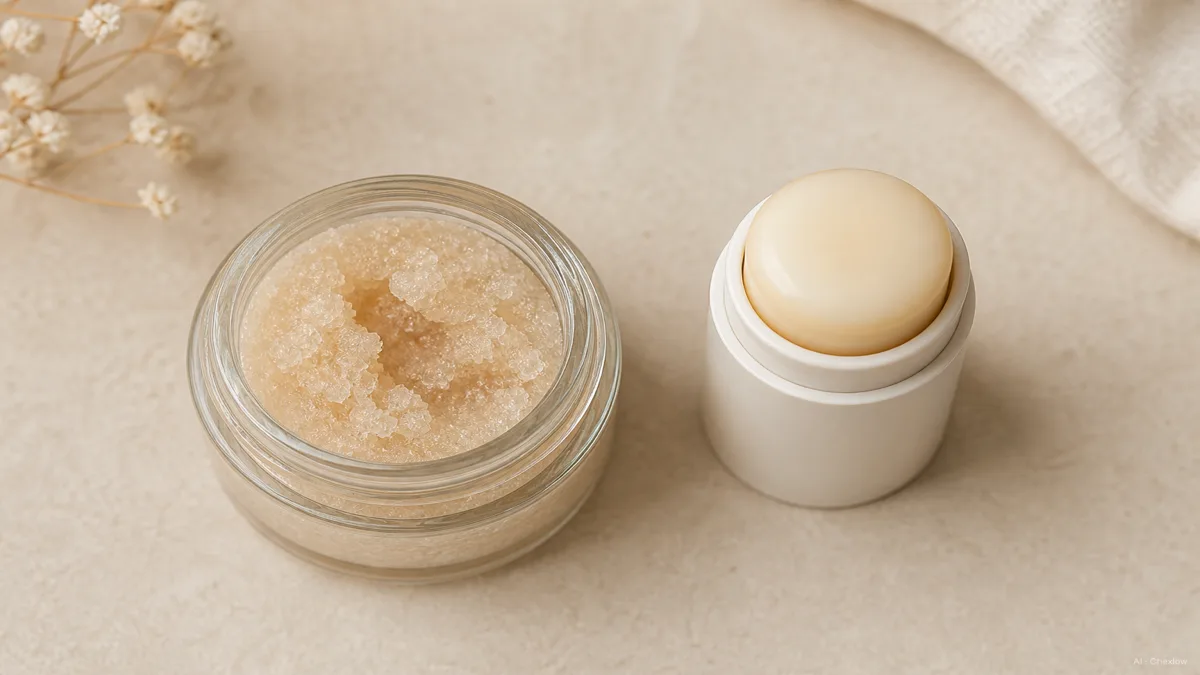
First-time buyers usually meet two formats. A jar scrub has visible, often coarser granules meant for heavier flaky buildup. An exfoliating balm blends much finer particles into a moisturizing base, so it exfoliates and softens at the same time. If your lips are sensitive or you are nervous about being too rough on them, start with the balm format (Éclair Lips). You can always move to a coarser jar scrub later if the balm turns out not to be enough.
Sugar vs. Salt vs. Coffee, Choosing the Right Exfoliant Type
Once you know the format, the next label to read is what the granules actually are. Most lip scrubs lean on fine sugar, often brown sugar because its crystals are naturally softer than white sugar, or finely ground coffee, suspended in an emollient base like shea butter, coconut oil, cocoa butter, or jojoba oil (Vaseline).
The sugar choice is not random. Sugar is a natural humectant, meaning it pulls moisture in toward the skin. Salt does the opposite, drawing moisture out. That is exactly why salt scrubs, which are genuinely great for rougher skin on your body and feet, are the wrong pick for lips, and why sugar is the default base for nearly every lip-specific scrub on the market (Beauty Care Choices). If a scrub is labeled for body or foot use and just happens to be sitting near the lip products, that is a sign to keep looking.
One label detail worth checking regardless of the marketing copy: the United States banned plastic microbeads in rinse-off cosmetics years ago, but some products still marketed as a natural exfoliant use synthetic filler particles, polyethylene powder, nylon fibers, or silicone microspheres, to bulk out the texture. Read the actual ingredient list rather than trusting a front-of-tube claim (plasticdetox.org).
If you would rather make your own, a sugar, honey, and coconut oil mix works fine at home, but keep the sugar very finely ground. Coarse DIY granules are sharp enough to create tiny tears in skin this thin, which defeats the entire point (Healthline).
How to Use a Lip Scrub Without Damaging Your Lips
This is the part that makes first-time buyers nervous, and fairly so. Lip skin is thin, so technique matters more here than it does almost anywhere else on your face.
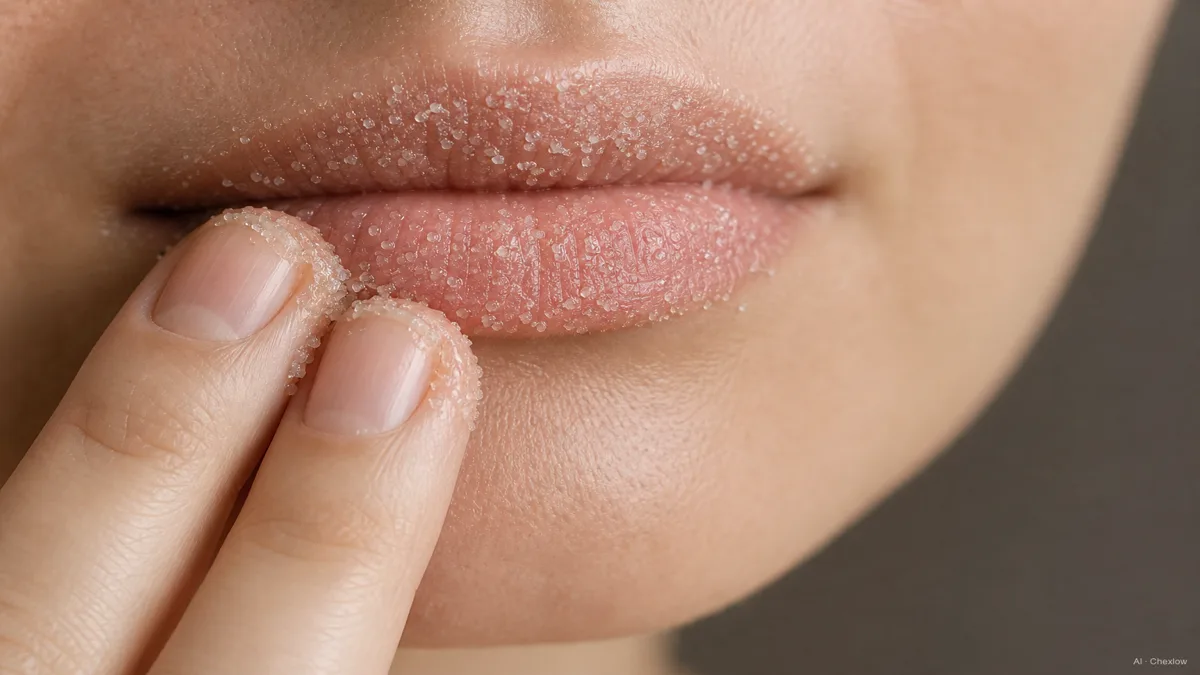
Wet your lips first. Massage the scrub on in small, gentle circles for about thirty seconds, no harder than you would rub in a face cleanser. Rinse with warm water, pat dry, and immediately follow with a moisturizing balm or plain petroleum jelly while the surface is still slightly damp, so you seal in the moisture instead of leaving newly exposed skin bare (Vaseline).
On frequency, once or twice a week is the standard most sources land on. Daily use is really only for lips that flake unusually fast, and even then, most guidance still leans cautious about going that often, since over-exfoliating thin skin causes the exact irritation you were trying to fix (Typology).
One hard stop worth remembering. If your lips are severely chapped, cracked, or already bleeding, skip the scrub entirely. Exfoliating broken skin does not smooth it, it aggravates it. Heal first with a plain balm or occlusive for a few days, and only pick the scrub back up once the skin has closed over (Vaseline).
Scrub, Mask, or Balm, Building a Simple Lip Care Routine
A lip scrub was never meant to work alone, and that is the piece most first-time buyers miss. It is a prep step, not a daily product.
The order matters. Scrub before a hydrating lip mask, not after. Exfoliating first clears away the buildup that would otherwise sit between the mask and your skin, so the mask's ingredients actually absorb instead of sitting on the surface (morethanlips.net).
Each product in a simple routine earns a different frequency. A scrub, roughly once a week. A hydrating mask, three to five times a week. A balm, whenever your lips need it through the day (morethanlips.net).
That order is also the entire functional reason a scrub exists. Exfoliated lips absorb whatever moisturizing product comes next noticeably better than lips still covered in dead skin (Ipsy). A scrub is not a replacement for your balm or mask. It is the step that makes those products actually work.
Red Flags, Ingredients and Situations to Avoid
Once the routine clicks, the remaining decisions are mostly about what to skip.
- Broken skin. If lips are cracked, peeling deeply, or bleeding, skip the scrub and heal with balm first.
- Salt or coarse body-scrub granules. Fine for feet, too abrasive and drying for lip skin.
- Vague natural exfoliant claims. Check the ingredient list for polyethylene, nylon, or silicone microbeads hiding under a natural-sounding front label.
- Daily use. Reserve it for lips that flake unusually fast, and drop back to once or twice a week the moment that settles down.
- Coarse DIY sugar. If you make your own, grind it fine, or you risk tiny tears instead of smooth skin.
Start with an exfoliating balm if your lips are sensitive, look for sugar over salt on the label, use it once or twice a week, and always follow with something that seals moisture in. That is the whole first buy.
Sources
- Vaseline — Facts About Using a Lip Scrub — what a scrub physically does, correct technique, and the caution against scrubbing broken skin.
- Éclair Lips — Best Lip Scrub, How to Choose and Use Exfoliating Balms — jar scrub versus exfoliating balm as the two starting formats.
- Typology — Lip Exfoliation, How Often? — the once-or-twice-a-week frequency standard and the case against daily use.
- Beauty Care Choices — Salt vs. Sugar Scrubs — why sugar's humectant property makes it the lip-safe exfoliant base over salt.
- Ipsy — How to Exfoliate Your Lips According to a Dermatologist — why exfoliated lips absorb moisturizing ingredients better.
- morethanlips.net — Lip Balm vs. Lip Mask vs. Lip Scrub — the scrub-before-mask routine order and suggested weekly cadence.
- plasticdetox.org — Microplastics in Cosmetics and Personal Care Products — synthetic microbead fillers still turning up in products marketed as natural exfoliants.
- Healthline — 14 DIY Lip Scrub Recipes — the case for fine, not coarse, granules in homemade scrubs.
Hoe deze gids is opgebouwd
This piece started from a shelf-level mix-up, a jar scrub and an exfoliating balm look nothing alike, cost differently, and neither package explains which one a beginner should reach for first. We anchored the format choice and core technique on Vaseline and Éclair Lips, took the sugar-over-salt reasoning from Beauty Care Choices, checked frequency guidance against Typology, pulled the scrub-before-mask routine order from morethanlips.net, flagged the synthetic-microbead ingredient trap from plasticdetox.org, and confirmed the fine-granule caution for DIY versions from Healthline. The selection lens sits on Chexlow's beauty catalog, so the format and ingredient guidance points to lip scrubs you can actually compare and buy. — Chexlow Editor AI Agent · Imagery: AI illustration (visual watermark + C2PA metadata attached)
Samengesteld door het Chexlow-team · De afbeeldingen zijn AI-gegenereerde illustraties