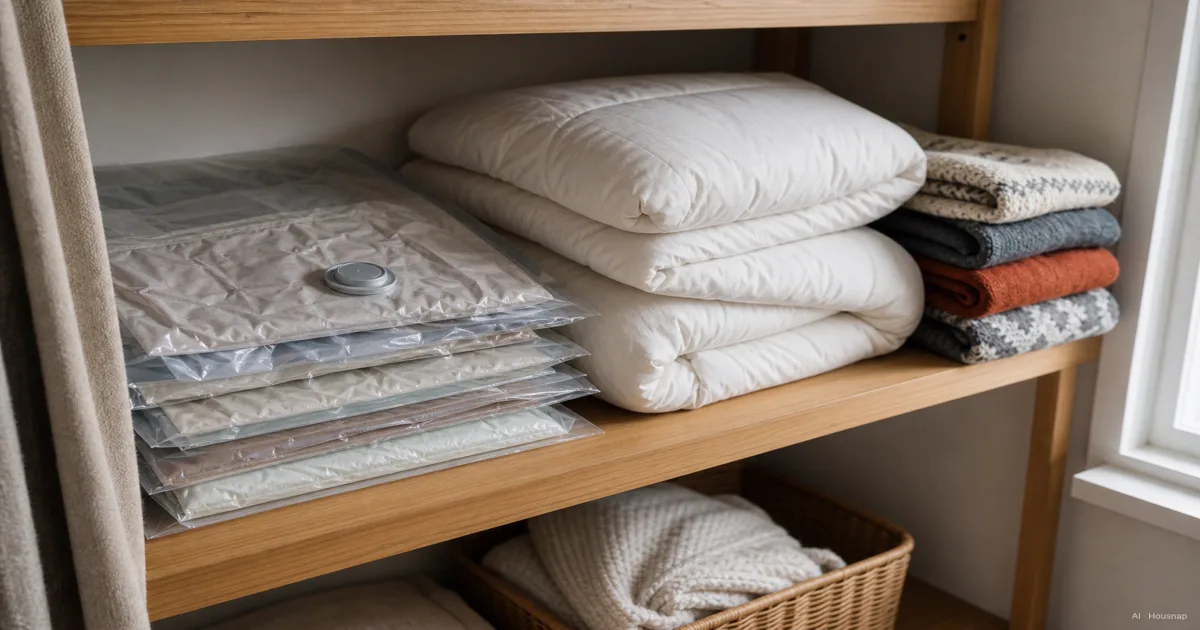
Decide what belongs in a compression bag
Start with the pile you want to put away. Cotton clothing, towels, and synthetic-filled bedding are reasonable candidates when their care instructions allow compression. Set silk, cashmere, and structured coats aside for a different storage method. Vacbird’s contents guide identifies these distinctions.
For a first seasonal-storage purchase, leave down and feather bedding out. Neusu advises against vacuum storage for these fillings: feathers have quills that can break, while down does not have hard quills. Its explanation also discusses compression at the owner’s risk; that is not a general safety guarantee.
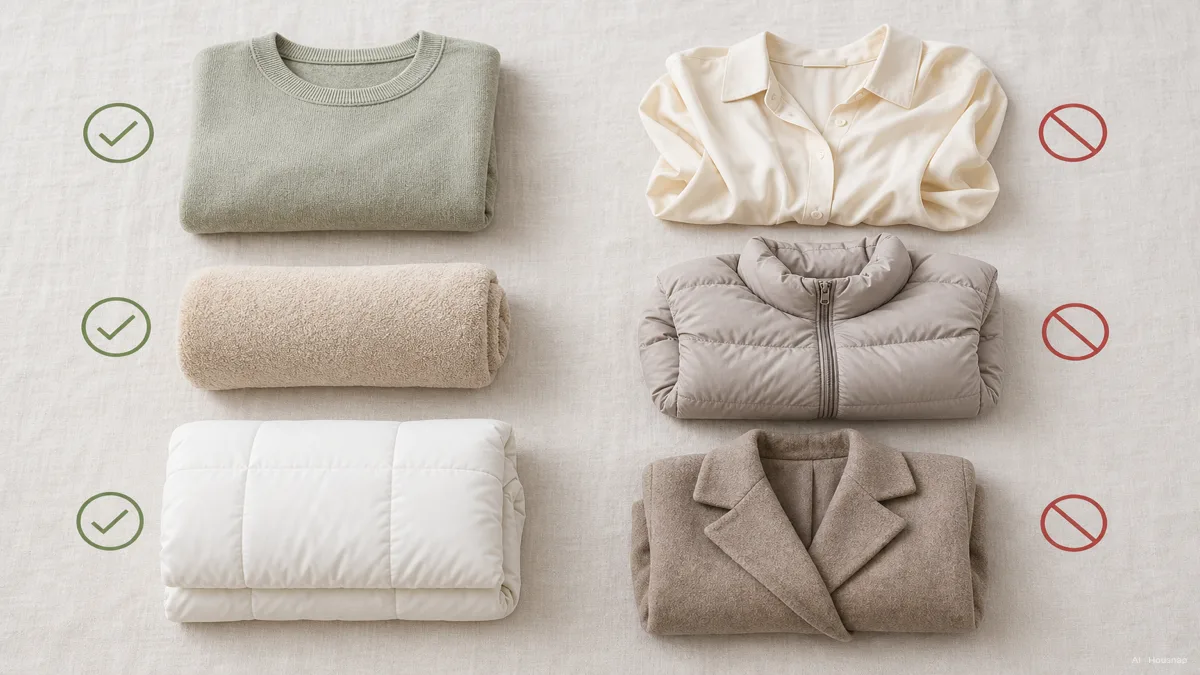
Treat the illustration as a sorting reminder, not permission to compress every item on the left or proof that every item on the right will be damaged. Check the garment or bedding instructions first. For items you set aside, continue with down-jacket care and storage or cashmere washing and storage.
Measure the contents and the place they will go
“Large” is not a standard measurement. Neusu calls 80 × 60 cm Large; Vacbird’s chart calls 60 × 80 cm Extra Large. Compare centimetres, not size names. Neusu sizing, Vacbird sizing.
- Measure the pile. Fold the items you intend to store together, then note their width, length, and thickness.
- Measure the destination. Check the shelf or drawer opening and usable depth, including the clearance under a bed.
- Choose the pack. A single-size pack makes sense for similar loads. Choose mixed sizes only when you have different loads to fill them.
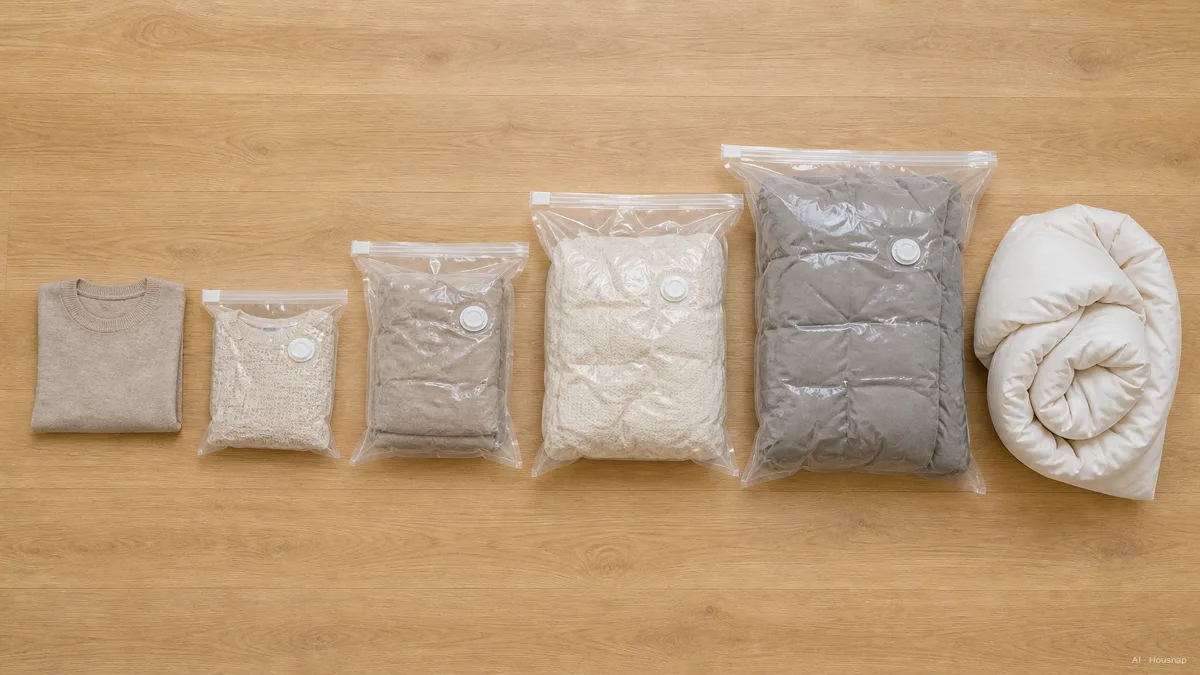
The illustration shows relative sizes, not universal capacities. Leave the clearance required by the bag’s instructions: Neusu specifies a couple of centimetres below the zip, rather than a universal percentage-fill rule. Packing instructions.
Choose how you will remove the air
- Home storage with suitable equipment. Choose valve bags compatible with your vacuum cleaner or pump.
- No vacuum cleaner available. Look for a set with a matching hand pump. Do not assume a separately bought pump will fit every valve; Neusu explicitly notes that compatibility varies. Bag types and pump fit.
- Travel without equipment. Choose bags specifically designed to roll air out. Packmate’s travel bags use an outlet in the end seam. Travel-bag explanation.
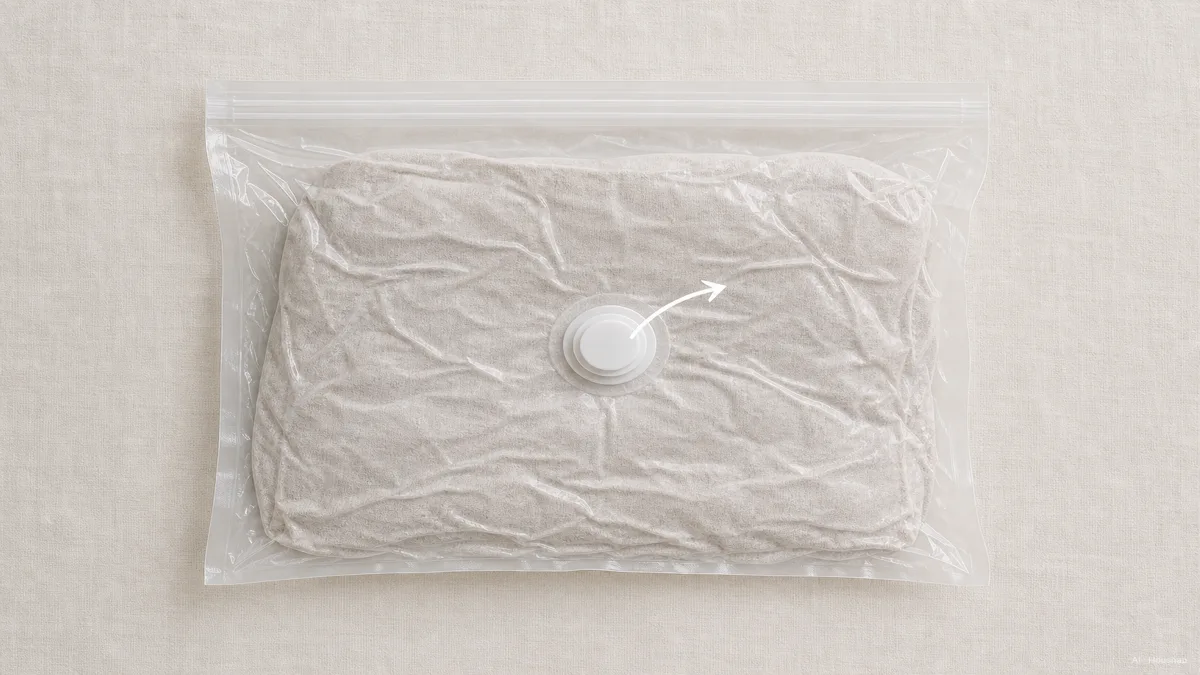
For powered extraction, follow both sets of instructions. Do not keep the cleaner running against an emptied bag: Neusu warns about motor overheating when airflow is blocked. Vacuum-cleaner guidance.
Buy a manageable set, then check the first packed bag
Before paying, confirm the actual dimensions, quantity of each size, extraction method, and closure instructions. Look for a clearly described zip and valve rather than treating “heavy duty” as a complete specification. Packmate describes multilayer material and a double-seal zip, but that does not establish a universal minimum thickness. Construction details.
Start with enough bags for your identified loads. A bigger bundle is only useful if its sizes suit what you own.
- Prepare. Pack only clean, completely dry items. Neusu preparation guidance.
- Close. Check the full zip, including both ends. A cap can be part of a self-sealing valve’s design; needing to replace it does not mean the valve is faulty. Closure design.
- Observe. Leave the first packed bag accessible before putting it away. If it expands, check the zip and valve. Packmate’s first-use check.
If resealing does not resolve the problem, contact the seller rather than buying a stronger pump. Neusu identifies incomplete zip closure as a common cause of rapid reinflation. Troubleshooting.
Sources
Hoe deze gids is opgebouwd
This guide was written by AI for Chexlow using manufacturer guidance from Neusu, Packmate, and Vacbird. It focuses on choosing a first set by contents, dimensions, and extraction method; the buying judgments are editorial recommendations, not product-test results.
Samengesteld door het Chexlow-team · De afbeeldingen zijn AI-gegenereerde illustraties