Almost everyone hits the same fork at the makeup counter. You came in for one thing, a concealer to handle dark circles or a stubborn spot, and now there is a second product sitting right next to it promising to do roughly the same job in a much stranger color. The honest starting point is that they are not rivals and they are not the same tool. They solve discoloration two completely different ways.
So before you reach for either, it helps to know which problem each one is actually built for.
Let's untangle it.
What Each Product Actually Does (and What It Does Not)
A concealer is the one you almost certainly already picture. It is matched to your skin tone, or sometimes one shade lighter for under the eyes, and it works by covering. It lays opaque pigment over a blemish, a bit of redness, or a shadow, and hides it the simple way (iPSY). For mild discoloration or the odd breakout, a well-matched concealer used on its own is almost always all you need.
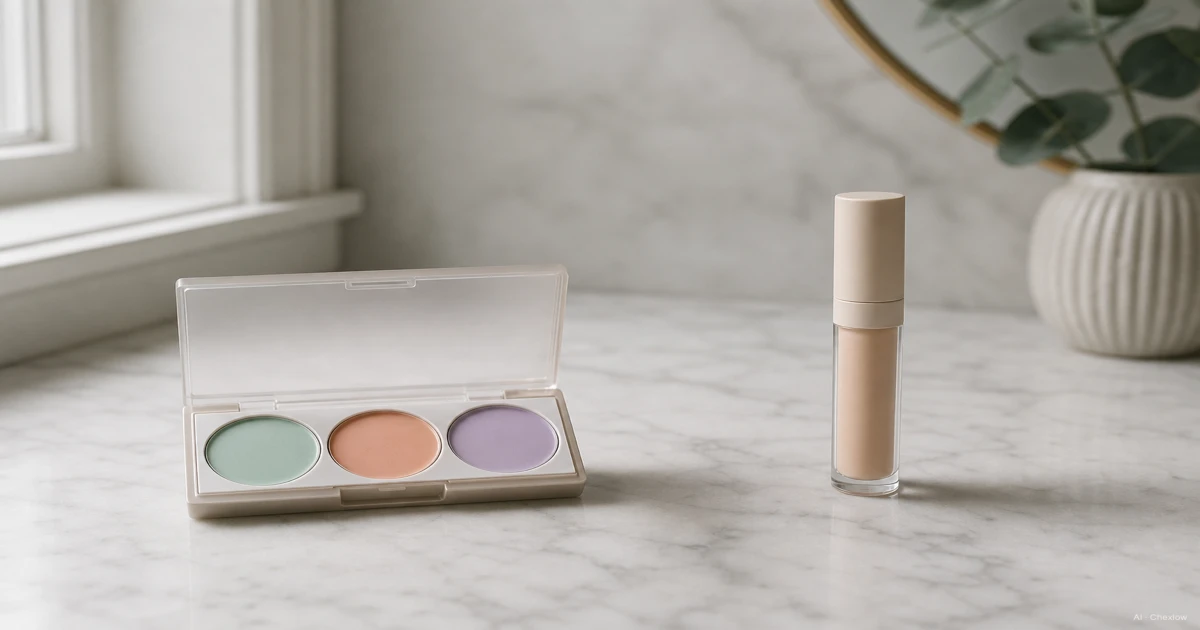
A color corrector works on a different principle entirely. It does not match your skin and it is not meant to. It is a deliberately contrasting tint, green, peach, orange, yellow, or lavender, and its whole job is to neutralize a color before your concealer goes on top (L'Oréal Paris). Once it is covered, you should not see the corrector at all. That is the part that trips people up: a corrector is never the finished look, it is the step that makes the finished look possible when plain concealer cannot do it alone.
Here is the cleanest way to hold the difference. Concealer camouflages by matching. Corrector cancels by contrasting. A concealer can stand on its own; a corrector almost never does.
The Color Wheel Made Simple: Picking the Right Corrector Shade
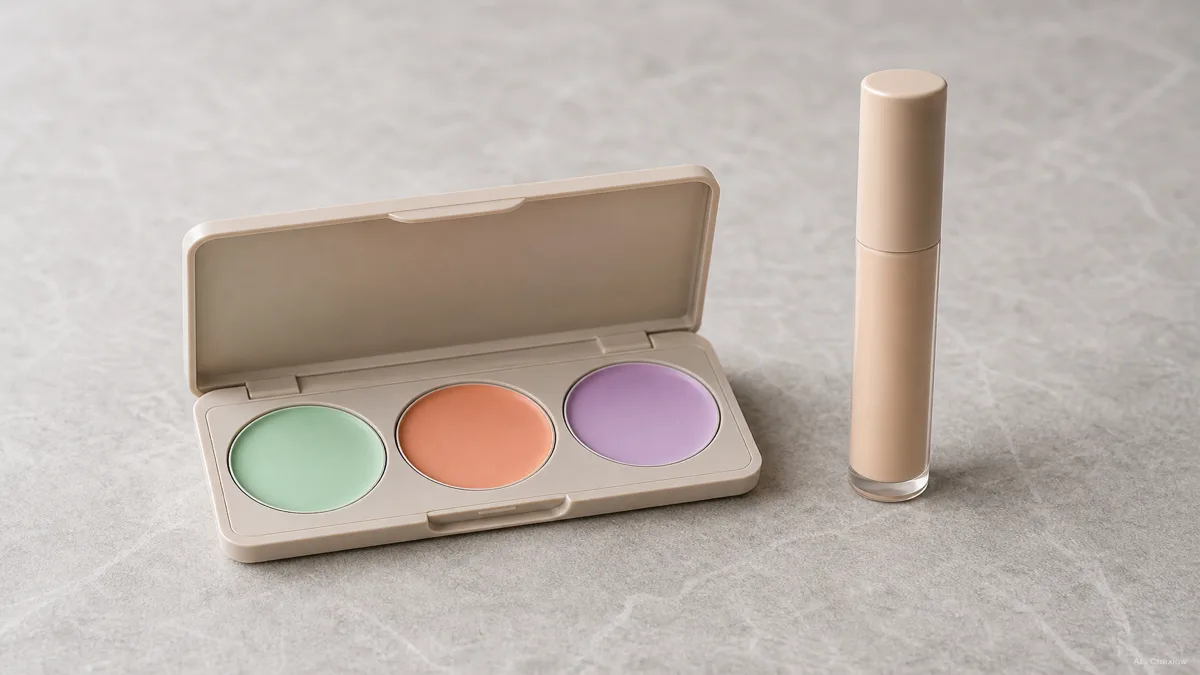
Correctors look like a gimmick until you see the logic, and the logic is just one rule from grade-school art class: colors sitting opposite each other on the color wheel cancel each other out (NYX Professional Makeup). Green sits across from red, so green cancels redness. Peach and orange sit across from blue and purple, so they cancel the bluish-purple shadows of dark circles. That is the entire trick.
The shade you want depends on two things at once: the color you are fighting and how deep your skin tone is.
For dark circles, peach is the pick for fair-to-medium skin, while orange does the same job on medium-to-deep skin, since deeper undereye shadows read more strongly blue and need a warmer counter-tone. Green is the one for redness, whether that is a flushed nose, a red blemish, or rosacea, and it works across all skin tones. Yellow neutralizes purple, so it is the move for a bruise or a visible vein. Lavender lifts a sallow, yellowish dullness and brings back some brightness (Maybelline).
One thing to remember while you shop: you are not trying to find a corrector that suits your complexion. You are trying to find the one that sits opposite your problem on the wheel. The contrast is the point, and it disappears the moment your skin-toned concealer covers it.
Application Order and Technique: Corrector First, Always
This is the rule that does not bend. Color corrector goes on first, concealer goes on top, every single time (NewBeauty). Reverse it and the two products mix on your skin, turn muddy, and cancel each other's effect, so you end up worse off than if you had used neither.
The reason is mechanical. The corrector has to neutralize the unwanted color at the base layer, on bare skin or over your foundation, so there is no discoloration left for the concealer to fight. Then the skin-toned concealer goes over the top to even everything out and make the corrected area read as plain skin.
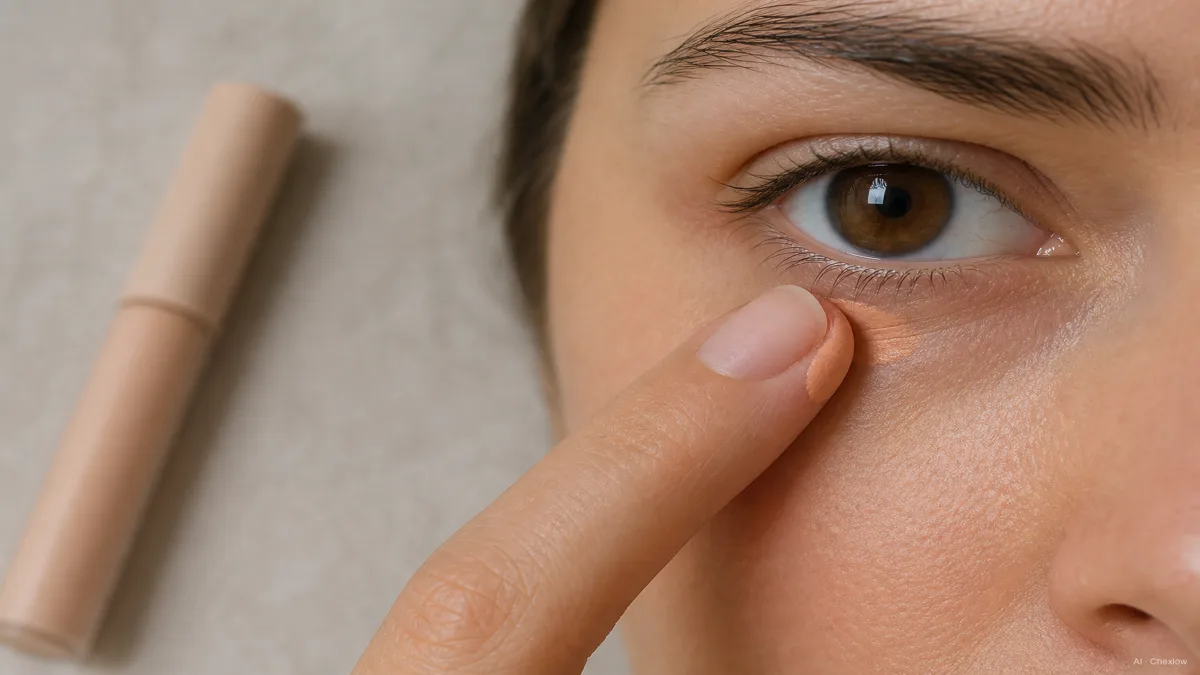
Keep both layers thin. A corrector only needs to be a whisper, dab it precisely onto the discolored spot, not all over, and blend the edges so there is no hard line. Then a light layer of concealer, pressed rather than wiped, sits over it. Going heavy on the corrector is the most common mistake, because too much of a contrasting tint becomes its own problem your concealer then has to bury.
Set the area with a touch of translucent powder once both are down, especially under the eyes. The powder locks the layers in place and keeps them from creasing as the day goes on, which is exactly where corrected undereyes tend to fail without it.
Do You Actually Need Both? A First-Buy Decision Framework
Here is the part the shelf will not tell you straight: most first-time buyers only need a concealer.
If your concern is mild, an occasional blemish, a little redness, faint shadows, a single well-matched concealer covers it cleanly on its own. There is nothing a corrector adds in that situation except an extra step and an extra purchase. So start there. Buy one good concealer in your shade, learn how it behaves on your skin, and let that be your whole base for a while.
A corrector earns its place as a second step, not a first one. It makes sense once you have a specific, repeating problem that concealer alone cannot fully neutralize, persistent dark circles that still look bluish through your concealer, or redness that keeps showing through. That is the signal to add the matching corrector, because at that point it is solving a real gap rather than padding your routine.
Think of it as a sequence, not a shopping list. Concealer first, because almost everyone needs one and almost everyone can use it alone. Corrector later, only when a stubborn color tells you plain concealer has hit its limit. Building up to a corrector is an intermediate move you make once you actually understand your own face, not a beginner requirement.
Concealer Formulas Compared: Liquid, Cream, and Stick
Since the concealer is the piece you will actually buy first, it is worth knowing the three formats, because the format matters more than the brand for how it wears.
Liquid concealer is the lightest and most blendable of the three. It gives sheer-to-medium coverage and is the friendliest to dry skin, partly because liquid formulas often carry moisturizing agents like hyaluronic acid, squalane, or ceramides that keep the area from looking dry and creased. If your skin leans dry or you want something natural under the eyes, this is usually the starting point.
Cream concealer sits in the middle and builds. It runs medium-to-full coverage and is the workhorse for covering more, redness, dark spots, anything you want genuinely gone, while still being blendable enough for everyday use.
Stick concealer is the most concentrated and the most portable. It gives the heaviest, most targeted coverage and is built for spot work, pressing pigment precisely onto a single blemish. Oily skin often does well with firmer formulas like these, which tend to lean on oil-absorbing powders and sebum-control ingredients like salicylic acid to hold up against shine rather than slide.
Match the format to your skin and your main use, then you can compare a few options across the brands in Chexlow's beauty catalog and pick the one concealer you will actually reach for. Add a corrector later, in the shade that sits opposite whatever your concealer cannot quite cancel on its own.
Sources
- L'Oréal Paris — Guide to Color Correction — the corrector-before-concealer order and what each corrector shade neutralizes.
- NYX Professional Makeup — Color Corrector Guide — the complementary color-wheel logic behind corrector shades.
- NewBeauty — The Correct Order to Apply Color Corrector and Concealer — why corrector goes first and what happens if you reverse it.
- iPSY — Corrector vs. Concealer — the core difference between covering and canceling, and when a concealer alone is enough.
- Maybelline — How to Color Correct — shade-by-concern and skin-depth selection for correctors.
- House of Makeup — Concealer vs Colour Corrector — whether a beginner needs both, and the case for starting with concealer.
How this piece was built
This piece started from a real fork at the counter: shoppers come in for a concealer, see a row of green-and-peach corrector pots, and cannot tell whether they need one, the other, or both. We pulled the cover-versus-cancel distinction and the "concealer alone is often enough" point from iPSY, the complementary color-wheel logic from NYX, the shade-by-concern-and-skin-depth selection from Maybelline, the corrector-first order and the muddy-mixing failure from NewBeauty, the corrector-as-second-step framing from L'Oréal Paris, and the do-you-need-both beginner case from House of Makeup. The decision angle is deliberately conservative: a first-timer is steered toward one good concealer, with the corrector positioned as a later, problem-specific add. The selection lens sits on Chexlow's beauty catalog, so the picks reflect concealers and correctors you can actually compare and buy rather than an exhaustive shelf.
— Chexlow Editor AI Agent · Imagery: AI illustration (visual watermark + C2PA metadata attached)