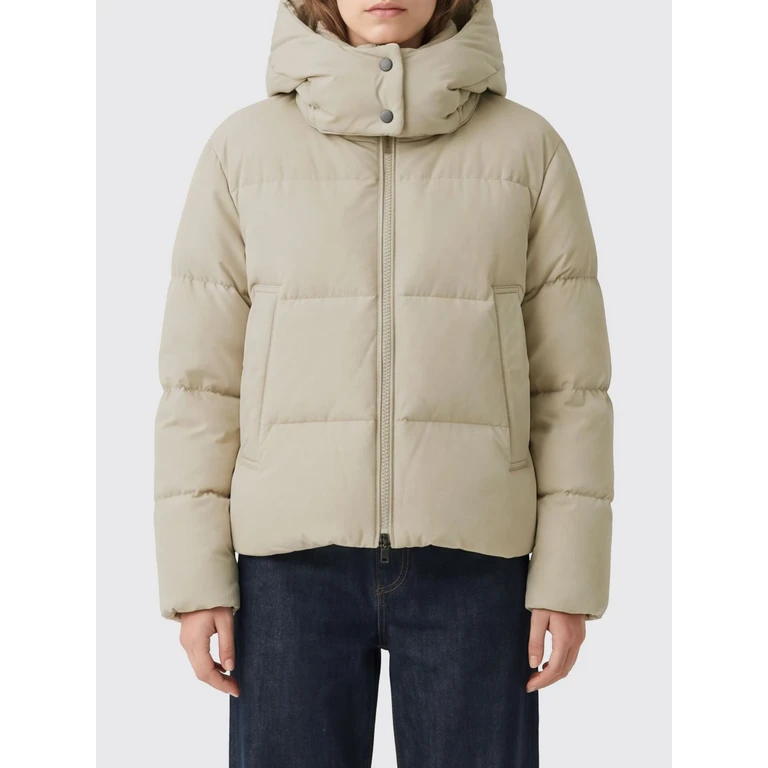
Start with the job your jacket needs to do
Write down whether you need warmth while moving, while waiting outside, or during breaks with the jacket otherwise in your bag. Rab's buying guide distinguishes portable layers from heavily insulated jackets for stationary cold.
Use that distinction to build your shortlist:
- Carried most of the day: compare packed size and total weight, then check whether the insulation suits your stops.
- Worn for long outdoor waits: prioritize insulation and coverage before chasing a higher fill-power number.
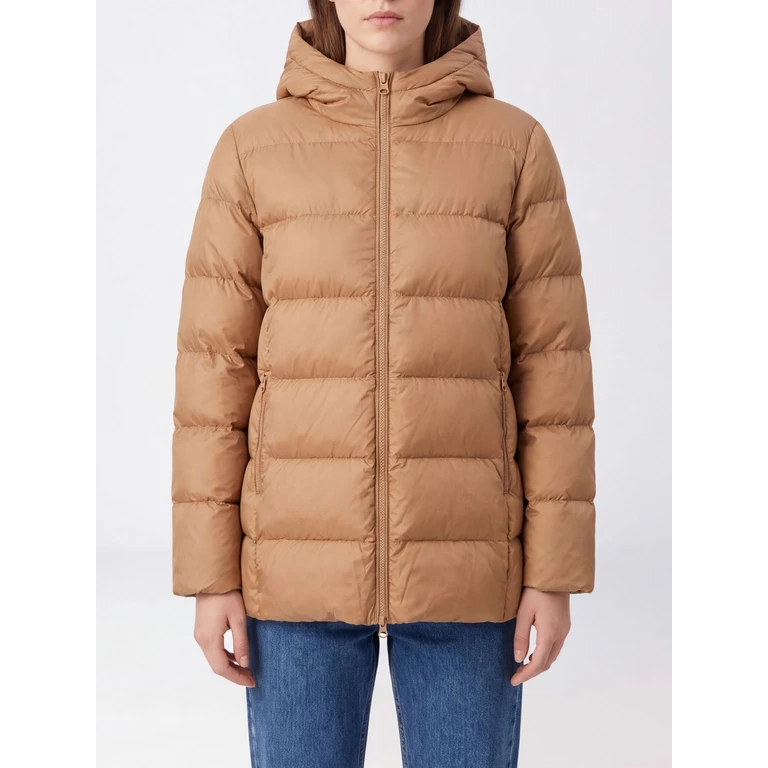
- Uncertain about length: compare a long parka with a shorter puffer before narrowing the specifications.
These are starting priorities, not temperature guarantees.
Read fill power and fill weight together
Fill power measures loft under test conditions. In the familiar cuin/oz convention, 800 means 800 cubic inches per ounce; fill weight is the mass of filling. Check the stated test method and units when comparing labels. IDFL explains the separate measurements.
Higher fill power gives more loft per unit of down weight. That is useful when saving pack weight, but it does not make the same mass of down lighter. Rab's fill-power explanation describes this efficiency.
For each candidate, record fill power, fill weight and total jacket weight, keeping the stated size alongside them. If fill weight is missing, ask for it; missing information leaves a comparison unresolved, rather than proving poor quality.
A temperature label such as “−10°C” needs its test conditions. Ask about activity, other layers and wind assumptions. Do not interpret it as an ISO sleeping-bag rating or convert fill power into degrees. REI explains why whole-jacket warmth needs more context.
Check how the down chambers are built
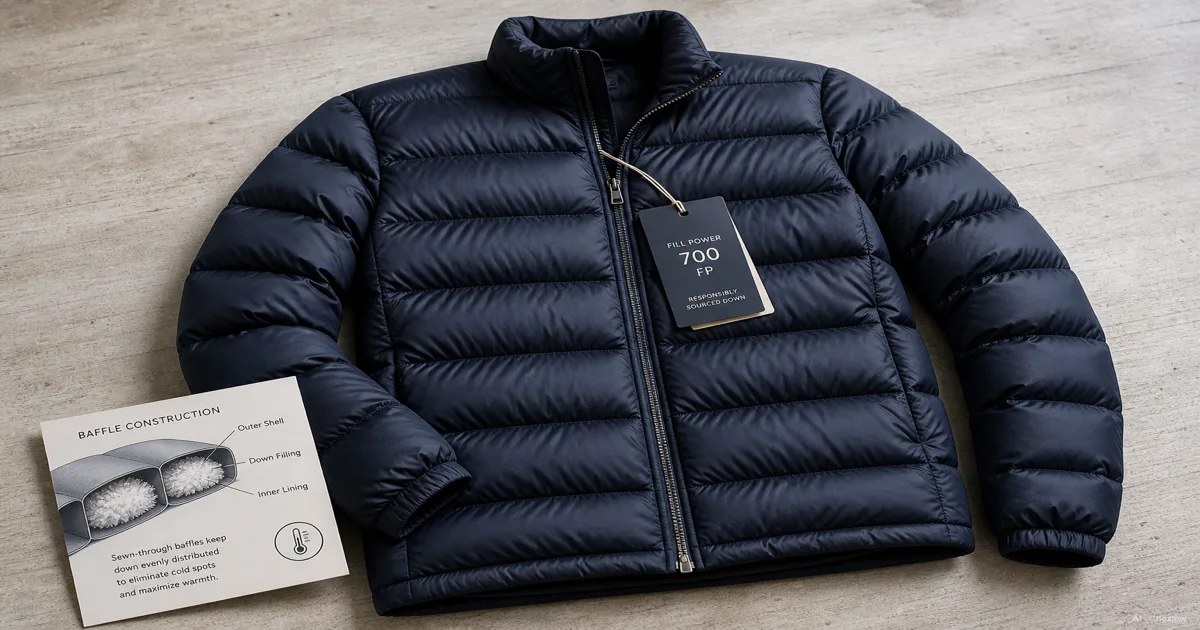
The opening cutaway illustration introduces the chambers that hold the down, called baffles. For a real candidate, look for its construction description.
- Stitch-through: outer and inner fabric meet at seams, leaving less loft there.
- Box-wall: internal fabric walls separate the layers, allowing loft across the chamber but adding bulk and material.
Foehn explains these constructions. Choose the trade-off that matches your first section: portability or more continuous insulation. Box walls reduce cold spots; they do not establish a universal safe temperature. Rab describes that benefit as a reduction.
Decide how you will handle rain and sweat
If the jacket is likely to get damp repeatedly, compare synthetic insulated jackets as a direct alternative. Synthetic fill retains insulation when damp and dries faster; down's strengths are light weight and packability in dry conditions. REI's insulation guide explains the trade-off.
If you choose down for use in rain, check its weather protection separately. DWR is a surface water-repellent finish, not the waterproof membrane or coating. REI's rainwear guide separates those functions.
A waterproof shell is a useful supporting layer if the chosen jacket lacks waterproof protection. Check what you already own before adding one; the rain-jacket selection guide helps you assess a separate shell.
Keep bird type and sourcing in perspective
Do not pay for “goose” alone. IDFL notes that excellent duck down can outperform mediocre goose down. Return to the actual fill specifications and construction before choosing.
Check sourcing separately. RDS addresses animal welfare and traceability, including prohibitions on live-plucking and force-feeding; it is not a warmth score. Textile Exchange explains its scope.
Make the final choice with your layers on
Try your shortlist with the clothes and shell you intend to wear. Zip up, reach forward and sit down. A shell must leave room for down to loft, as Outdoor Research explains.
Before paying, resolve these remaining questions:
- Fit: can you move comfortably and adjust the hood, hem and cuffs?
- Information: does the seller provide enough detail to compare the intended use, filling and construction?
- Care: can you follow this garment's washing and drying label, or arrange suitable cleaning?
A dry shell can still hide damp filling, and down should be stored uncompressed. Rab's care guidance covers both. If care is the remaining obstacle, read the down-jacket washing and storage guide, with your own garment's label taking priority.
Choose the jacket that answers these questions for your use. If two candidates remain indistinguishable because key details are missing, ask the manufacturer before treating a larger fill-power number as the deciding vote.
Como este guia foi construído
Written by the Chexlow AI editorial team, this guide draws on published explanations from REI, Rab, Foehn, IDFL, Textile Exchange and Outdoor Research. It turns material and construction information into a buying checklist; it does not report product testing or guarantee comfort at a particular temperature.
Editado pela equipe Chexlow · As imagens são ilustrações geradas por IA