Waterproof vs water-resistant vs water-repellent: what the labels actually mean
These three terms are not interchangeable, but they are often treated as if they are — sometimes intentionally.
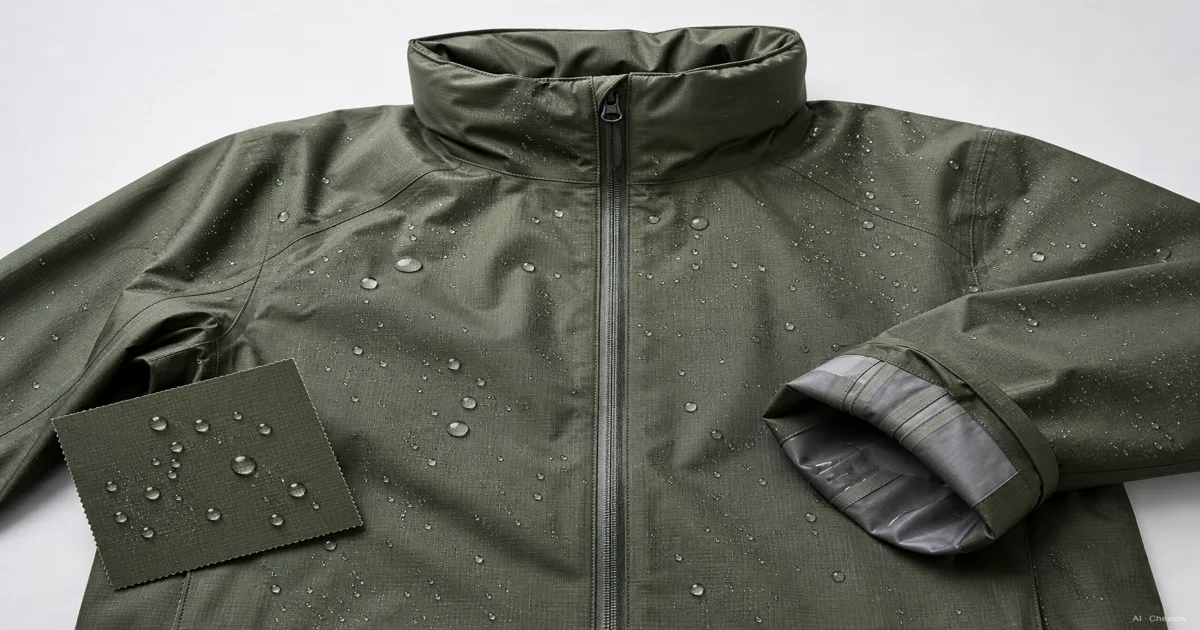
"Water-repellent" is the weakest claim. It usually means the outer fabric has a DWR (durable water repellent) finish that causes light rain to bead and roll off. It is not a membrane. It provides no protection in sustained rain. Most casual windbreakers and "shower-proof" jackets fit this description. The DWR coating also degrades with use and washing, which is why a jacket that shed water when new starts soaking through after a season or two.
"Water-resistant" is a step up, but still short of waterproof. It typically means the fabric can handle light rain for a short duration. Many soft-shell jackets fall here. The seams are not sealed, which is where water infiltration happens first.
"Waterproof" means the jacket has a waterproof-breathable membrane (Gore-Tex, eVent, Pertex Shield, or a proprietary equivalent) laminated to the outer fabric, and the seams are taped. Without both — the membrane and the seam taping — it is not truly waterproof. If a brand claims waterproof without specifying a mm rating and seam construction, that claim is worth nothing as a buying signal.
Waterproof ratings: what the mm number actually measures
The mm rating, or hydrostatic head, is the standard measure of how much water pressure a fabric can withstand before it leaks. The test places a column of water over a sealed patch of fabric and measures how high that column can grow before water penetrates. A fabric rated to 10,000mm can withstand a column of water 10 meters high.
In practice, what those numbers mean for real weather:
- 1,500mm: light drizzle only. Not adequate for actual rain.
- 5,000mm: light to moderate rain. Acceptable for casual urban use in unpredictable weather.
- 10,000mm: moderate to heavy rain, sustained exposure. A solid baseline for city commuting, day hiking, and travel. REI's threshold for "rainproof" is around 2,100mm, so 10,000mm is genuinely well above the protection floor.
- 20,000mm+: heavy rain, sustained alpine or trail use, wet-on-wet conditions. Necessary for hiking in the Scottish Highlands or spending extended time in the Pacific Northwest.
One nuance worth understanding: hydrostatic head measures static water pressure, not dynamic impact. In real rain, additional forces apply — movement, sitting on wet ground, a loaded pack pressing fabric against your back. The practical waterproofing threshold in real conditions is lower than the lab rating. This is why a 10,000mm jacket is a sound choice for city rain, but for mountain hiking in bad weather you want the headroom that 20,000mm+ provides.
Breathability: why it matters and what the numbers mean
A jacket that keeps rain out but traps all sweat inside can still leave you soaked — from the inside. This is where breathability matters, and it is measured as MVTR (Moisture Vapour Transmission Rate), expressed in grams of moisture that can pass through one square meter of fabric per 24 hours.
Higher MVTR means more moisture vapor escapes from inside the jacket. What the numbers mean in practice, via Appalachian Outfitters' breakdown of rain gear breathability:
- Below 5,000 g/m²/24h: low breathability. You will feel clammy in anything more than a slow walk. Acceptable only for standing in the rain, not moving in it.
- 5,000–10,000 g/m²/24h: moderate breathability. Fine for light urban activity — commuting, errands, low-effort movement.
- 10,000–15,000 g/m²/24h: good breathability. Comfortable for hiking, cycling, moderate activity.
- 20,000+ g/m²/24h: high breathability. Designed for high-output use — trail running, ski touring, fast hiking. At this level, the jacket keeps up with heavy sweating.
For most city dwellers buying their first rain jacket: 10,000 g/m²/24h is comfortable for daily use. If you plan to hike or run in your rain jacket, aim for 15,000–20,000 g/m²/24h.
One thing to know: waterproofness and breathability are in tension. Higher waterproof ratings often come with stiffer, denser membranes that reduce breathability. This is why ultra-waterproof expedition jackets are often described as "clammy" unless the membrane technology is premium. Gore-Tex Pro and eVent are engineered specifically to maintain high breathability at high waterproof ratings. Budget membranes often sacrifice one for the other.
Seam taping: what makes a jacket truly waterproof
Even a fabric rated to 20,000mm waterproof will leak through the needle holes left by stitching. Every seam in a jacket is a row of tiny punctures. Seam taping seals those punctures with a strip of waterproof tape bonded over the stitching from the inside.
There are three levels, and REI's guide to rainwear explains them clearly:
Fully taped (fully seam-sealed): every seam in the jacket is taped, including underarm seams, side seams, pocket seams, and zipper edges. This is true waterproof. If a brand says "fully seam-sealed," that is what it means.
Critically taped: only the high-stress seams at the shoulders and outer arms are taped. Interior seams, underarm seams, and pocket seams are not. This works well for moderate rain in situations where those untaped seams are less exposed. Lighter and cheaper than full taping, but not fully waterproof.
No taping: the fabric may have a waterproof rating, but the jacket as a whole is not waterproof. Water will come through the seams in sustained rain.
The practical rule: if you want a jacket that works in actual rain, look for "fully taped seams" or "fully seam-sealed" in the spec sheet. Critically taped is a reasonable compromise for light rain at a lower price. No taping means it is water-resistant, not waterproof — regardless of what the fabric rating says.
Layer construction: 2-layer, 2.5-layer, and 3-layer
The layer count refers to how the waterproof membrane is bonded into the jacket, and it affects weight, packability, and feel against the skin. Switchback Travel's breakdown of rain jacket construction covers this well.
2-layer: the waterproof membrane is bonded to the outer face fabric, and a separate lining hangs inside. The lining protects the membrane and adds comfort, but it also adds weight and bulk. 2-layer jackets are typically the most affordable and are comfortable for casual use. They tend to be heavier and less packable than 2.5- or 3-layer versions.
2.5-layer: the membrane is bonded to the inner face of the outer fabric, and a thin printed or textured pattern replaces the full hanging lining. That "half layer" protects the membrane without the weight of a true lining. 2.5-layer jackets are lighter and pack smaller than 2-layer versions. The trade-off is that they can feel less comfortable against bare skin, and the interior can feel slightly damp during high-activity use because moisture vapor has less surface area to dissipate.
3-layer: the outer fabric, the membrane, and an inner fabric are all bonded together as a single composite. There is no separate lining and no gap between layers. 3-layer jackets are the most durable, the most packable, and typically the most breathable for their waterproof rating. They are also the most expensive. A quality 3-layer jacket in hard use lasts years longer than a 2-layer equivalent.
For city use and casual travel: a 2.5-layer jacket with fully taped seams and a 10,000mm rating is a strong, practical choice. For extended hiking or mountain use: 3-layer construction at 20,000mm+ is worth the premium.
Hoods, packability, and features that matter
A few details on the jacket itself worth checking before you buy.
Hood: a good rain jacket hood should cinch tight enough to stay on in wind, have a stiffened brim to direct water away from your face, and be adjustable at the back of the head and around the face. Helmet-compatible hoods are larger and designed to fit over a climbing or ski helmet — if you do not need that, they are often too large and let rain in at the gap. Rollable or stuffable hoods are a convenience feature but do not change waterproofing.
Packability: a jacket that compresses into its own chest pocket is useful for travel and commuting. Packable jackets typically use lighter fabrics (10D–20D nylon) and 2.5-layer construction. The trade-off is durability — a 10D packable jacket abrades faster than a 30D hardshell. If the jacket will mostly live in a bag and come out in rain, packability is worth it. If you are wearing it in rough terrain, durability matters more.
Pit zips: underarm zippers that ventilate without removing the jacket. Useful for high-output activity. Not necessary for casual city use. They add cost and a small amount of weight.
Cuffs and hem: adjustable velcro or snap cuffs seal out wind and rain better than elasticated cuffs. A drawcord hem lets you seal the jacket around your waist. Both matter more for outdoor use than for walking between office and train.
Layering with a down jacket: how the system works
In cold, wet weather, a rain jacket and a down jacket together create a more versatile system than either alone. The order matters.
The principle is: insulation in the middle, waterproofing on the outside. Down jacket goes on first, over a base layer. Rain jacket goes over the down jacket. The rain jacket's job is to keep rain off the down, because wet down loses its insulating properties dramatically. The down's job is to keep you warm while the rain jacket handles moisture.
This is why the order cannot be reversed. A down jacket worn over a rain jacket traps moisture between layers, gets wet from the inside, and provides no protection to the down from external rain.
For a true three-layer system: base layer (moisture-wicking) + mid layer (down or synthetic, optional in milder conditions) + outer shell (rain jacket). In city use, the base-plus-rain-jacket combination is often enough above freezing. In sustained cold rain below 5°C, the mid layer becomes important.
One note on down under rain: most down jackets have DWR-treated shells that shed light rain for a short time, but they are not waterproof and will eventually wet through. Once the down itself gets wet, warmth drops fast and drying takes a long time. This is exactly why the rain jacket goes over, not under.
Choosing for your climate and use
A few decision points that simplify the choice.
If you commute in a city with regular rain — UK, Pacific Northwest, Southeast Asia monsoon season — fully taped seams and 10,000mm waterproofing cover your needs. A 2.5-layer jacket at this spec is lighter and easier to carry. If the jacket doubles as a travel layer, packability into its own pocket is a practical feature.
If you hike or spend extended time in the mountains — Appalachians, Alps, Scottish Highlands, Cascades — 20,000mm waterproofing and 3-layer construction are the right starting point. Breathability matters more here because you are moving hard. Aim for 15,000–20,000 g/m²/24h MVTR.
If you see mostly light rain and occasional heavier showers and want one affordable jacket for everything: a 10,000mm fully taped jacket in 2-layer or 2.5-layer construction covers most realistic scenarios. Avoid jackets that advertise waterproofing without specifying the mm rating or seam construction — that is where the gap between label and reality is largest.
Sources
- Hydrostatic Head Explained: Measuring Waterproofness — Section Hiker, clear breakdown of the hydrostatic head test, what different mm ratings mean in practice.
- How Rain Gear Works — REI Expert Advice, seam taping types, waterproof ratings, and jacket construction categories.
- Rain Jacket Construction: 2L vs 2.5L vs 3L — Switchback Travel, detailed comparison of layer construction trade-offs for weight, durability, and packability.
- Rain Gear 101: Waterproof Ratings, Breathability (MVTR), and DWR Care — Appalachian Outfitters, MVTR rating tiers and the waterproof-breathability trade-off explained.
- Rain Jacket Layers Explained: 2 vs 2.5 vs 3 Layer — Kathmandu, concise overview of how each layer construction affects performance and comfort.