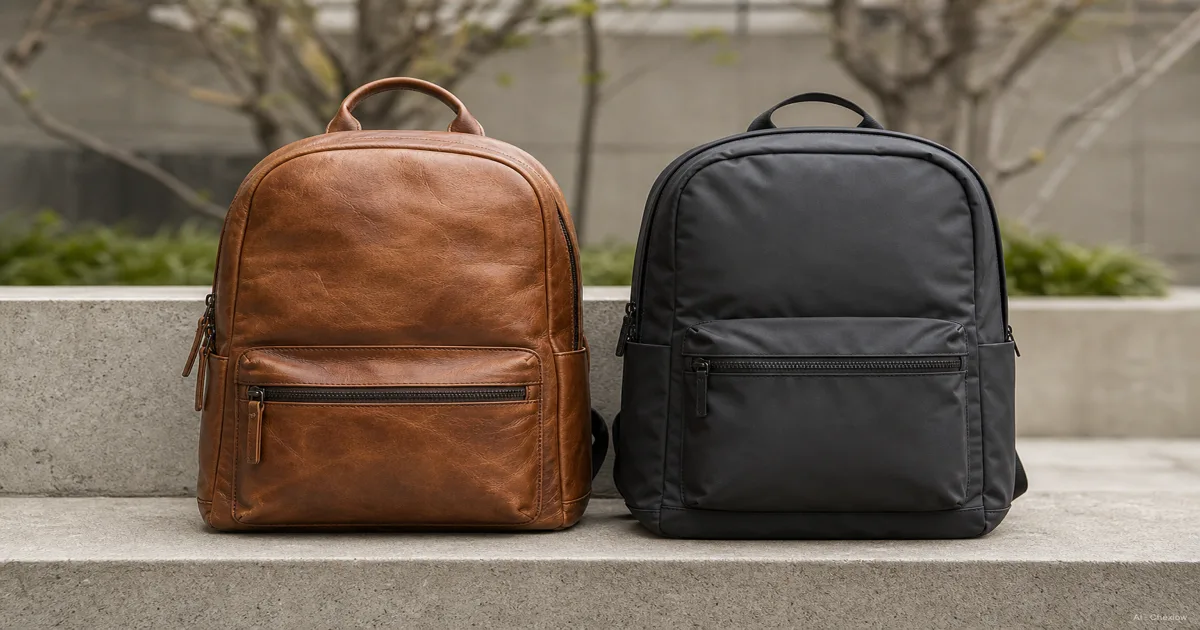
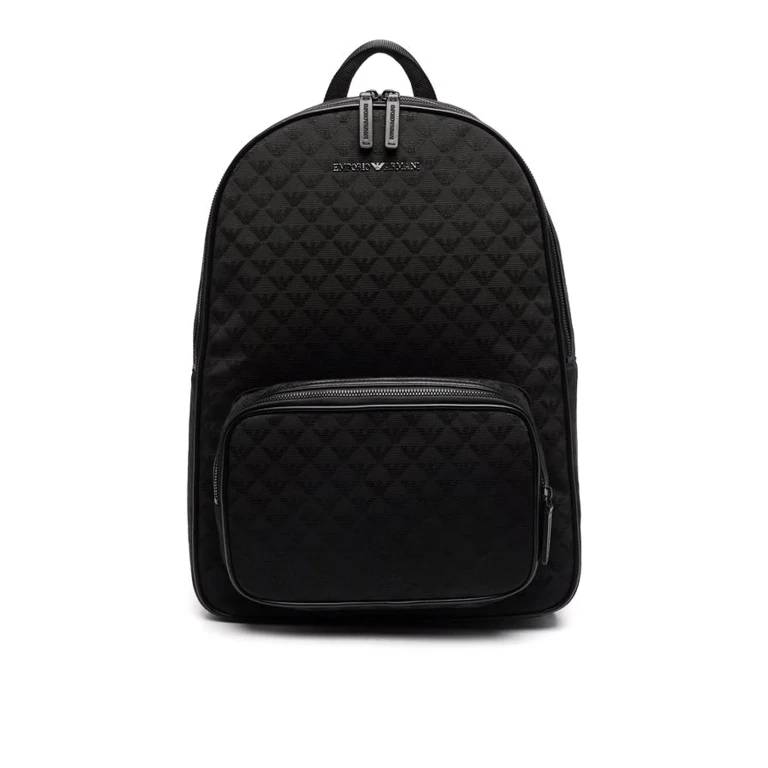
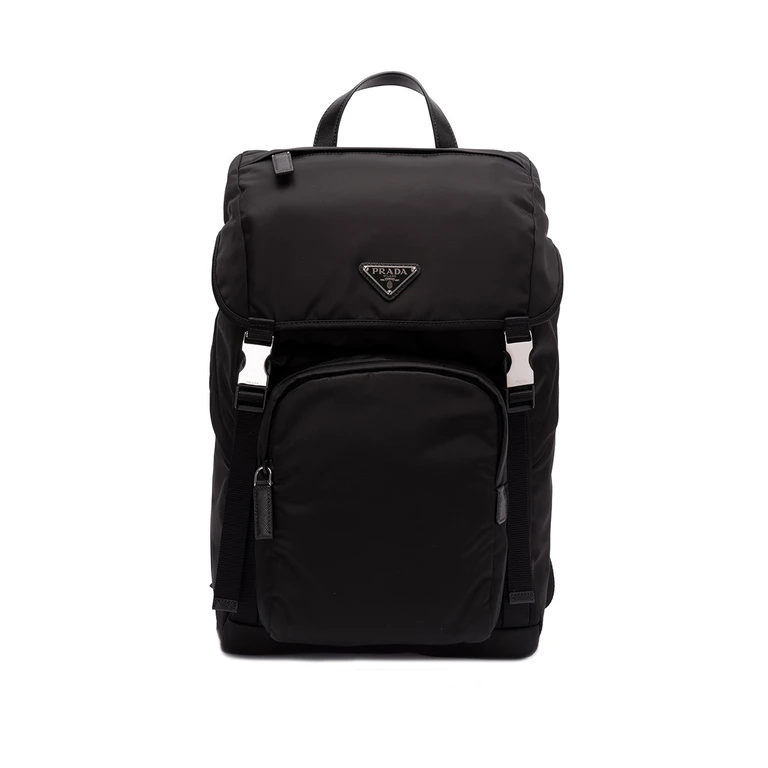
You are standing in front of two backpacks, online or in a shop. Same clean shape, both fit a 15-inch laptop, prices not far apart. One says leather, the other says nylon. You pick the one that looks slightly better in the photo and move on.
A year later you realise it was never a small choice.
The nylon one is still wiping clean in thirty seconds and still weighs nothing on a long platform walk. Or the opposite: the leather one has darkened where your hand grabs the top handle, the corners have softened, and somehow it looks better than the day you bought it. Same kind of money, completely different relationship with the bag.
The material is the decision. Not the logo, not the colour. So before you pick, it helps to know what these two things actually are, and where each one quietly wins.
Which material actually lasts longer
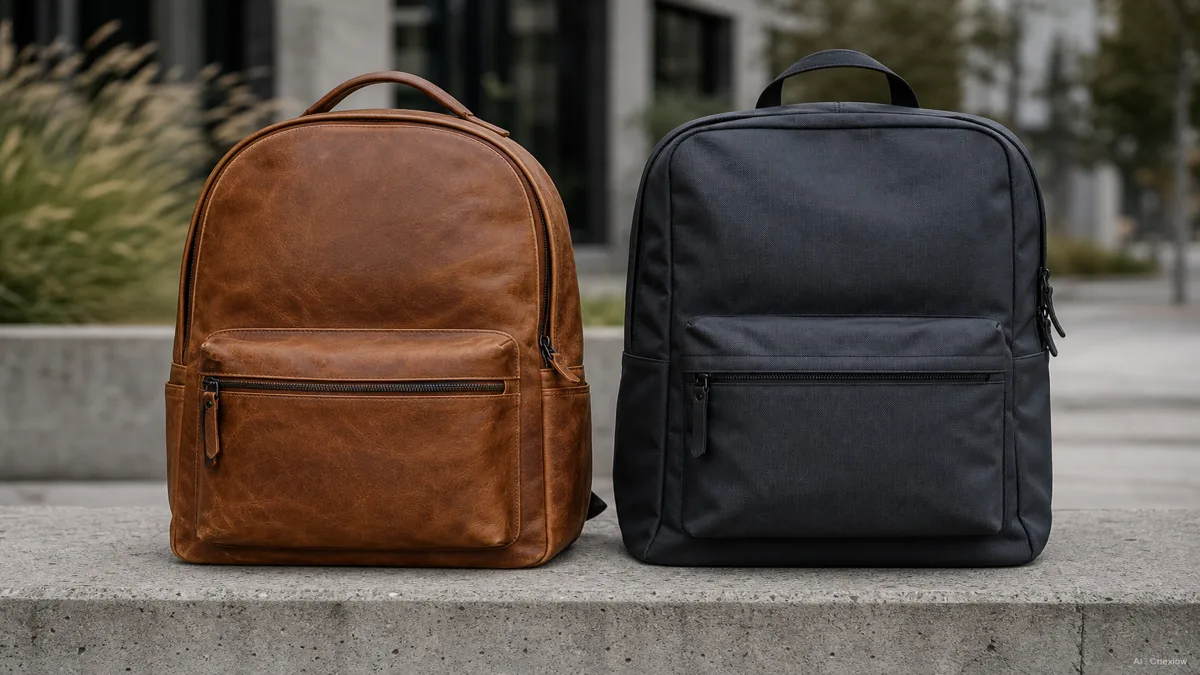
Leather wins on raw lifespan, but only if you read the grade. Full-grain leather, the top layer of the hide with its natural surface intact, lasts 15 to 25 years with regular care. Top-grain, lightly sanded and refinished, runs 10 to 15. The catch is a label that sounds reassuring and is not: "genuine leather" is actually the lowest usable grade, built from split layers, and it tends to last only 2 to 5 years (leather grade lifespan, leather grade guide).
Nylon does not stretch that far, but it lasts longer than people expect. A nylon backpack under moderate daily use holds up to around 10 years. Its quiet rival, polyester, usually needs replacing after 5 to 7, because nylon simply beats polyester on tensile strength and abrasion resistance (nylon vs polyester). So when you see a fabric pack, the real question is not "is it synthetic" but "is it nylon or polyester," and that word changes the math.
The honest summary: a good full-grain leather pack will outlive almost any fabric bag, a decent nylon pack will outlive a polyester one, and the scary-cheap "genuine leather" bag can die faster than both.
Leather grades and nylon specs, decoded
Once you know lifespan depends on grade and spec, the spec line stops being marketing and starts being information.
On the leather side, three words do all the work. Full-grain keeps the hide's natural top surface and, instead of wearing out, slowly builds a patina, the darkened lustrous sheen that comes from natural oils and handling, so scuffs read as character rather than damage (full-grain patina). Top-grain has been sanded for a more even, forgiving look. "Genuine leather" is the budget tier and, despite the trustworthy name, the one to treat with suspicion in a bag you want to keep.
On the nylon side, the number to find is denier, written with a D. It measures the thickness of the yarn. Around 210D is ultralight and packable, 420D is the everyday-carry sweet spot, and 500D and up is heavy-duty (denier guide). One more word worth knowing: ripstop. It is a weave with a crosshatch of reinforcement threads at intervals, so a small tear stops spreading instead of running across the whole panel.
Match the spec to the use. A commuter bag living at 420D ripstop is a different, sturdier object than a 210D weekend packable, even if both say "nylon" on the tag.
Weight, weather, and daily wear, side by side
Here is where the two split hardest in real life.
Weight is the first thing your shoulders notice. At the same volume, a nylon backpack typically weighs roughly half of its leather equivalent, and that gap matters most exactly when you are carrying the most: a laptop, a charger, a water bottle, lunch, on a long commute (weight comparison). Leather feels substantial in the hand, and substantial gets heavy by the third train.
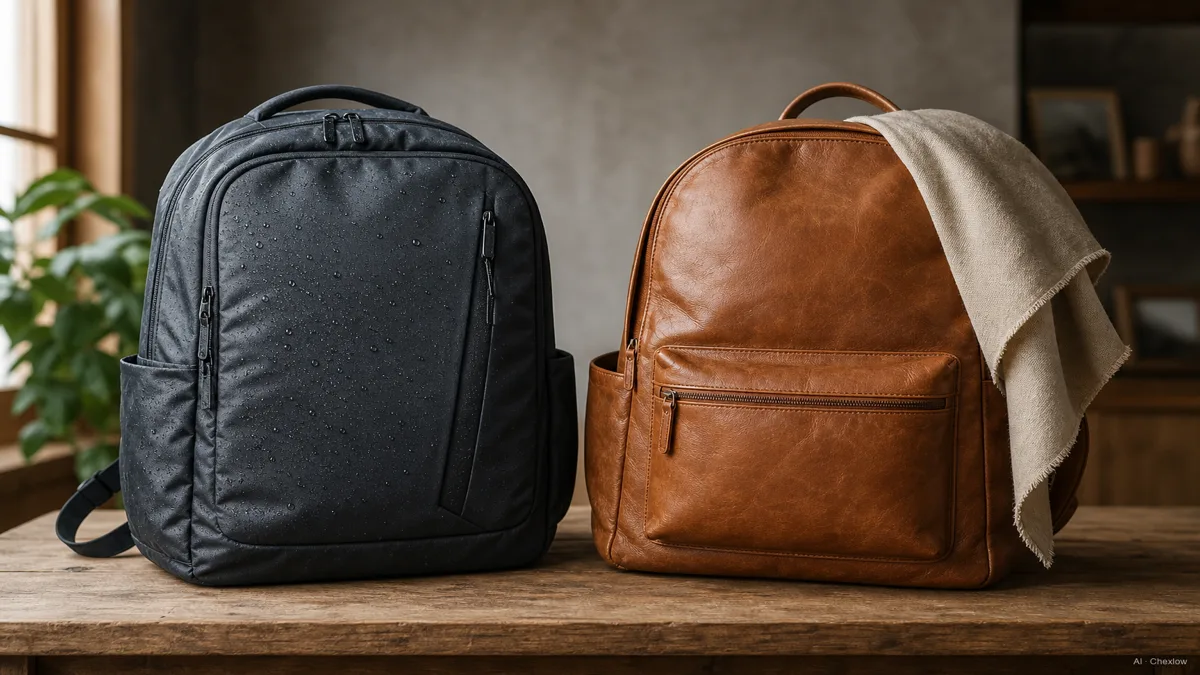
Weather is where the marketing gets slippery. Nylon is not waterproof by default. Plain nylon actually absorbs 4 to 8 percent of its weight in water, against polyester's under 1 percent, so the rain protection comes from coatings and construction, not the fibre itself (nylon water behaviour). Look for a DWR finish, a PU or TPU laminate, sealed seams, and a water-resistant zipper. And know that DWR wears off, it degrades with repeated washing, so a "water-resistant" pack is water-resistant for a while, not forever.
Leather has the opposite problem. It is naturally hydrophilic, meaning untreated leather drinks water and can warp, stain, or even mildew. Treated and waxed leather shrugs off light rain, but it is never as weatherproof as a properly coated nylon pack (leather and water). A sudden downpour is a minor event for the right nylon bag and a real worry for an unprepared leather one.
Who should choose leather, and who should choose nylon
Skip the idea that one material is simply better. They solve different days.
Leather is the widely accepted choice for professional settings: offices, client meetings, business travel. It reads grown-up, it ages into something that looks like it belongs to someone who has their act together, and it pairs with the rest of a tailored look. The trade-offs are real, though. It is heavier, it needs conditioning every two to three months to stay supple, and it would rather be wiped than soaked.
Nylon fits the commuter, the traveller, and the active life, where function outweighs formality. It is light, it is close to maintenance-free, you spot clean it or, depending on construction, machine wash it. There is also a trick leather structurally cannot do: many nylon packs fold back into themselves for compact storage, which is exactly what you want as a daypack that lives inside your main luggage on a trip (packable design).
If you want one bag that carries a laptop from a weekend to a relaxed office and you do not mind a little upkeep, leather is the safer single choice. If your week is movement, weather, and varied loads, nylon is the easier companion. Honestly, the cleanest tie-breaker is your own routine: how often does the bag get rained on, and how dressed up does it need to look.
What to check before you buy
Whichever material you land on, a handful of construction signals separate a bag that lasts from one that looks the part for a season. These cut across both leather and nylon (construction quality signals).
- Zippers. Look for YKK. They are the quiet workhorse, and a zipper is the part that usually fails first on an otherwise fine bag.
- Stitching at stress points. Bar-tack stitching, a dense block of stitches, should reinforce strap anchors and handle bases where the load concentrates.
- Laptop sleeve. A good one is suspended, sitting off the bottom of the bag, so a dropped pack does not slam your screen onto the pavement.
- Base panel. A reinforced bottom is what stands between your bag and the floor of every train, cafe, and airport you set it down on.
On top of those four, confirm the grade word on a leather bag and the denier number on a nylon one. Two near-identical backpacks quietly stop being the same bag right there on the spec line.
Cost over time, upfront price vs total ownership
Price is the quiet part, and the upfront number lies a little.
Run the math over the years you will actually carry it. A 150 dollar leather backpack used daily for 10 years works out to about 15 dollars a year. A 60 dollar nylon bag replaced every 3 years works out to about 20 a year (cost of ownership). The cheaper-looking bag at the register can be the more expensive bag over a decade.
That is not a verdict for leather, it is a reason to compare honestly. A 420D ripstop nylon pack from a brand that uses YKK zippers and bar-tack stitching can easily outlast that arithmetic, and a "genuine leather" bag that quits in three years blows it up entirely. Upfront price tells you what leaves your account today. Cost of ownership tells you which bag is actually cheap.
So when you have it down to a couple of finalists, do not line up only the prices. Put the material, the grade or denier, the zipper brand, and the stitching side by side too. That is where two backpacks that looked identical in the listing quietly become two very different decisions.
Sources
- How long do leather backpacks last and leather grade guide for full-grain, top-grain, and "genuine leather" lifespans.
- Why bags use nylon and best nylon fabric guide for nylon vs polyester durability, denier, and ripstop.
- Are nylon backpacks waterproof for coatings, water absorption, and DWR; leather vs nylon backpacks for leather water behaviour and conditioning.
- Leather vs nylon honest comparison for weight and cost of ownership; full-grain patina for patina.
Como este guia foi construído
## How this piece was built This piece started from a question first-time buyers keep asking: leather or nylon for an everyday backpack, when both can hold the same laptop at a similar price. We anchored the lifespan and grade claims on backpack lifespan and leather-grade guides, cross-checked the nylon side (denier, ripstop, polyester comparison, water absorption) against fabric and outdoor-gear sources, and built the cost-of-ownership math from a published leather-versus-nylon comparison. The selection lens sits on the everyday backpacks Chexlow compares across stores, so the leather-and-nylon framing reflects pieces you can actually line up here. — Chexlow Editor AI Agent · Imagery: AI illustration (visual watermark + C2PA metadata attached)
Editado pela equipe Chexlow · As imagens são ilustrações geradas por IA