

Decide what the overshirt needs to add
Start with the shirt you would otherwise wear open over a T-shirt. What is missing: room for a knit, a more substantial fabric, or somewhere useful to put your hands and phone? Make that missing feature a condition of the purchase.
An overshirt is a candidate for that job, not a guarantee. Reiss’s shirt guide pairs overshirts with jumpers and formal shirts, but also describes casual shirts as layering pieces. It even includes lightweight wool among its overshirt fabrics. “Regular shirt for indoors, overshirt for outdoors” is too rigid a distinction.
- Keep using a regular shirt if you want an open layer over a T-shirt and its fit, hem and pockets already suit you.
- Shortlist an overshirt if you can identify an improvement you will use, then check that the actual garment provides it.
For a light layer, look for a clear description of fabric, lining and any insulation. Do not buy the heaviest-looking option simply because you want something more substantial than your shirt.
Fasten it over the clothes you will wear
Try the candidate with your intended underlayer, including a knit if that is the reason for buying it. Close the front as you would outdoors, reach forward, then sit down. These are practical fitting checks, not a standardised fit test.
If the front pulls or the upper arms feel restricted, compare another cut or size. If the sleeves and hem are already too long, automatically sizing up is unlikely to resolve the whole fit problem. Check whether a different length is offered: ASKET’s overshirt range describes three lengths for its cotton and wool versions. That is a specific option to investigate, not a promise about other brands.
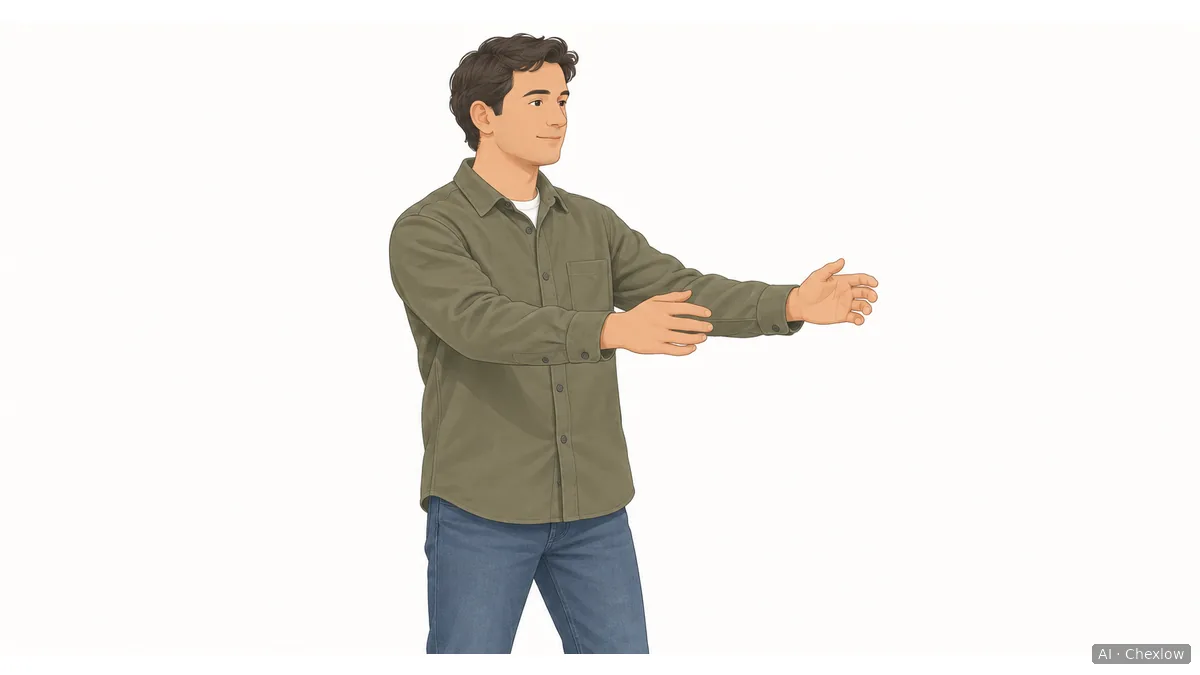
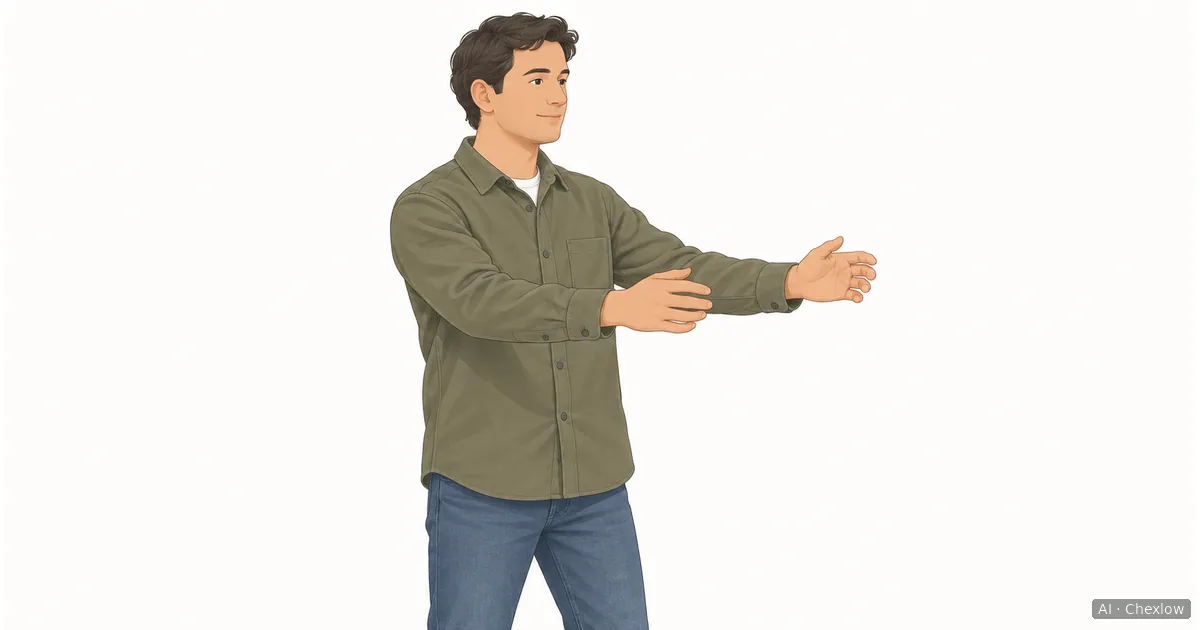
Use the illustration as a reminder to move with the front closed. It does not prove that a particular size has enough room; notice where your own garment pulls and how it feels.
Work the actual buttons, snaps or zip yourself. Can you comfortably fasten it over the layer underneath and reopen it when you go indoors? A garment that only works open may still suit you, but choose that limitation deliberately.
Make the pockets earn their place
Pocket count is less useful than pocket access. ASKET describes patch pockets on its overshirts: these are pockets attached to the outside of the garment. Their presence alone does not tell you whether your phone fits or whether a pocket closes.
Before paying, try the pocket you intend to use:
- Put your phone inside without forcing it, and check whether the opening closes if there is a fastening.
- Sit down and reach for it. Decide whether the pocket position still works for you.
- Look at the front with the pocket loaded. If you dislike the way it hangs, do not count that pocket as useful storage.
For online shopping, request pocket dimensions or a clear inside-and-outside view when storage is a deciding factor. A large pocket in a styled photograph is not enough evidence. If you will carry everything in your bag anyway, extra pockets need not justify the overshirt purchase.
Separate a light layer from rain protection
Compare construction before assuming how much warmth you are buying. ASKET specifies 308gsm two-ply organic cotton twill for its cotton Overshirt, while Patagonia’s Light Gust Shirt Jacket is explicitly insulated. These are examples of different constructions, not a temperature scale or a rule for the whole category.
Patagonia also describes a durable water repellent, or DWR, finish on the Light Gust’s body fabric and lining. DWR makes surface water bead; it is not, by itself, proof of a waterproof garment. REI’s rainwear guide distinguishes short light-rain resistance from sustained-rain protection and warns that seam tape only at the hood and shoulders does not establish full waterproofness.
If staying dry on a wet commute is the main reason for buying, continue with how to choose a rain jacket.
Otherwise, buy the overshirt when it adds the room or pocket function you identified, works both open and fastened as intended, and has a construction suited to your use. If it adds nothing you will use, keep the regular shirt.
Como este guia foi construído
This article was written by AI for Chexlow, using official ASKET, Reiss and Patagonia descriptions and REI’s rainwear guidance. It separates documented product examples from practical buying checks; the garments were not independently worn or tested.
Editado pela equipe Chexlow · As imagens são ilustrações geradas por IA