Decide which clothes can share the wash
Start with the clothes, before choosing a bag. A machine-washable delicate garment is a candidate for separation; a hand-wash-only or dry-clean-only item needs its specified treatment, not simply another layer of mesh.
Miele’s care-label guide explains that the number inside the wash tub is the maximum temperature and a single bar underneath calls for reduced agitation. It also excludes dry-clean-only garments from home washing. A bag does not replace those instructions.
Make separate groups when the required washing methods differ. For example, do not put a cashmere sweater into a mixed load just because it fits inside a bag. If that is the garment you are deciding about, use the cashmere washing and drying guide first.
Match the bag to the garment and its fastenings
Brabantia describes its three-bag set as protective for delicates and supplies two sizes. That makes different sizes worth comparing, but does not establish a universal number of garments per bag.
Use these practical checks to narrow the choice:
- Small or thin pieces. Inspect the mesh openings and seams against the actual item. Reject a bag if parts of the garment can readily protrude through its openings.
- Shaped garments. Check usable depth as well as width. Do not choose a flat pouch solely because its advertised length looks sufficient for a bra.
- Closure. Look for a zipper that closes fully and a cover for its pull tab. Check that fabric is clear of the teeth before closing it.
The Brabantia Bra Wash Bag provides a concrete construction example: a covered zipper pull and listed dimensions of 16 cm high, 26 cm long and 19 cm wide. Those are product dimensions, not a promise that every cup shape fits or that every bra permits machine washing.
Keep using an intact bag that passes these checks. Buy another shape or size only when the existing one cannot accommodate the permitted wash.
Check usable room before adding another item
Lay out the intended contents, place them inside without packing them down, and compare the result with the bag maker’s loading instructions. Published dimensions help with shortlisting; they do not describe how much room remains around your particular clothes.
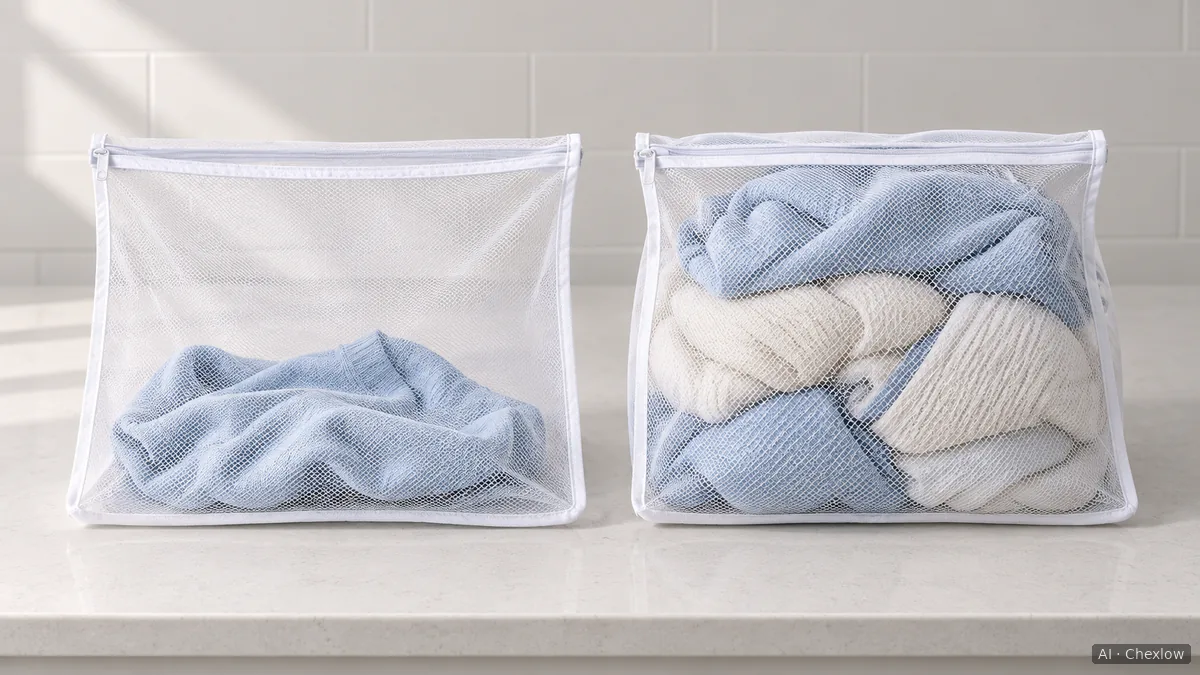
As a practical fit check, stop if you must push the contents down to close the zipper or if the bag is pulled taut around a compact bundle. Remove an item, split the contents between suitable bags, or try a larger bag. This is an editorial screening check, not a tested capacity rating.
The manufacturer pages cited here do not establish one loading fraction for all mesh bags. Do not turn “half full” into a universal rule. Follow an explicit limit supplied with your bag; when its guidance is unclear, ask about the intended garment and load rather than assuming that any zipped-up bundle is acceptable.
Keep washing and drying limits separate
Check both the garment and bag instructions before starting. Use a permitted programme and temperature, close the bag fully, and tuck the pull into its cover where provided. A bag also does not make otherwise unsuitable laundry compatible: GUPPYFRIEND advises separating hard and soft textiles.
Its Washing Bag instructions illustrate why product-specific limits matter. The listed 50 × 74 cm bag is intended for synthetic garments; the maker specifies a fully closed zipper, washing with other garments at no more than 40°C, removal of clothes while damp, and disposal of fibres collected from the hem in general waste. These instructions belong to that bag, not every mesh pouch, and ordinary mesh is not evidence of equivalent fibre filtration.
After washing, take the garments out and follow their drying labels. Miele’s guide explicitly identifies clothing that must not be tumble-dried. Permission to machine-wash does not settle the drying method, and a wash bag supplies no extra permission.
How this guide was built
Written by AI for Chexlow, using manufacturer care guidance and wash-bag documentation from Miele, Brabantia and GUPPYFRIEND. The fit checks are editorial guidance rather than original product testing; named dimensions and operating limits remain specific to the cited products.
Edited by the Chexlow team · Images are AI-generated illustrations