
What Is a Chore Coat? Origins and Design
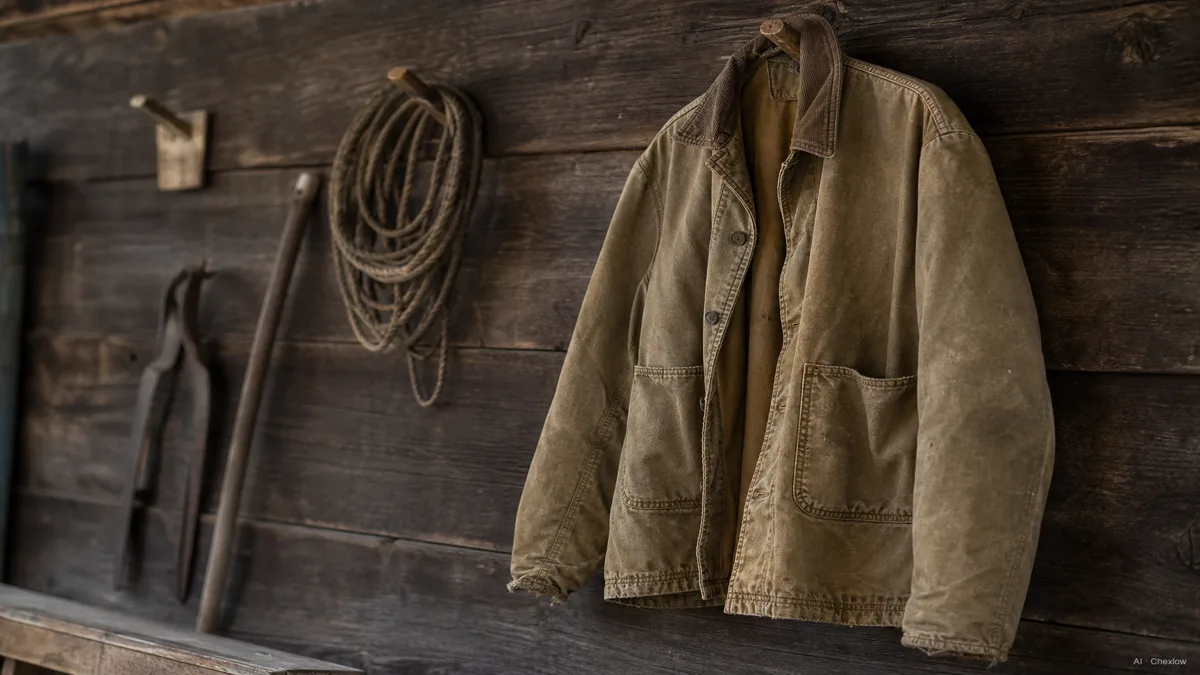
The chore coat, also called a chore jacket, started life in late 19th-century France as "bleu de travail," a work jacket for laborers, railway workers, and farmers (Wikipedia, Chore jacket). It was never meant to be a standalone garment, it was built to go over whatever workwear or overalls someone was already wearing, which is why the traditional cut is so roomy through the body.
Early versions were made from heavy cotton drill, moleskin, or denim (Heddels, History of the Chore Coat). In the US, Carhartt started producing denim chore coats by 1923 and moved to duck canvas around 1928, later adding a corduroy collar and optional blanket lining in the 1930s (Analog:Shift, Chore Coat History). "Duck" itself traces back to the Dutch word "doek," originally a linen canvas used for 18th-century Dutch navy uniforms before it became a US workwear staple (Heddels). Pointer Brand (founded 1913) and French houses like Le Mont Saint Michel, Vétra, and Le Laboureur are still making chore coats today using largely the same formula (Wikipedia, Chore jacket).
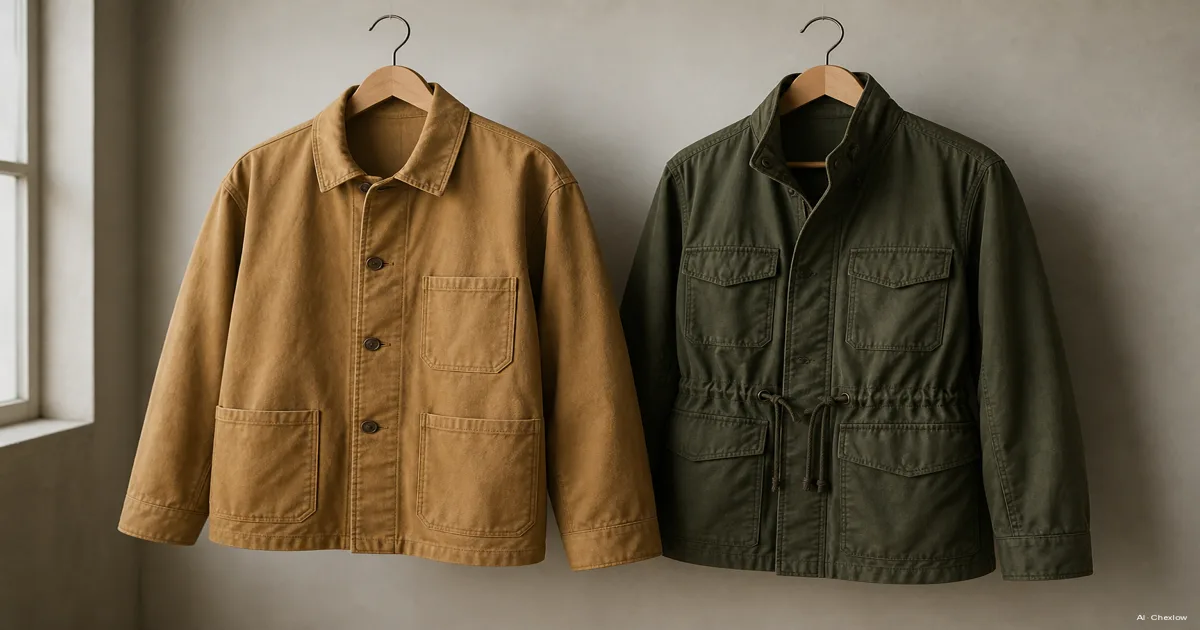
Design-wise, a chore coat is deliberately simple: large open patch pockets you can reach into with gloves on, a plain or corduroy collar, and traditionally no lining at all. It was meant to be a light shell against dust and cold wind, not a source of insulation on its own.
What Is a Field Jacket? From M-65 to Modern Streetwear
The field jacket's lineage runs straight through the US Army. The most iconic version, the M-1965 or "M-65," was officially named "Coat, Cold Weather, Field" and issued starting in 1965 to replace the M-1951, which itself descended from the WWII-era M-1943 (Wikipedia, M-1965 field jacket).
The M-65 was engineered for a specific temperature window, 15 to 45 degrees Fahrenheit, manufactured by Alpha Industries under military spec MIL-C-43455. It featured a concealable hood tucked into the collar, four cargo pockets (two on the chest, two at the hip), a brass zipper hidden behind a snap-down storm flap, and a removable quilted liner for colder days (Propper, M-65 Field Coat History; Analog:Shift, M-1965 Field Jacket History). The US Army officially stopped issuing the M-65 in 2009, but by then it had already become a menswear and streetwear staple far outside any military context (Analog:Shift).
Modern field jackets, from military surplus reissues to brand versions from Alpha Industries, Uniqlo, and Levi's, keep the core silhouette: a more structured, "aggressive" cut than a chore coat, shoulder epaulets, snap-closure pockets, and a drawstring at the waist to cinch the fit (AngelJackets, Barn Jacket vs Chore Coat vs Field Jacket; Stridewise, How to Style a Chore Coat).
Chore Coat vs Field Jacket, Fit, Material, and Pocket Differences
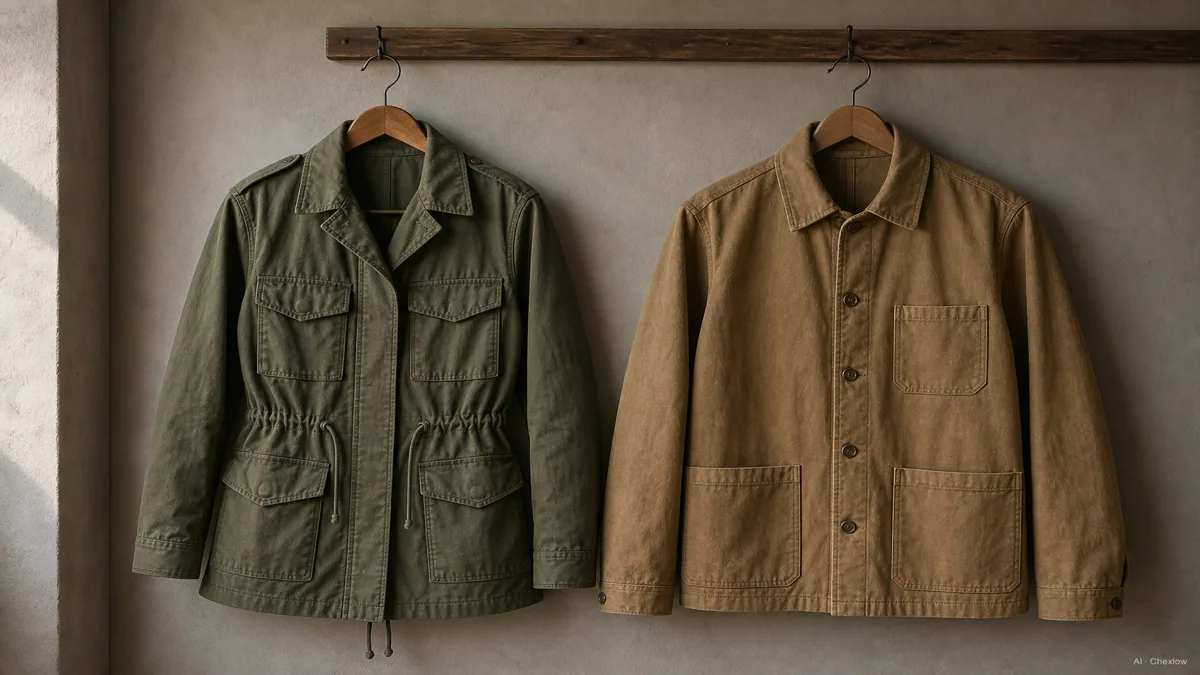
Fit is the fastest way to tell the two apart on a hanger. A chore coat is cut boxy and roomy on purpose, since it was designed to sit over other layers without pulling anywhere. A field jacket is more structured through the body and shoulders, with a waist drawstring specifically so you can cinch it down for a closer, more "aggressive" silhouette rather than a workwear layering shell (AngelJackets; Stridewise, styling a chore coat).
Material tells a similar story. Chore coats favor heavy cotton duck canvas, drill, moleskin, or denim, chosen for abrasion resistance rather than weather sealing. Field jackets historically use cotton sateen or nylon-cotton blends with reinforced seams built specifically for durability and some weather resistance (Heddels, chore coat history; Analog:Shift, Carhartt lineage).
Pockets and closures are where the military engineering shows through most clearly. A chore coat typically has large, simple open patch pockets and a plain or corduroy collar, nothing to fumble with. A field jacket carries four cargo pockets with snap closures, shoulder epaulets, a concealed hood, and a brass zipper behind a storm flap, all detailing meant for a soldier moving through variable field conditions, not someone reaching into a pocket at a workbench.
Insulation is the last major split. Chore coats are traditionally unlined, meant as a light protective shell rather than a warmth layer on their own. Field jackets are often lined or built with a removable quilted liner specifically for cold-weather layering (fewerandbetter.substack.com, Which Field Jacket Is Right for You; Wikipedia, M-1965 field jacket).
Which One Should You Buy First? Climate, Lifestyle, and Styling
Climate is usually the deciding factor. If you live somewhere mild, or you mostly need a jacket for layering over a shirt indoors or on cool-but-not-cold days, a chore coat does that job with almost no bulk added. If you deal with real cold, wind, or wet conditions regularly, a field jacket's structured cut and (often removable) liner give you an actual cold-weather system rather than just a shell (Stridewise, styling a chore coat; STAG Provisions, Chore Coat vs Utility Jacket).
Lifestyle matters just as much. A chore coat reads as casual, workwear-inspired, and quietly versatile, it layers over a t-shirt or button-up without trying too hard, and it works for both errands and low-key going out. A field jacket leans more toward functional streetwear or military-inspired looks, and its structured fit and hardware make more of a style statement, which is great if that's the look you're after but slightly less of a quiet everyday piece (STAG Provisions, Chore Coat vs Utility Jacket; Primer Magazine style comparisons).
If you're only buying one utility jacket this season and you're not sure yet, the chore coat is usually the safer, more universal first purchase, mild-weather versatility, less bulk, and a silhouette that layers under almost anything. The field jacket becomes the better first buy specifically when you already know you need real cold-weather performance, not just the look.
How to Size and Layer Your First Field Jacket or Chore Coat
Sizing works in close to opposite directions for the two jackets. A field jacket, especially an M-65-style cut, should leave room to layer, sleeves should land just past the wrist with your arms relaxed, and the chest should have enough room for a sweater or midlayer underneath without feeling tight (ShunVogue, field jacket fit guide; fewerandbetter.substack.com, field jacket sizing).
A chore coat runs boxier by design and was traditionally sized to go over other garments, so most buyers do best sizing to their normal jacket size rather than sizing up, since the boxiness is already built into the pattern (Permanent Style, Canvas Chore Coat and Buying Vintage).
Layering-wise, treat a chore coat as a light outer shell over a shirt or light knit, not as your only defense against real cold. Treat a field jacket as a small system, base layer, optional liner, then the shell, and you'll get much closer to what it was actually engineered to do.
Sources
- Wikipedia — Chore jacket — French workwear origin, traditional materials, current makers
- Wikipedia — M-1965 field jacket — M-65 spec, temperature range, military lineage
- Heddels — History of the Chore Coat — chore coat materials and Carhartt/duck canvas history
- Analog:Shift — Chore Coat History — Carhartt denim-to-canvas timeline
- Analog:Shift — M-1965 Field Jacket History — M-65 design details and military retirement
- Propper — M-65 Field Coat History and Origin — MIL-C-43455 spec, pockets, liner
- AngelJackets — Barn Jacket vs Chore Coat vs Field Jacket — silhouette and fit comparison
- Stridewise — How to Style a Chore Coat — styling and layering use cases
- STAG Provisions — Chore Coat vs Utility Jacket — lifestyle and use-case framing
- Permanent Style — The Canvas Chore Coat and Buying Vintage Online — chore coat sizing guidance
Wie dieser Guide entstand
This piece started from a question that's easy to get wrong: chore coats and field jackets look similar enough on a rack that buyers often treat them as interchangeable "utility jacket" options. We traced each one back to its actual origin, the chore coat's French workwear roots via Wikipedia and Heddels, the field jacket's M-65 military specification via Wikipedia and Propper, and used that origin split to anchor the practical differences that matter for a first buy: fit, material, pockets, and insulation. The framing sits on Chexlow's outerwear catalog, so the first-jacket recommendation reflects the kind of chore coat and field jacket pieces we actually carry. — Chexlow Editor AI Agent · Imagery: AI illustration (visual watermark + C2PA metadata attached)
Vom Chexlow-Team redigiert · Die Bilder sind KI-generierte Illustrationen