Find the instructions for this shell
Before adding more cleaner or a water-repellent treatment, identify the jacket and read its care label. Check the permitted wash method, cleaner and drying instructions together. If the label is missing or the instructions conflict, ask the garment maker before choosing a heat setting.
Gore’s outerwear instructions explicitly require following the garment manufacturer’s guidance too. Their ordinary wash-and-reactivate routine is not permission to treat every membrane shell identically.
One important exception is GORE-TEX with a persistent beading surface, such as SHAKEDRY. These garments have no textile outer layer and need no DWR treatment; Gore prohibits tumble drying, ironing and applying DWR to them. Identify this exception before using the steps below, which concern shells with a textile face fabric.
Resolve the wash and rinse before adding treatment
If the jacket has just been washed and you suspect detergent remains, check whether the required rinse was completed. For ordinary GORE-TEX outerwear, Gore specifies a small amount of liquid detergent, two rinses and minimal spinning. It excludes powder detergent, fabric softener, stain remover and bleach. These are Gore’s instructions, not a universal recipe for every technical jacket.
- Suspected residue after an otherwise permitted wash. Use the rinse procedure allowed for the garment and machine, without adding another dose of cleaner. A dark patch when water touches the outside is not enough to identify residue.
- A jacket that still needs cleaning. Choose a cleaner accepted by the garment maker and follow its dose for your load and water conditions. Do not borrow a dose from a different cleaner.
- An unsuitable additive was used. Tell the garment maker what went into the wash and ask for a recovery procedure. Do not assume repeated rinsing or a new coating will undo it.
A technical clothing cleaner can support the cleaning step if you do not already have a suitable product. Nikwax describes Tech Wash as a cleaner for outdoor clothing. A cleaner advertised to revive water repellency is still a different purchase from a product that applies new DWR; its description does not override your jacket’s instructions.
Check surface beading after permitted drying
DWR means durable water repellent: the treatment that helps water bead on the outside. It serves a different function from the waterproof membrane. REI explains that a saturated outer fabric can feel wet and clammy without proving membrane failure.
Complete the garment’s drying and any permitted reactivation first. Gore’s standard procedure includes another 20 minutes of tumble drying once the garment is dry, but that is only applicable where the garment instructions allow it. Do not transfer that setting to the special-care exception above or another shell with different instructions.
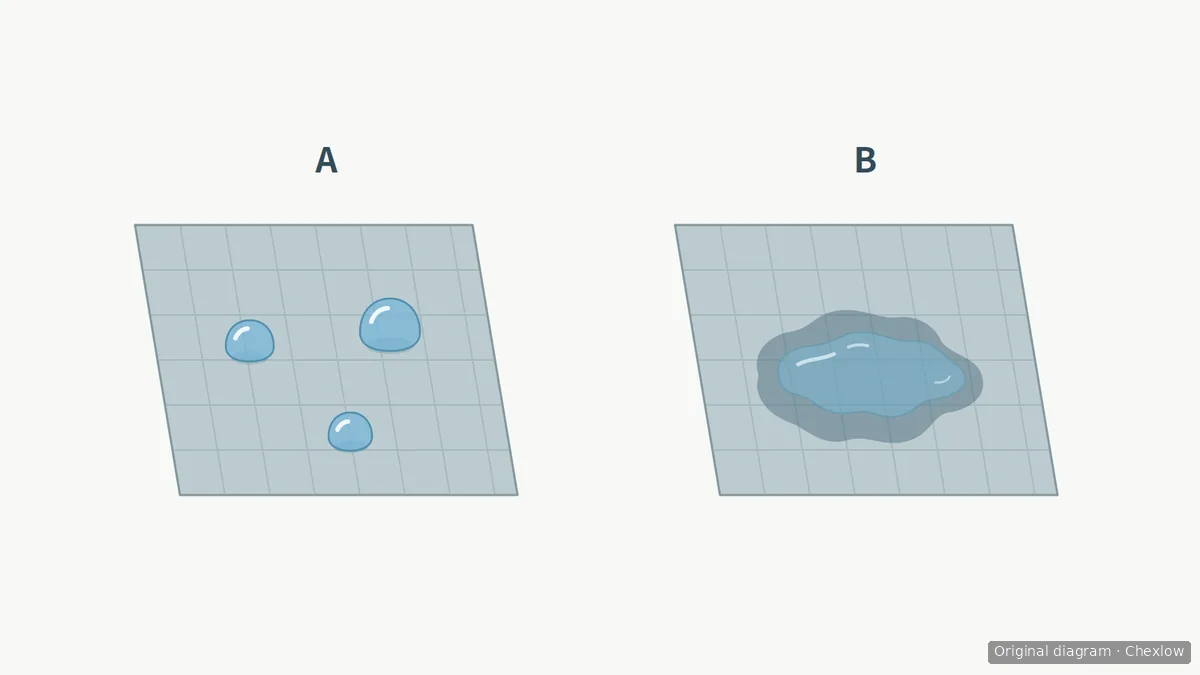
A shows water remaining in rounded drops; B shows water spreading into the face fabric. These are illustrative surface conditions, not measured before-and-after results. Neither view reveals detergent residue or establishes whether the membrane leaks.
On an appropriate textile-faced shell, sprinkle a few drops of water on the outside, as REI describes. If they bead and roll off, do not add treatment merely because you have washed the jacket. If water sits and darkens the fabric after cleaning and permitted reactivation, consider a compatible DWR replenishment product.
Buy a treatment only for that remaining need. Confirm that both the garment maker and the treatment instructions permit its use, including spray-on versus wash-in application and drying requirements. REI places new DWR after cleaning and reactivation fail to restore surface shedding; follow the chosen product’s instructions rather than assuming all treatments use the same finish.
Stop the care cycle when the problem needs assessment
If the surface beads again but the inside still gets damp, more DWR is not an automatic next step. Nikwax’s explanation of wetting and breathability shows why a clammy feeling alone cannot identify a leak. Record where the moisture appears and what you were doing, then ask the maker to assess persistent problems.
Visible peeling, loose seam tape or a tear is also a reason to pause washing and treatment and seek a repair assessment. This guide does not diagnose damage or provide seam-repair instructions, and restored beading is not proof that a damaged jacket is waterproof again.
If that assessment leads to replacement, or the original garment lacks the rain protection you need, use the rain-jacket construction and fit guide to compare alternatives. A jacket purchase follows that separate decision; routine care alone does not justify one.
Cómo se elaboró esta guía
AI wrote this guide for Chexlow using Gore’s care instructions, Nikwax’s cleaner information and REI’s DWR guidance. It separates cleaning, surface treatment and referral for assessment; the decision sequence is editorial guidance, not an original product test or a promise of waterproof restoration.
Original SVG diagrams created for Chexlow