Cotton gabardine: why trench coats behave differently from wool or down
Cotton gabardine is a twill-woven fabric, meaning the threads interlace in a diagonal pattern rather than a simple over-under grid. The diagonal weave packs the threads tightly together, which creates a dense surface that resists water penetration. Burberry's original innovation was developing a method to waterproof the yarn itself before weaving, so the protection was built into the fabric structure rather than applied only to the surface (The Laundress, Trench Coat Care for Longevity).
This is different from a wool coat, which repels light rain through the natural lanolin in the fiber but soaks through quickly in heavier rain, or a down jacket, where the shell fabric is treated for wind and water resistance but the warmth comes from the insulation layer inside. A cotton gabardine trench has no insulation — it is a shell garment, and its water resistance is a property of the weave plus the finish, not a membrane or coating underneath.
Some modern trench coats use polyester gabardine or polyester blends. These behave similarly in rain but are more forgiving in the wash — they can usually handle machine wash on a gentle cycle without the shrinkage risk you get with 100 percent cotton. The care label will tell you what you have. Technical fabric trench coats — a small category using Gore-Tex or similar laminates — are waterproof, not just water-resistant, and need care instructions specific to that fabric.
The practical implication: a classic cotton gabardine trench will handle drizzle and light rain well when the DWR finish is intact. In heavy or prolonged rain, it will eventually wet through. That is not a defect — it is how the fabric works.
DWR coating: checking and restoring water resistance
DWR stands for durable water repellent. It is a chemical finish applied to the surface of fabric that causes water to bead up rather than spread into the fibers. Without it, even a tightly woven gabardine will start to absorb moisture when it gets wet enough.
Testing whether your DWR is still active takes thirty seconds. Splash a little water on the shoulder of the coat. If the water beads up and rolls off, the finish is working. If the water spreads and soaks into the fabric — you will see the color darken — the finish has degraded. This is called "wetting out," and it happens naturally with wear and washing over time (REI, DWR Coating: Application, Cleaning and Care).
Before re-applying DWR, wash the coat first. Dirt and oil in the fabric interfere with how the treatment bonds, so a clean garment takes the new finish better.
Two product types work for DWR re-treatment:
- Wash-in treatments. Nikwax TX.Direct Wash-In is the most widely recommended option for outerwear. Run the coat through a wash cycle with a technical cleaner (Nikwax Tech Wash), then run a second cycle with TX.Direct added to the machine instead of detergent. The wash-in formula penetrates the fiber structure and bonds throughout the fabric, including the lining (Nikwax, How to Clean and Re-Waterproof your Rain Jacket).
- Spray-on treatments. Grangers Performance Repel and Gear Aid Revivex are common options. With a spray-on, you apply the product to the clean, damp coat, work it in evenly, and then heat-activate it. Spray-ons let you target specific areas (the shoulders and sleeves that take the most rain exposure) without treating the lining.
Heat activation matters either way. After applying a wash-in or spray-on DWR, use a tumble dryer on low heat for 20 minutes, or press the coat with a warm iron using a press cloth between the iron and the fabric. The heat causes the DWR molecules to bond properly to the fiber — skipping this step leaves the treatment less effective (iFixit, How to Reapply Durable Water Repellent+Coating/24190)).
How often you need to re-treat depends on how often you wear and wash the coat. As a rough guide, if the water test shows wetting out, it is time. For a coat worn a few times a week through a wet season, that might be once a season. For a coat worn occasionally, every two to three years is more typical.
Washing: when to machine wash and when to dry clean
Most cotton gabardine trench coats can be machine washed if the care label allows it — check before the first wash, because "dry clean only" on the label is not a suggestion. For coats labeled as machine washable:
- Cold water only. Hot water shrinks cotton and can set creases permanently into gabardine.
- Gentle cycle. High agitation loosens the weave and can damage the DWR finish.
- No fabric softener. Softener coats the fibers and degrades the DWR treatment.
- Lowest spin speed, or remove the coat while still damp and let it drain over the bathtub. High spin creates deep creases in gabardine that are difficult to remove (Laundry Heap, How to Wash a Trench Coat).
If the coat has a detachable lining, remove it before washing the coat. Wool linings should be dry cleaned separately. Polyester linings can usually be machine washed.
Take the coat to a dry cleaner when:
- The care label says "dry clean only."
- The coat is heavily structured (fused interfacing, stiff chest panels) — the structure can distort in a home wash.
- It is the first clean of the season and you want a professional press at the same time.
- There is a localized stain that home washing has not removed.
One rule regardless of method: do not let the coat sit wet. Gabardine that stays damp for hours sets wrinkles deeply and can develop a musty smell. Hang it immediately after washing, or lay it flat if the fabric is very heavy.
Wrinkle removal and pressing
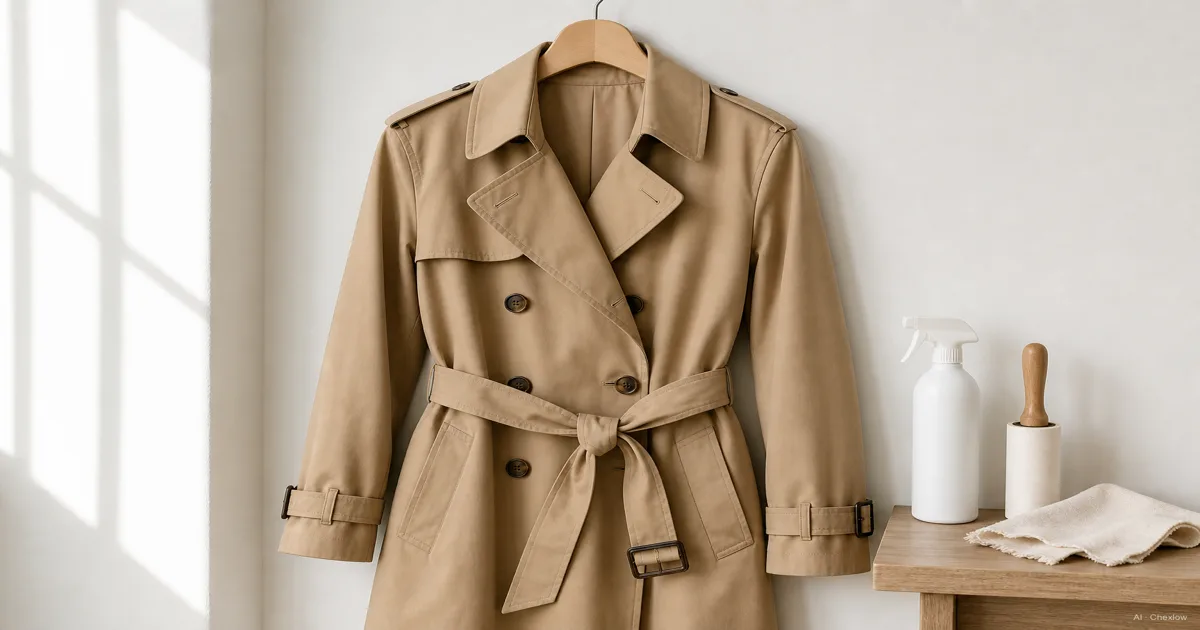
Steam is the right tool for a trench coat. A garment steamer held a few centimeters from the fabric relaxes gabardine without contact, which means no shine marks and no risk of scorching. Work from the collar down, holding seams taut with one hand while you steam with the other.
If you need to use an iron, always use a press cloth — a clean cotton cloth or a thin tea towel laid between the iron and the coat. Cotton gabardine can develop a permanent sheen if the iron touches it directly, especially on dark colors. Use a medium-heat setting, not high.
The lapels and collar are the trickiest areas. They have multiple layers of fabric and sometimes interfacing, and they crease at angles that are hard to reverse. Steam works better here than an iron because you can direct it into the fold without pressing the shape flat.
For the belt, snap it into place before pressing so the loops stay positioned correctly. Iron the belt itself on medium heat with a press cloth, or steam it lightly.
A professional press once a season is worth considering if you wear the coat regularly. Dry cleaners have pressing equipment that applies even pressure across the full width of a panel, which a home iron cannot replicate.
Storage: how to hang a trench coat without ruining it
A trench coat should be hung, not folded. Cotton gabardine creases deeply if folded under its own weight for months, and those creases are difficult to remove even with steaming. The exception is temporary storage during travel — a loose roll can work for a day or two, but not for weeks.
Hanger choice matters. A padded hanger or a wide-shouldered wooden hanger distributes the coat's weight across the full shoulder line. A wire hanger creates two pressure points at the shoulder tips that, over a full off-season, permanently deform the shoulder seams. The coat is heavy — it needs real support (Tidy Diary, Care Guide For Trench Coats).
Remove the belt before hanging for long-term storage. A belt left threaded through the loops adds weight at the waist, which over months pulls the fabric down and distorts the coat's drape.
Use a breathable garment bag, not a plastic dry cleaning bag. Plastic traps humidity, and trapped humidity in a stored coat leads to mildew and can degrade the DWR finish. A cotton muslin garment bag or a fabric garment bag allows air to circulate while keeping dust and light off the coat (Carry Crew, How to Store Coats).
Keep the stored coat away from direct sunlight. Sustained UV exposure fades cotton fabric unevenly — the shoulders and the facing of the lapels (which catch more light) fade faster than the back panel, and the color difference becomes visible after a few seasons.
Store in a cool, dry location. Attics get too hot and accelerate fiber degradation. Basements are typically too humid. An interior closet at consistent room temperature is the right place.
When snap buttons lose their snap
The double-ring snap buttons on most trench coats — on the storm flap, the cuffs, and sometimes the collar — eventually lose their grip. The mechanism is a press-fit between a cap stud and a socket, and it wears down with repeated use. A loose snap that no longer holds closed is a job for a tailor or a leather goods shop, not a home repair. They can replace individual snaps without touching the surrounding fabric. Trying to force a worn snap closed or pressing it too hard will eventually crack the socket, which makes the repair more complicated.
Sources
- Trench Coat Care for Longevity, The Laundress — gabardine construction, machine wash settings
- How to Wash a Trench Coat, Laundry Heap — cold water, gentle cycle, spin speed, drying method
- DWR Coating: Application, Cleaning and Care, REI — DWR testing, wetting-out explanation, treatment timing
- How to Clean and Re-Waterproof your Rain Jacket, Nikwax — TX.Direct wash-in method, clean-before-treat protocol
- How to Reapply Durable Water Repellent, iFixit+Coating/24190) — heat activation method, spray-on vs wash-in
- Care Guide For Trench Coats, Tidy Diary — hanger choice, belt removal, long-term hanging storage
- How to Store Coats, Carry Crew — breathable garment bag vs plastic, storage environment