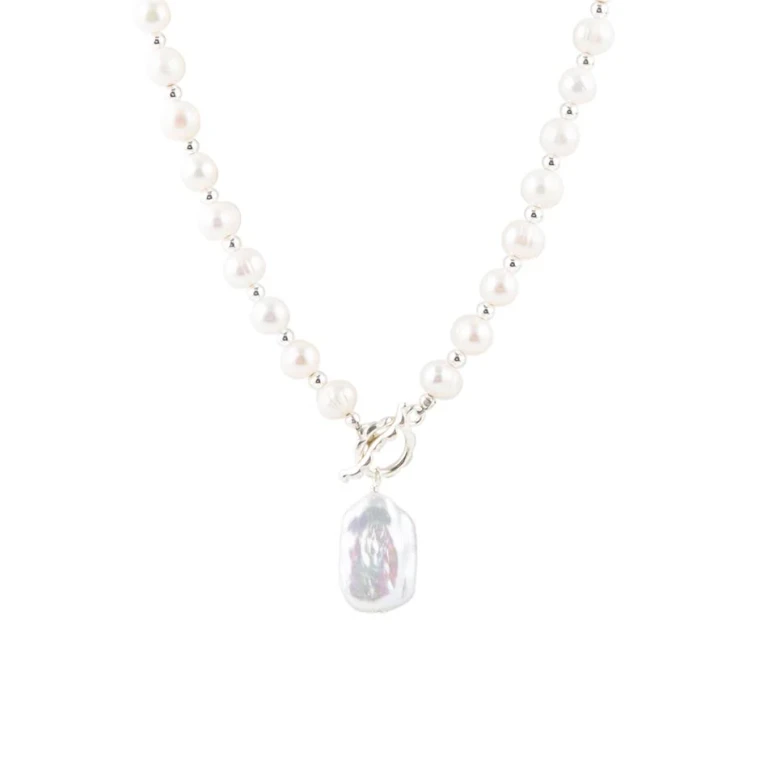
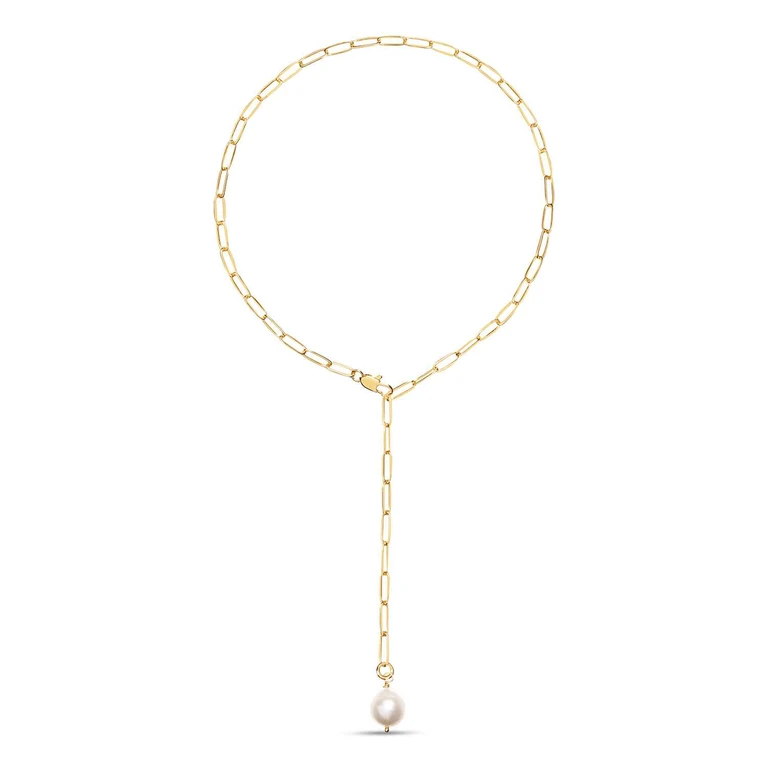
Every pearl necklace guide throws a wall of names at you before you've even decided you want one. Akoya. Freshwater. Tahitian. South Sea. Nacre. Overtone. If that vocabulary already feels like a lot, that's a completely normal reaction to a first pearl purchase.
Strip it back and the real first decision only has two contenders. GIA recognizes four main types of cultured pearls, Akoya, Tahitian, South Sea, and Freshwater, but for a first necklace the choice almost always comes down to Akoya or Freshwater. The other two are pricier specialty categories most first-time buyers grow into later, not start with.
What Akoya and Freshwater Pearls Actually Are
Akoya, Tahitian, and South Sea pearls all grow in saltwater oysters. Freshwater pearls grow in mussels, mostly in lakes and ponds across China (GIA). That's the headline difference, but the one that actually shapes everything else in this guide is structural.
Akoya pearls are bead-nucleated. A farmer inserts a small mother-of-pearl bead into the oyster, and the oyster spends months coating it in nacre, the iridescent material pearls are made of. That coating usually ends up somewhere between 0.35mm and 0.7mm thick by harvest time. Underneath it, there is always a bead.
Freshwater pearls are grown differently. Most are non-bead-nucleated, just a small piece of tissue placed inside the mussel, and the mussel builds the entire pearl out of solid nacre from that point on. There is no bead at the center. The whole thing is nacre, through and through.
Hold onto that one fact. It explains why one type shines the way it does, why one holds up better to decades of wear, and why one costs several times more than the other for a similar-looking strand.
Luster, Shape, and Color, How to Tell Them Apart at a Glance
Line the two up next to each other and a few things jump out fast.
Akoya pearls are almost always round, almost always under 9.00mm, and almost always white or cream with a rose or pink overtone shimmering underneath (GIA). That consistency is not an accident. Saltwater oysters and controlled bead-nucleation produce a much narrower range of outcomes than freshwater mussels do.
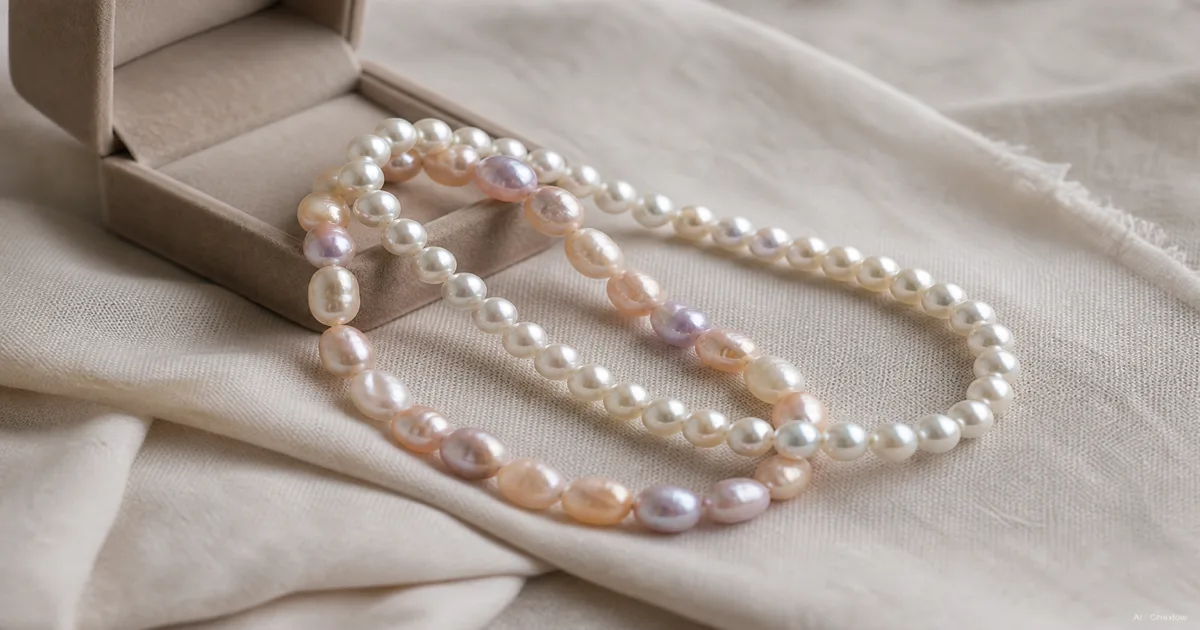
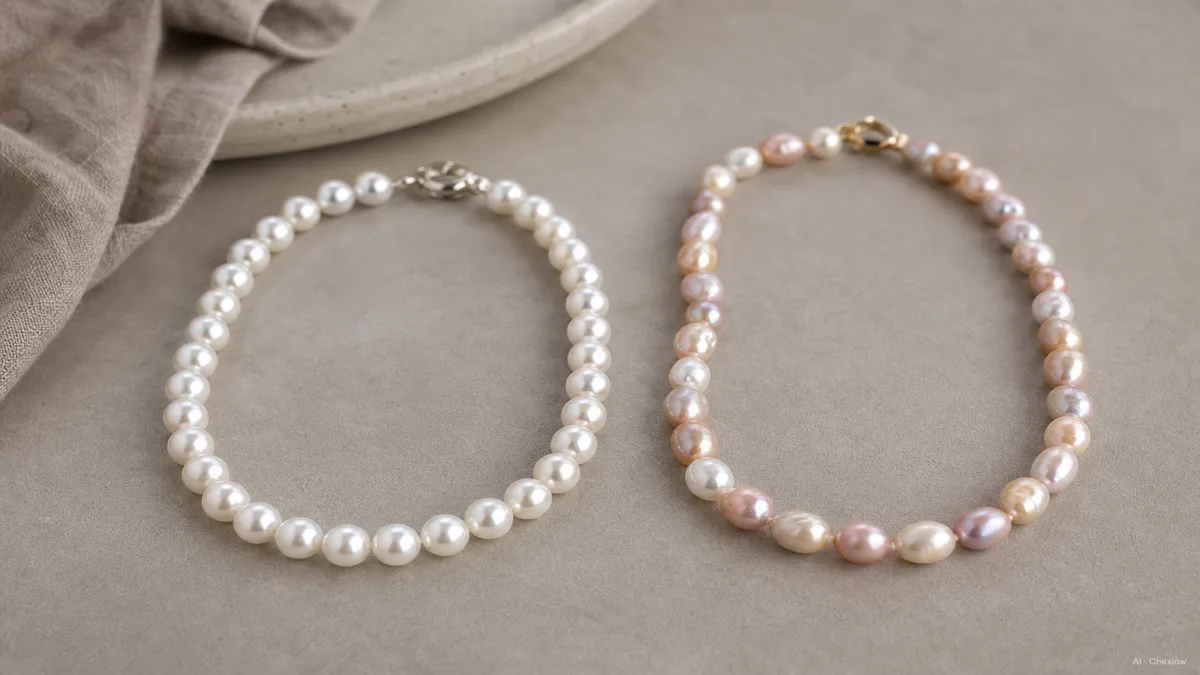
Freshwater pearls go the other way entirely. They show up in round, oval, button, and baroque shapes, and in a wider spread of pastel colors, pink, orange, lavender, alongside the classic white (GIA). That variety, plus a much lower price floor, is why freshwater strands are so much more common in everyday jewelry stores.
The luster gap is the part most first-time buyers actually notice in person. Akoya pearls are famous for a sharp, almost metallic shine that reads bright from across a room, the kind jewelers describe as glassy. Top-grade freshwater pearls, the metallic or Gem Grade rounds, have closed a lot of that gap in recent years. But that classic Akoya shine still edges out even excellent freshwater strands for buyers set on a formal or bridal look.
One thing worth flagging before you shop, some sellers market pearls as "Freshadama" or "freshwater Akoya." GIA has published guidance calling this a trending misnomer, since true Akoya is strictly a saltwater pearl type. A freshwater pearl, however good, is not an Akoya, no matter what the listing calls it.
Durability and Everyday Wear, What Nacre Thickness Actually Means for Care
This is the part most style-first guides skip, and it's genuinely the more useful question for a first necklace you plan to actually wear.
Because freshwater pearls are solid nacre, they tend to hold up better against chips and everyday knocks. There's no bead underneath waiting to show through if the surface wears thin. That makes them a fairly forgiving choice if this necklace is going to live in your regular rotation rather than a jewelry box.
Akoya pearls need a bit more care. That thin nacre coating over a bead can chip or peel after decades of wear, especially if the pearls take a hard knock or spend years without any attention. It's not fragile in any dramatic sense, just less tolerant of rough handling over the long haul.
Both types still want the basics. Wipe pearls down with a soft cloth after wearing them, put them on last when you get dressed and take them off first when you don't, and keep perfume, hairspray, and lotion away from direct contact. Store the strand separately from other jewelry so it doesn't get scratched. Akoya owners should be a little more deliberate about that routine, and a little more careful around chlorine and heat, since there's simply less nacre standing between the surface and the bead underneath.
Price and Value, What a First Pearl Necklace Budget Should Expect
For most first-time buyers, this is the section that actually decides things.
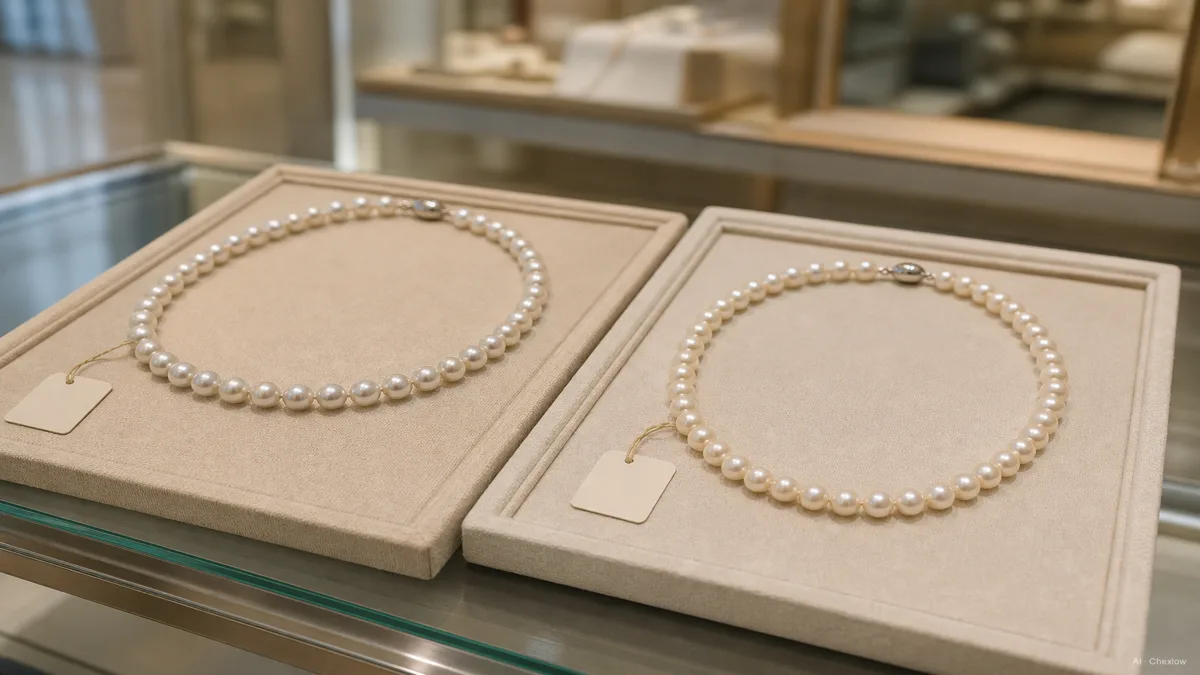
A comparable 8.5 to 9.0mm strand in AAAA quality runs around $1,800 in freshwater, versus $5,000 or more for an equivalent Akoya strand. Roughly speaking, freshwater pearls cost a quarter to half of what a similarly sized, similarly graded Akoya strand does.
Mikimoto, the brand most people picture when they hear "Akoya pearl," prices classic Akoya strand necklaces from around $2,000 up past $10,000, depending on pearl size (6 to 9mm is typical) and grade. Even its entry pieces, a single pendant or a pair of studs, usually start somewhere between $300 and $1,000 (Mikimoto; SebastianCharles Auctions).
Pearl jewelry sits in a narrower, more specialized slice of the catalog than something like sneakers or phone cases, so don't expect an endless wall of options in either type. What you can expect is real price separation between the two categories at every size and grade, which is exactly the number that should drive a first purchase more than anything else in this guide.
Which One Should Your First Pearl Necklace Be? A Decision Framework
Once you've got the structure, the look, and the price gap sorted, the actual decision usually comes down to what you're buying the necklace for.
- A first pearl necklace on a starter budget. Freshwater is the practical pick. Multiple buyer guides land on the same recommendation for exactly this reason, lower cost, more color and shape choice, and a strand that shrugs off daily wear a little better than a thin-nacre Akoya does (Pearls of Joy; Pure Pearls; TheCaratCut).
- A bridal, graduation, or formal-occasion piece. Akoya's round, uniform shape and classic white or cream color are exactly why it has been the traditional pick for these moments for decades.
- Wanting the sharpest, most mirror-like shine. Akoya still wins this one, even against excellent freshwater strands.
- Wanting variety, color, and shape options in one collection. Freshwater is built for this. Round, oval, button, baroque, pastel tones, it covers a lot more ground than Akoya's tighter round-and-white lane.
There's no universally correct first pearl. There's only the one that matches what you actually plan to do with the necklace once it's around your neck.
Sources
- What Are the Main Types of Cultured Pearls?, GIA — the four cultured pearl types and saltwater vs freshwater origin
- Different Pearl Types & Colors, GIA — Akoya and freshwater size, shape, color, and luster characteristics
- Freshwater Akoyas, A Trending Misnomer, GIA — why "freshwater Akoya" is not an accurate label
- Freshwater vs. Akoya Pearls, Pure Pearls — first-buyer comparison and recommendation
- Akoya Pearls vs Freshwater Pearls, Pearls of Joy — buyer guidance on which type to buy first
- Akoya vs. Freshwater Pearls, TheCaratCut — 2026 pricing and durability comparison
- Mikimoto Akoya Pearl Jewelry — reference Akoya strand and entry-piece pricing
- How Much Are Mikimoto Pearls Worth in 2025?, SebastianCharles Auctions — Mikimoto price range context
How this guide was built
This piece started from a question that comes up the moment someone starts pearl shopping, Akoya and freshwater pearls can look nearly identical in a case, so what actually separates them before a first purchase. We pulled the structural and type facts from GIA's own cultured pearl references, including its note on the "freshwater Akoya" misnomer, then cross-checked pricing and buyer recommendations against Pure Pearls, Pearls of Joy, and TheCaratCut, and used Mikimoto's own Akoya pricing alongside SebastianCharles Auctions for a luxury reference point. The selection lens sits on Chexlow's jewelry catalog, spanning pearl necklaces across both types.
Edited by the Chexlow team · Images are AI-generated illustrations