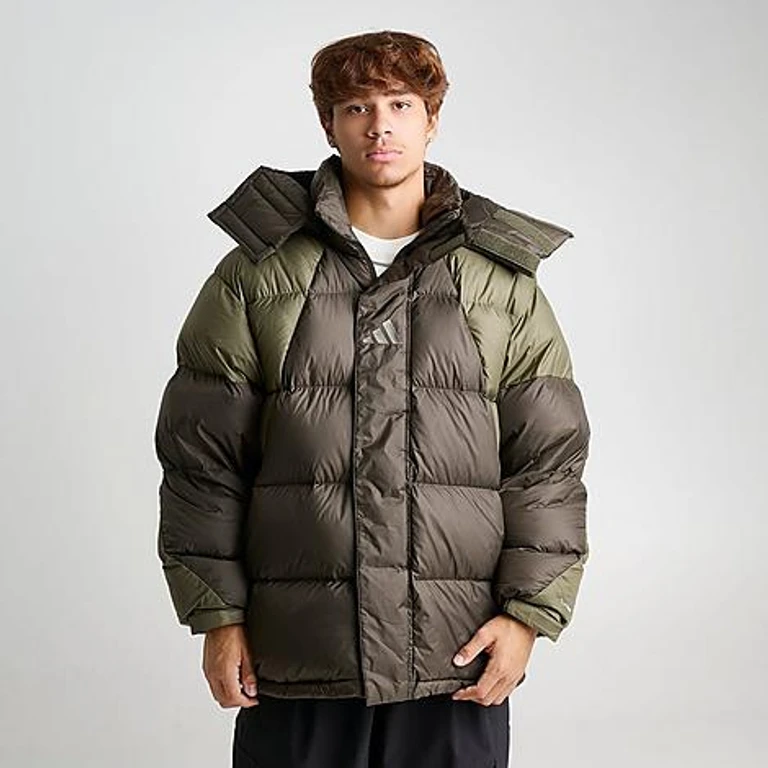
Fill power: what the number actually measures
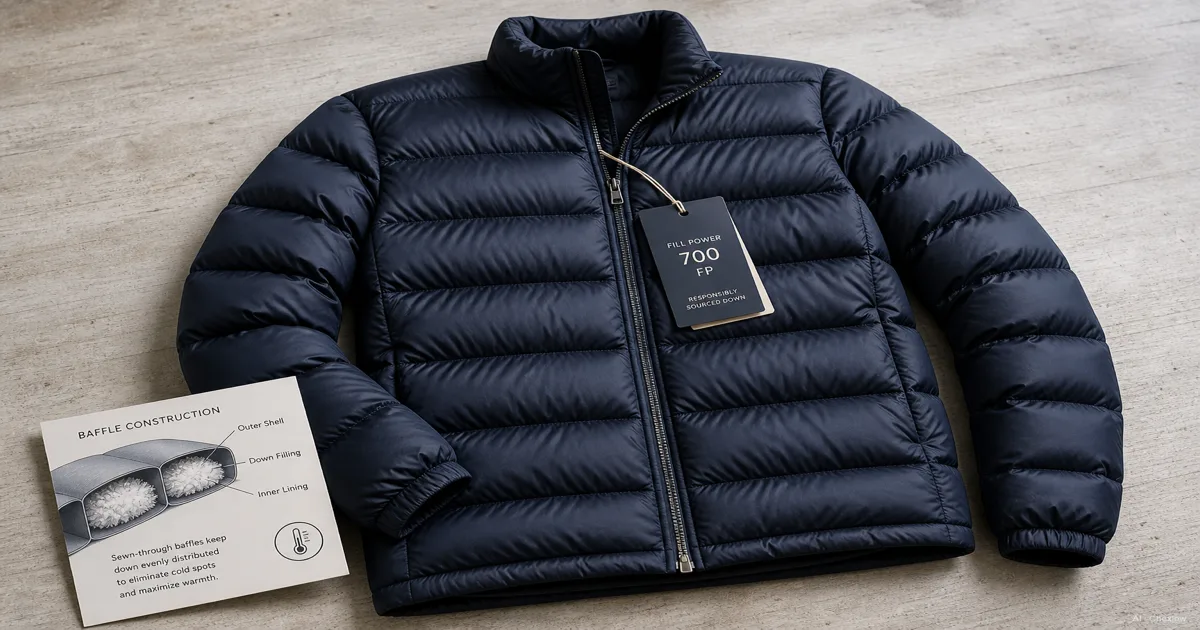
Fill power is measured in cubic inches per ounce. One ounce of 650-fill down expands to fill 650 cubic inches of space. One ounce of 800-fill down expands to fill 800 cubic inches. Higher-fill down forms larger clusters that trap more air relative to their weight — which is where the warmth comes from. Air is the insulator, not the down itself.
The practical consequence: higher fill power = same warmth at less weight. A 700-fill jacket and an 800-fill jacket can be equally warm, but the 800-fill version will be lighter and more compressible if both use the same total weight of down. If the 800-fill jacket uses 30% less down by weight to achieve the same warmth, it packs smaller and feels less bulky on the body.
What fill power does not tell you is how warm the jacket actually is. That depends on fill weight — the total grams of down used. A jacket with 800 fill power and 40g of down is not a warm jacket. A jacket with 550 fill power and 200g of down is. When comparing jackets, look for both numbers. Brands that only advertise fill power and hide fill weight are usually hiding something unfavorable.
A rough hierarchy for context: 400–550 fill power is entry-level, good for mild winters and casual use. 600–700 is the everyday winter sweet spot, solid warmth-to-weight. 750–850 is the performance range for backpacking and real cold. 900+ is expedition grade, premium pricing, and genuinely diminishing returns for most people.
Temperature ratings: what -10°C on the hangtag actually means
Down jackets that carry temperature ratings use the same thermal testing framework developed for sleeping bags under EN 13537 and its successor ISO 23537. A heated mannequin in a controlled chamber measures how much heat loss occurs at a given temperature. From that, three numbers emerge: comfort, lower limit, and extreme.
Here is what they mean in practice. The comfort rating is the temperature at which most people — the standard used is a "standard woman in a relaxed posture" — will feel comfortable without shivering. The lower limit is the temperature at which a "standard man curled up to conserve heat" is just barely not cold. The extreme rating is the survival threshold, not a comfort baseline.
The practical rule: use the comfort rating as your real number. If a jacket is rated to -10°C lower limit, you will likely feel cold in it at -10°C unless you are running warm or layering heavily. The comfort figure will be several degrees warmer. Brands that advertise the lower limit without specifying which standard they used are common — always check which number they are citing.
One more nuance worth knowing: jacket temperature ratings and sleeping bag temperature ratings are not the same thing. A sleeping bag encloses your body on all sides and is used while lying still. A jacket has gaps at the waist and wrists, and the wind can penetrate a zipper. Do not compare them directly.
Baffle construction: why the seams matter in the cold
The way down is held inside a jacket matters almost as much as the down itself. The two main approaches are sewn-through (stitched-through) baffles and box baffles, and the difference affects warmth in cold conditions.
In sewn-through construction, the outer fabric and inner lining are stitched together directly, creating channels that hold the down. The stitching compresses the insulation along every seam line. No down sits in the seam itself, and the down on either side of it cannot fully loft at the edges. The result is a thin line across the jacket where heat escapes more easily — a thermal bridge. For mild-weather use, this is fine. The jacket is lighter and easier to produce. For temperatures below roughly -5°C, the cold spots at the seams become noticeable.
Box baffle construction adds a third piece of fabric — a vertical wall — sewn between the outer shell and inner lining. The down fills a true box-shaped chamber and can loft fully on all sides. There are no compressed seam lines, so the insulation layer is continuous. This adds some weight and cost but eliminates the cold-spot problem. Expedition parkas and serious cold-weather jackets use box baffles. Lightweight packable jackets almost always use sewn-through.
A middle-ground option is the trapezoidal or differential-cut baffle, which achieves some of the loft benefit of box baffles without the full weight cost. Worth looking for if you want something between the two.
Down vs synthetic: the wet-weather trade-off
Down is unbeatable on warmth-to-weight in dry conditions. The problem is water. When down clusters get wet, the filaments clump together, collapse, and lose their ability to trap air. A soaked down jacket in cold rain is significantly less warm than it was dry — which is dangerous in cold, wet conditions, not just uncomfortable.
Synthetic insulation handles moisture much better. The polyester fibers retain most of their loft even when wet, dry faster, and do not clump. The trade-off is weight and compressibility: synthetic jackets are heavier and bulkier than equivalent-warmth down jackets.
The practical decision: if you live somewhere with frequent rain or wet snow, or if you plan to use the jacket as a layer under a waterproof shell in wet conditions, synthetic is the more reliable choice. If you are primarily in dry cold — crisp urban winters, mountain days with low humidity, layering under a waterproof — down is more efficient and more packable.
One evolution worth knowing: hydrophobic down, sometimes called treated or water-resistant down, has a DWR-like coating applied to the clusters themselves. It handles light moisture significantly better than untreated down and slows the clumping process. Brands like Nikwax Hydrophobic Down and various proprietary treatments all operate on this principle. Hydrophobic down is not waterproof, but it extends the window before wet conditions degrade warmth.
Duck vs goose down: does the bird matter
The short answer is that goose down generally achieves higher fill power ratings than duck down. Premium goose down can reach 900+ fill power, while duck down typically maxes out around 750–800. Goose clusters are generally larger, which means more loft per gram. At equivalent fill power ratings, the bird matters less — a well-sourced 700-fill duck down jacket is warmer than a poorly sourced 700-fill goose down jacket.
What matters more than the bird is sourcing. The Responsible Down Standard (RDS) is the most widely recognized certification for ethical sourcing — it verifies that birds were not live-plucked or force-fed. If a brand uses RDS-certified down and mentions it, that is a meaningful signal. Brands that do not disclose sourcing are harder to assess.
For most buyers at the 650–750 fill power range, duck down at a lower price point is a perfectly solid choice. At 800+ fill power, you are almost always dealing with goose down by necessity.
Shell fabric and DWR: water resistance vs waterproofing
Down jacket shells are typically nylon ripstop, sometimes with a small percentage of polyester. The ripstop weave — a grid of heavier threads woven through lighter ones — prevents small snags from spreading into tears. Lighter shells use 10D or 15D nylon for packability. More durable shells use 20D or 30D for abrasion resistance.
The DWR (durable water repellent) treatment on the shell is important to understand. DWR causes water to bead and roll off the surface rather than soaking into the fabric. It does not make a jacket waterproof. A soaking rain will eventually penetrate any DWR-treated shell, especially once the DWR wears down with use and washing.
DWR treatment degrades over time but can be reactivated by tumble-drying on low heat, or restored with a wash-in or spray-on DWR product. If your jacket is getting wet and staying wet rather than beading, the DWR needs refreshing.
For reliably dry conditions in rain, you need a waterproof membrane — either a separate waterproof shell worn over the down layer, or a jacket with a laminated waterproof-breathable membrane built into the shell. Most lightweight down jackets have neither.
Choosing for your climate and use
A few decision forks to simplify the choice.
If you live somewhere with dry cold winters — below freezing but low humidity, minimal rain — a 650–750 fill down jacket with box baffles will cover most needs from October to March. You do not need 900 fill power for city winters.
If your winters are wet — frequent rain, wet snow, temperatures hovering near freezing — consider synthetic insulation or hydrophobic down. A DWR-treated shell matters more here too.
If you want one packable layer for travel that covers cool to cold conditions, a 750–850 fill jacket with sewn-through baffles (lightweight, compressible) is a better choice than a heavy expedition parka. The cold-spot limitation of sewn-through matters less for a mid-layer or a jacket used above -5°C.
If you are heading into genuinely cold conditions — ski touring, alpine hikes above 2000m, polar regions — box baffle construction and 800+ fill power start to earn their premium. Fill weight matters especially here: look for jackets with at least 150–200g of down and pay attention to the collar and cuffs, where heat loss is highest.
Down jacket care: tumble dry, no dry clean
The single most common way to damage a down jacket is to wash it and not dry it properly. Down clusters clump when wet and can stay clumped if dried too slowly or at too low a heat. The result is an uneven, flat jacket that no longer lofts correctly.
The correct method: machine wash on a gentle cycle with a down-specific detergent (regular detergent can strip the natural oils from down clusters). Then tumble dry on low heat with two or three clean tennis balls or dryer balls. The balls break up the clumping clusters as the jacket dries. Expect the process to take two to three cycles at 30–40 minutes each. Check for damp clumps in the baffles between cycles and break them up by hand before running again.
Do not dry clean down. The solvents used in dry cleaning can strip down oils and damage the clusters permanently. Do not iron down. Do not hang dry a wet down jacket and expect it to come back right without the tennis ball method.
Stored long-term, down is happiest in a loose bag or hung in a closet — not compressed in its stuff sack. The compression fatigue from months in a stuff sack reduces loft over time.
Sources
- What Is Down Fill Power? — REI Expert Advice overview of fill power measurement and what the numbers mean in practice.
- Buying Down and Synthetic Insulated Jackets — REI Expert Advice on shell fabrics, DWR treatment, and jacket category selection.
- Down vs. Synthetic Insulation — Switchback Travel's breakdown of wet-weather performance, RDS certification, and goose vs duck down.
- Down Jacket Baffle Construction Explained — Foehn guide to sewn-through vs box baffle construction, with diagrams.
- EN 13537 — Wikipedia overview of the European standard for sleeping bag temperature ratings, which underpins jacket rating methodology.