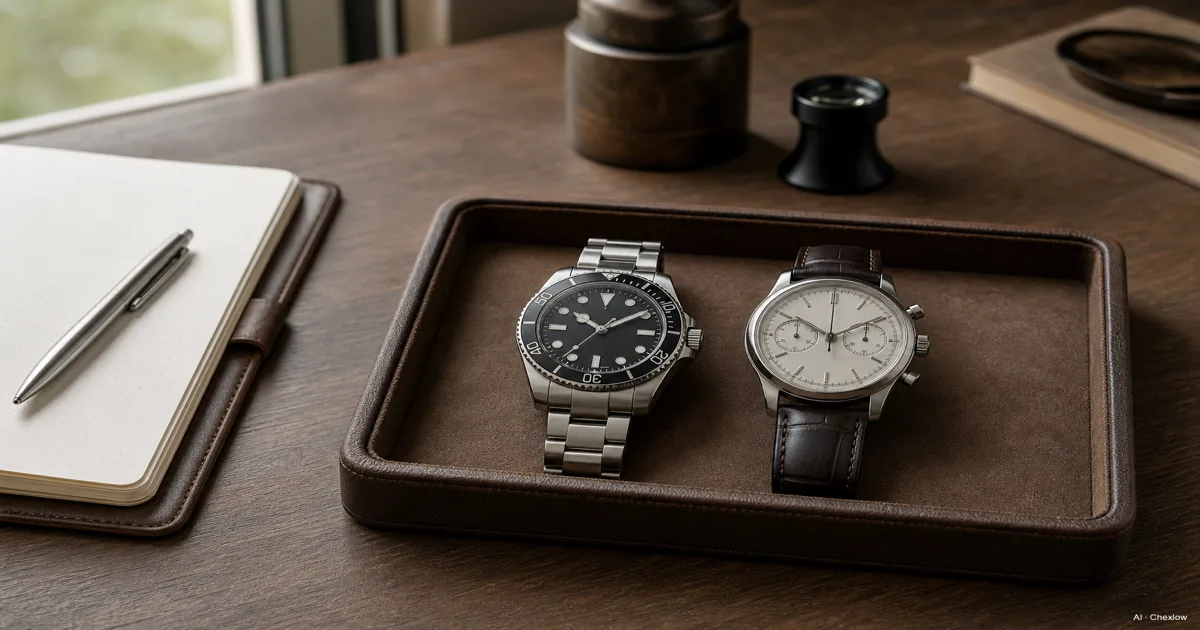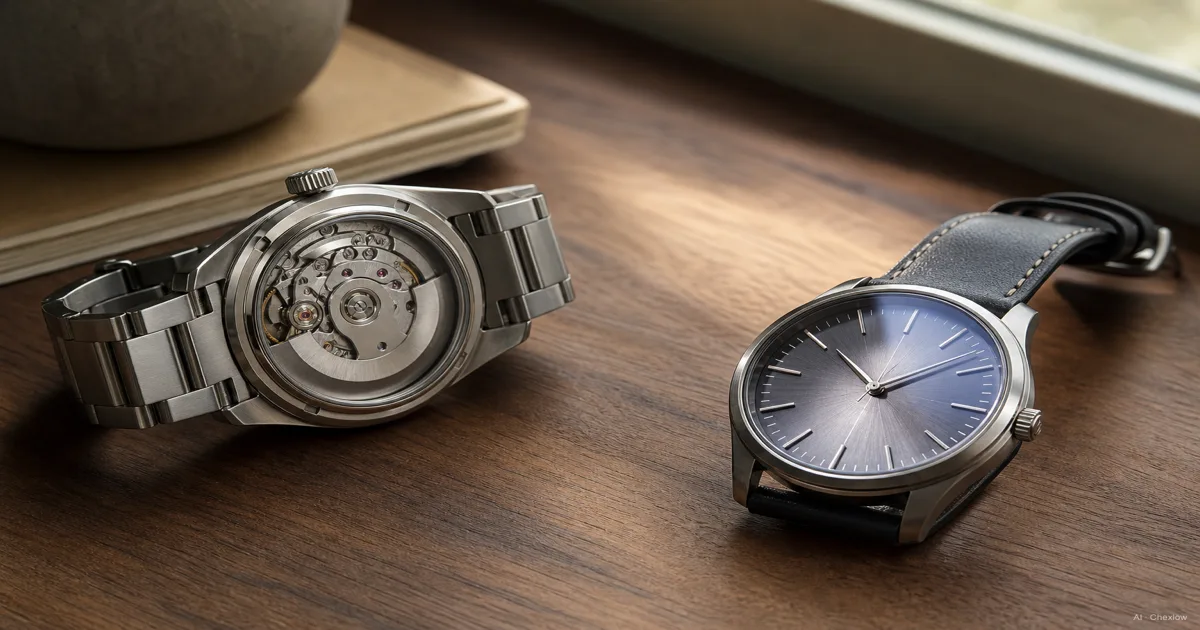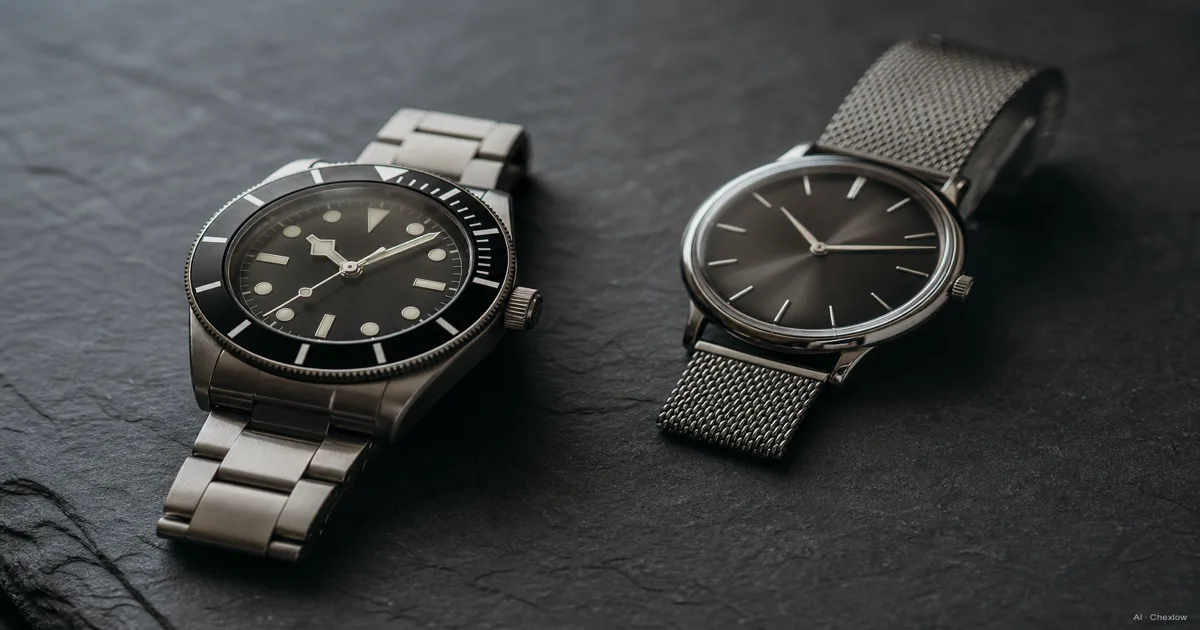
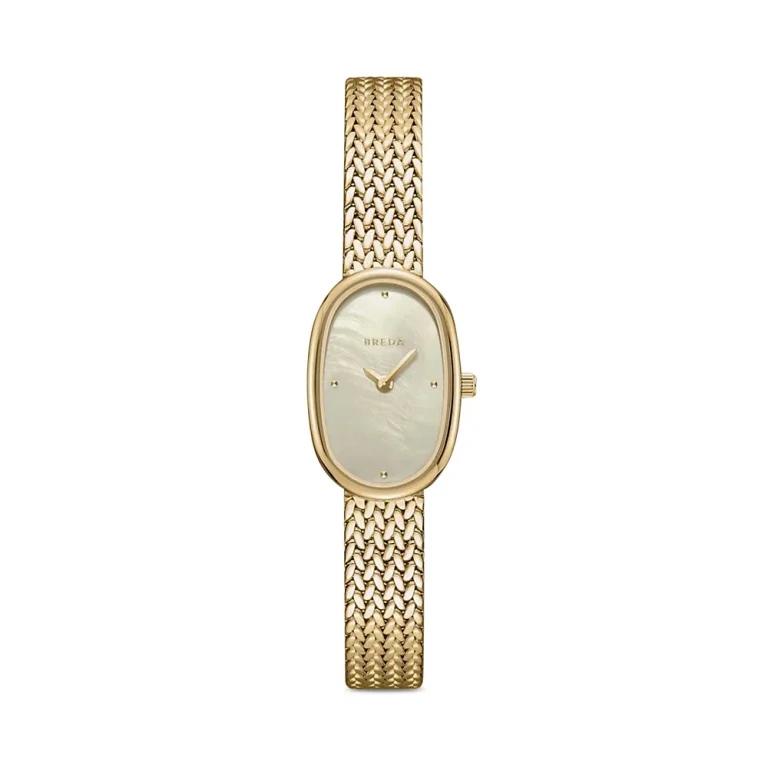
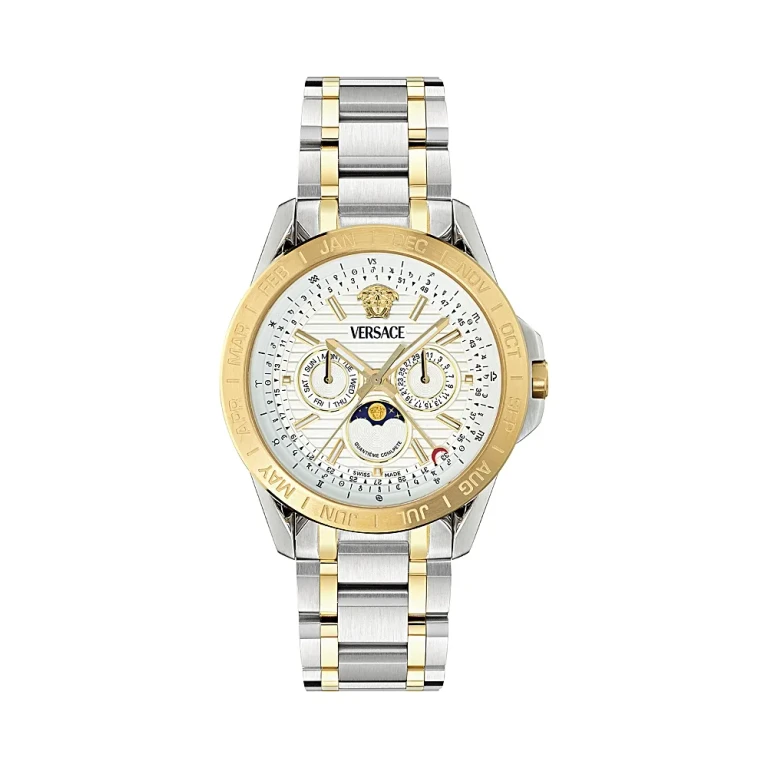
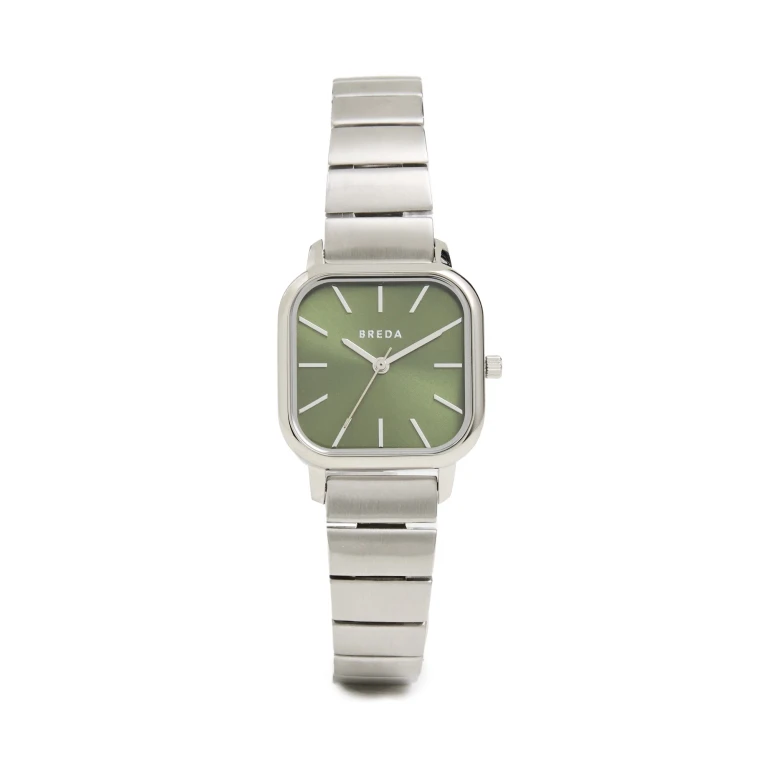
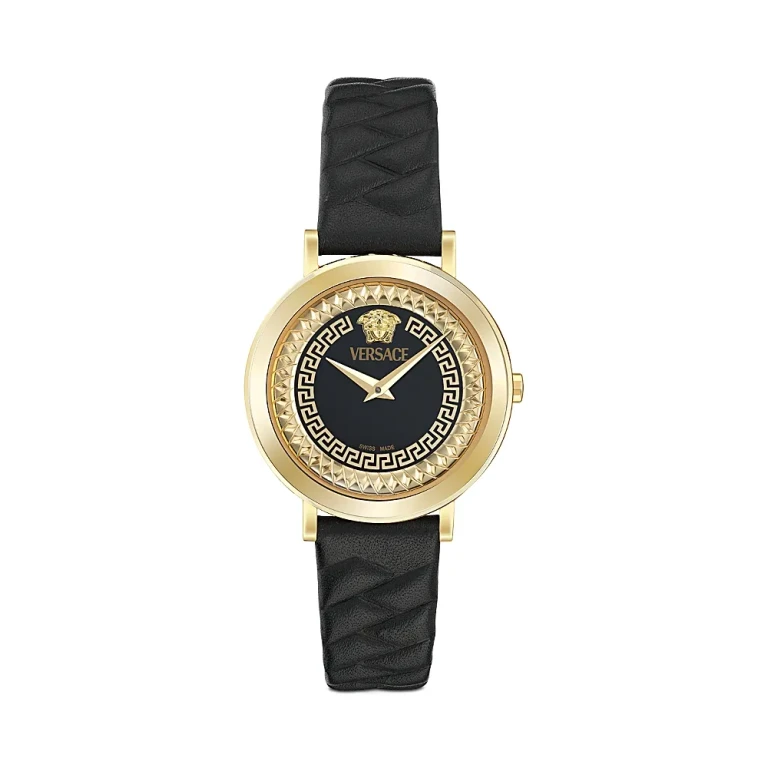
Start shopping for a first proper watch and the field narrows fast to two silhouettes. One is broad-shouldered and ready for anything, a turning bezel ringing the dial. The other is thin, calm, almost shy, the kind of thing that disappears under a shirt cuff. Dive watch or dress watch.
It looks like a style call. It runs deeper than that. These two were built to do different jobs, and the gap between them is the whole point. A dive watch is an instrument. A dress watch is closer to jewelry. Pick the one your actual week asks for and you wear it daily. Pick the other and it waits in a drawer. So before the brands and the budgets, let's get clear on what each one really is.
What Actually Separates a Dive Watch from a Dress Watch
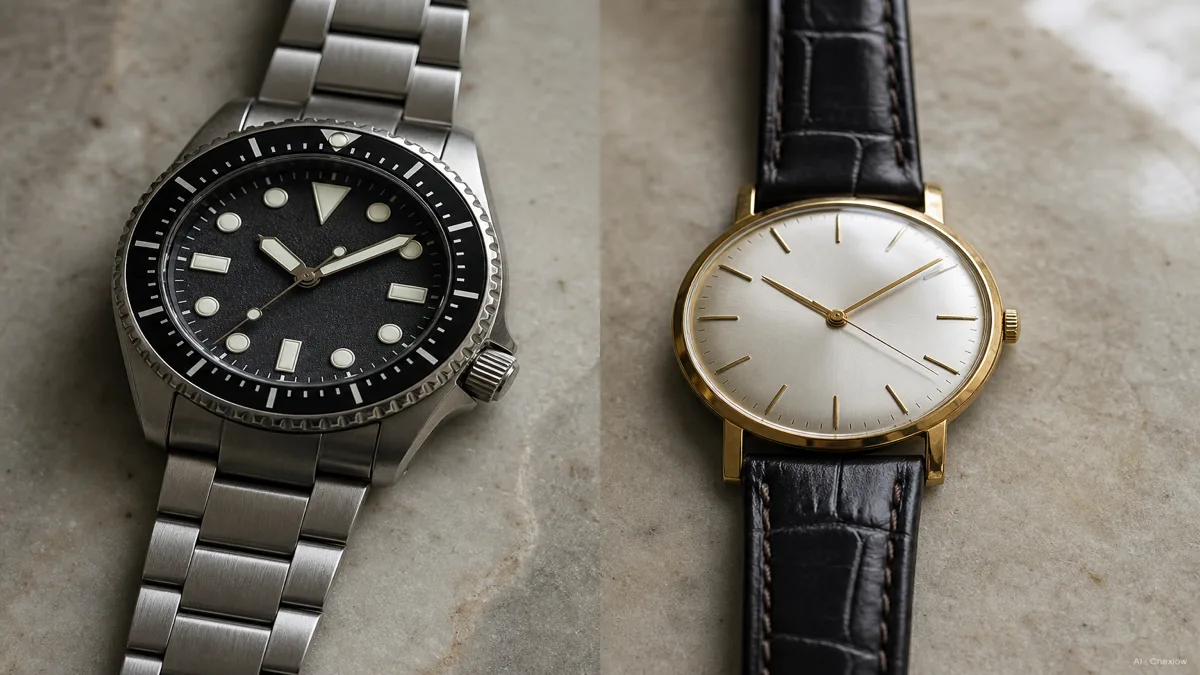
The simplest way to read the two is by what they refuse to give up.
A dive watch refuses to be hard to read or easy to flood. It is a tool watch, designed around legibility and durability before anything else. That means a thick case, usually steel, often 200 to 300 metres of water resistance in practice, a unidirectional rotating bezel for timing, and big luminous markers you can read in the dark (SkyrimWrist). Elegance is welcome but it never gets to outrank function.
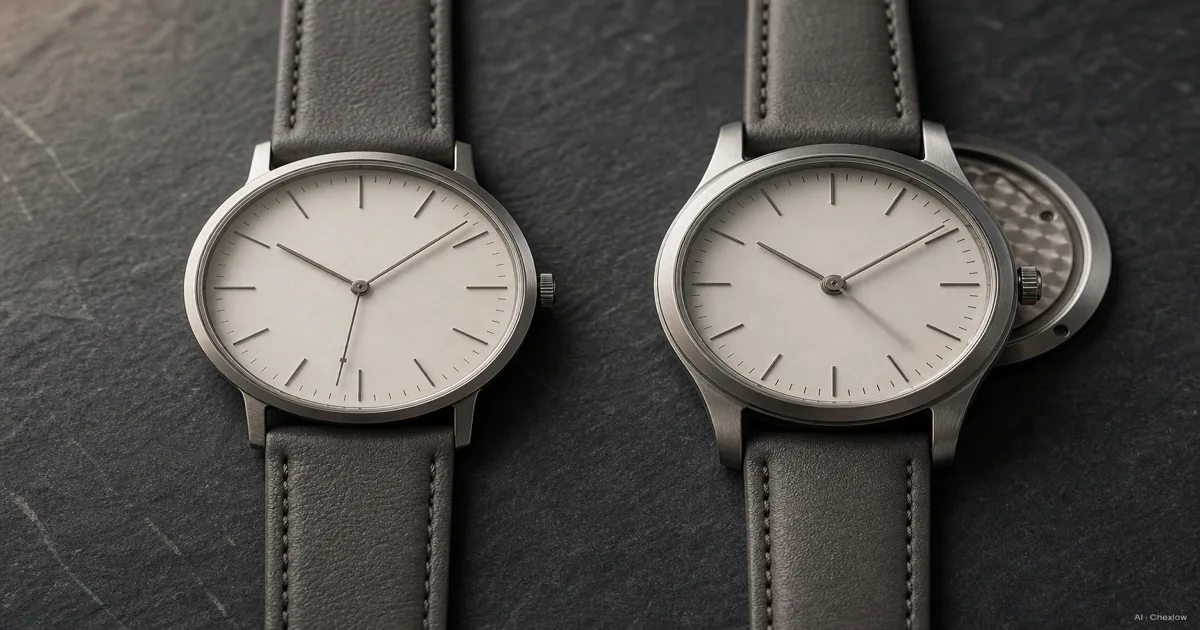
A dress watch refuses to add bulk or noise. It is closer to wrist jewelry, made to enhance formal clothing rather than compete with it. The numbers tell the story: most dress watches sit between 33 and 39 mm across and under 8 mm tall, thin enough to slip under a shirt cuff without a bump (NOMOS Glashütte). Cases run to premium metals, steel, gold, rose gold, platinum, almost always under a flat sapphire crystal that resists scratches and keeps the dial undistorted (Teddy Baldassarre). Complications are rare beyond a date. The whole design philosophy is to stay quiet.
Even the crystal choice splits along these lines. Dive watches lean on domed or double-domed sapphire that shrugs off pressure. Dress watches prefer flat sapphire for that sleek, low-profile look. Vintage-style divers sometimes still use acrylic, the early Submariner among them, which looks warm but scratches easily (Monochrome Watches). One side optimizes for the sea, the other for the boardroom.
The ISO 6425 Standard: What Makes a Watch a True Diver
Here is a thing most first buyers don't know: "dive watch" is not just marketing. There is an actual international standard, ISO 6425, that a watch has to meet before it can call itself a divers' watch, and it is strict.
Updated in 2018, ISO 6425 sets a hard floor. A true diver needs at least 100 metres of water resistance, a unidirectional rotating bezel or equivalent timing system graduated to at least 60 minutes, and luminous readability at 25 cm in total darkness, including a running indicator so you can confirm the watch is still going (Belmont Watches). And crucially, every single watch is tested individually, not just one sample from the batch. That testing covers salt-water corrosion, thermal shock, and magnetic resistance, plus a pressure test at 125 percent of the rated depth (ISO 6425:2018).
That 125 percent overpressure test is also why so many real-world divers carry 200 or 300 metres rather than the bare 100 metre minimum. The case has to survive well past its rating, so makers build in headroom.
One detail is worth slowing down on because it is a small piece of genius. The bezel only turns one way, counter-clockwise. A diver sets it to mark their start time, then reads remaining minutes off the scale. If the bezel gets knocked underwater, it can only ever rotate to show less time remaining, never more (Time and Tide Watches). A bumped bezel makes a diver surface early, never late. That safety logic is baked into every certified diver, and it is the reason the rotating bezel became the category's signature.
The two watches usually credited with founding the modern category make the lineage clear: the Blancpain Fifty Fathoms, first delivered to the French Navy in 1953, and the Rolex Submariner, shown at Baselworld in 1954. Both shaped the spec that ISO 6425 later codified (Diving watch, Wikipedia). You are very unlikely to buy either as a first watch, but every affordable diver you do consider is a descendant of those two.
Versatility Test: Which Watch Survives More of Your Week?
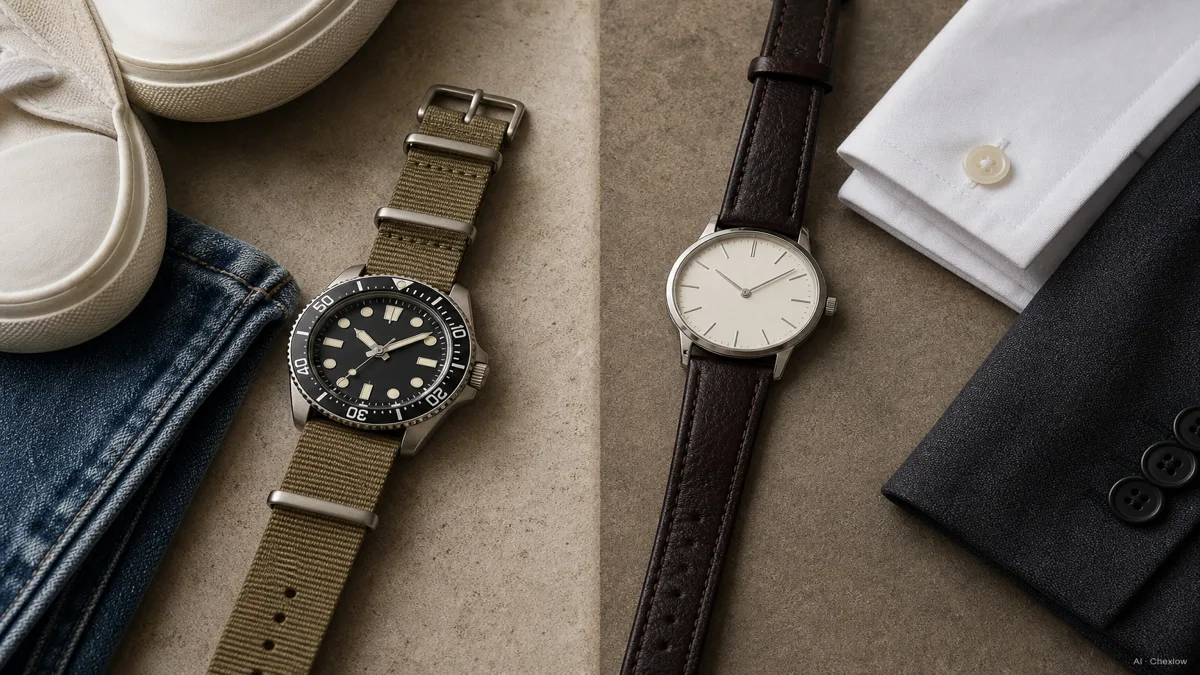
Now the practical question. If you can only have one for a while, which one shows up for more of your actual days?
For most people, the honest answer leans toward the dive watch, and it comes down to one lever: dial color. A dive watch with a black, deep blue, or gray dial reads as near-formal. Put it on a bracelet for the day and a leather or NATO strap in the evening and it covers everything from business-casual to weekend (Fratello Watches). The same watch in bright orange, yellow, or lime swings hard into sport territory and clashes with a suit. So if you want a do-everything first watch, a dark-dial diver on a swappable strap is the most flexible single object you can buy.
But there is a ceiling, and it is worth being honest about it. A dive watch is not actually a dress watch. Put a full suit or black-tie on and a chunky diver looks out of place, no matter how dark the dial (Time and Tide Watches). For those settings, only a slim dress watch finishes the look properly.
So the versatility verdict is lifestyle-shaped. If you spend most days in an office or in formal settings, a dress watch, or a field watch as a middle path, earns its place first. If your days run active, outdoor, or casual, a dive watch piles up far more wrist time (Quill & Pad). Be honest about the week you actually live, not the week you imagine.
The Two-Watch Rule, and When One Is Enough
Spend any time among watch people and you'll hear the same tidy idea: one dive watch and one dress watch covers nearly every situation a person dresses for. The diver brings durability and everyday range, the dress watch brings formality and polish, and between them they handle the office, the weekend, the wedding, and the funeral (WatchCrunch).
It's a genuinely useful frame, and it tells you something about sequence. If you're building toward two, the question stops being which is better and becomes which to buy first. Lead with the one your current life leans on, then fill the gap later.
And plenty of people are fine with just one. If your life almost never demands black-tie, a dark-dial diver on two straps quietly does ninety percent of the job, and you may never feel the missing dress watch. If you live in tailoring, a dress or dress-field watch may be all you ever reach for. The two-watch rule is a destination, not an entry fee.
For first buyers the catalog cooperates nicely here. Entry dive watches from Seiko, with its SKX, Turtle, and Prospex lines, and Citizen's Promaster sit in friendly territory, while Tissot's Seastar reaches a step up. On the dress side, Citizen's Eco-Drive, Tissot's Le Locle, and Seiko's Presage cover the slim-and-formal brief without asking for a luxury budget. You can build the classic pair without ever leaving the practical price range.
First-Buy Checklist: Five Questions Before You Choose
Before you commit, run these five. They sort the decision faster than any spec sheet.
- Picture your week, not your wish list. Count the days you actually spend in formal clothes versus casual or active ones. The bigger pile usually points straight at your first watch.
- Decide if you need true dive capability. If you actually dive or swim hard, look for ISO 6425 and a unidirectional bezel. If you just like the look, a 100 to 200 metre sporty watch gives you the style without the premium.
- Choose the dial color for range, not for flash. For a one-watch wardrobe, black, deep blue, or gray flexes the furthest. Bright orange or lime looks great but locks you into casual.
- Check the case size and height against your wrist and your cuff. A dress watch should slide under a shirt cuff, so under 8 mm tall and 33 to 39 mm across is the sweet spot. A diver can run larger, but try it against your wrist first.
- Match the budget to the tier you actually need. A solid entry diver or dress watch lives in the same accessible band from Seiko, Citizen, and Tissot. You don't need to chase the icons to get a watch that does its job.
Get those five answered honestly and the dive-versus-dress question stops feeling like a gamble. You're not choosing between two fantasies anymore, you're choosing the watch your real week will actually wear.
Sources
- ISO 6425:2018, Horology, Divers' watches — the official international standard defining a certified dive watch
- ISO 6425 explained, Belmont Watches — readable breakdown of the standard's requirements and individual testing
- Dress watches style guide, NOMOS Glashütte — case size, height, and proportion conventions for dress watches
- Dive watches are not dressy, Time and Tide Watches — the unidirectional bezel safety logic and the limits of diver formality
- One and done, dress or sports watch, Quill & Pad — the lifestyle-first rule for a single first watch
- Dive watches to wear with a suit, Fratello Watches — dial color as the versatility lever for divers
- Diving watch, Wikipedia — the Fifty Fathoms and Submariner origins of the modern category
- Best dress watches, Teddy Baldassarre — premium materials and flat sapphire conventions
How this guide was built
This guide started from a question almost every first-time watch buyer eventually faces, whether the first proper watch should be a rugged dive watch or a slim dress watch, and how much that choice really shapes daily wear. We anchored the technical claims in primary and specialist sources: the ISO 6425 dive standard and its individual testing from the official ISO listing and Belmont Watches' breakdown, the dress-watch proportions from NOMOS Glashütte and Teddy Baldassarre, the unidirectional bezel safety logic from Time and Tide Watches, and the versatility and lifestyle framing from Fratello and Quill & Pad. The lens itself sits on the entry-to-mid watch range Chexlow carries, so the brand examples reflect pieces a first buyer can actually compare here rather than aspirational icons.
Edited by the Chexlow team · Images are AI-generated illustrations