Chexlow

Category · Shoes / Care

Everyday Leather Shoes After One Year, What Changes and What You Can Do

Most leather shoes don't wear out. They're neglected at the wrong moment. The first year matters more than people expect, because the decisions you make (or skip) before month six tend to determine whether the shoe lasts another four years or quietly starts falling apart.

Everyday Leather Shoes After One Year, What Changes and What You Can Do

Current products to compare

These products come from Chexlow search results for this topic.

Current products are not ready yet

Use search while this guide waits for enough store prices.

Search current products

Most leather shoes that end up in the bin after eighteen months weren't worn out. They were left damp after a rainy commute, skipped their first conditioning, or had a heel cap that was never replaced before it wore down to the welt. None of those are dramatic failures. They're timing failures. The right action at the wrong moment, or no action at all.

Here's what actually happens to a leather shoe in its first year, stage by stage.

The first month: break-in and the first rain

In the first two to four weeks, the leather is adjusting to your foot. The upper, the part that covers the top of your foot, is softening along the flex lines specific to how you walk. This is normal, and it's why new leather shoes sometimes feel stiff in a way that disappears after a week.

One thing most care guides get wrong: don't condition a brand-new pair in the first two weeks. The leather hasn't taken its shape yet. Applying cream conditioner before break-in can soften the upper prematurely and reduce how well the shoe holds its final form. Wait until the shoe has a few dozen wears and has started to flex naturally.

The first rain changes that. If your shoe gets soaked before you've applied any conditioner, dry it slowly, away from direct heat, stuffed with newspaper or a cedar shoe tree, and then condition once it's fully dry. Water pulls out the natural oils that keep leather supple. That's the moment to replace them.

A cedar shoe tree (cedar wood, not plastic) is worth buying at the same time as the shoes. Cedar absorbs moisture, helps the shoe hold its shape overnight, and slows the development of deep creasing along the vamp. It's not optional for a shoe you intend to wear for years.

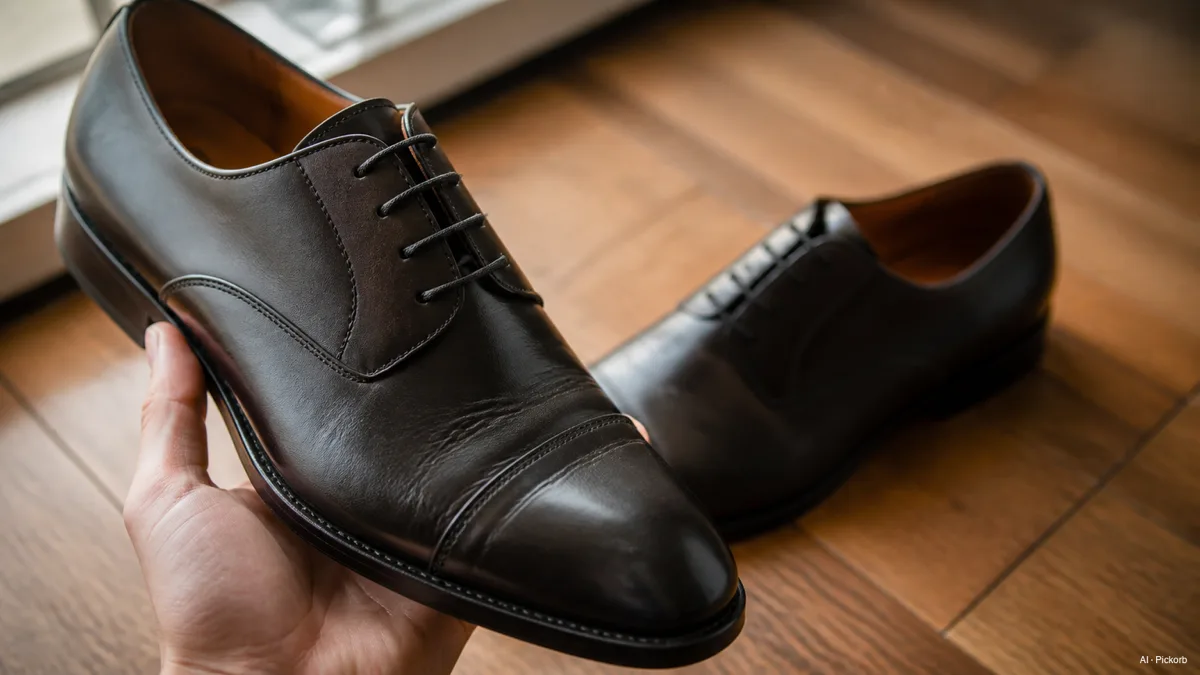
A pair of dark leather Oxford shoes in early break-in stage, one shoe held up to show slight flex lines forming across the vamp, natural morning light on a wooden floor (AI generated illustration)
AI-generated illustration

Months three to six: patina starts, sole edge wears

Around the three-month mark, something starts to happen to the leather surface that's often misread as damage. The color deepens slightly along the flex lines, and in brighter light you'll notice areas of variation. Richer tone where the leather has been stressed, lighter where it hasn't.

This is patina, and it's one of the things full-grain leather does that corrected-grain leather can't replicate. Full-grain leather, where the surface hasn't been sanded down and covered with a uniform coating, builds a patina that gets more interesting over time (Leather Working Group, leather types overview). Corrected-grain leather looks consistent when new but stays flat. If the shoes you're wearing have a perfectly even, almost plastic-looking surface when new, they're likely corrected grain.

The sole edge is also starting to show wear at this point. Look at the heel from behind. If both heel caps are wearing evenly, your gait is balanced. If one side is wearing faster than the other, the outer edge usually, it's a signal about how your weight distributes when you walk. This is worth knowing because uneven heel wear accelerates, and a heel cap that costs a few pounds to replace at three months becomes a welt repair job at twelve.

Sole edge dressing, a liquid or wax product applied to the edge of the leather sole, can slow the visual wear and prevent the edge from drying out and cracking. It's not a structural fix, but a five-minute job that extends the appearance of the sole.

This is also when your two or three pair rotation starts paying off. Leather needs 24 hours to dry out fully after a day's wear. A shoe worn every day without rotation compresses the insole and upper faster, and the moisture never fully clears. Two pairs worn on alternating days each last roughly twice as long as one pair worn daily. The maths aren't exact, but the direction is consistent.

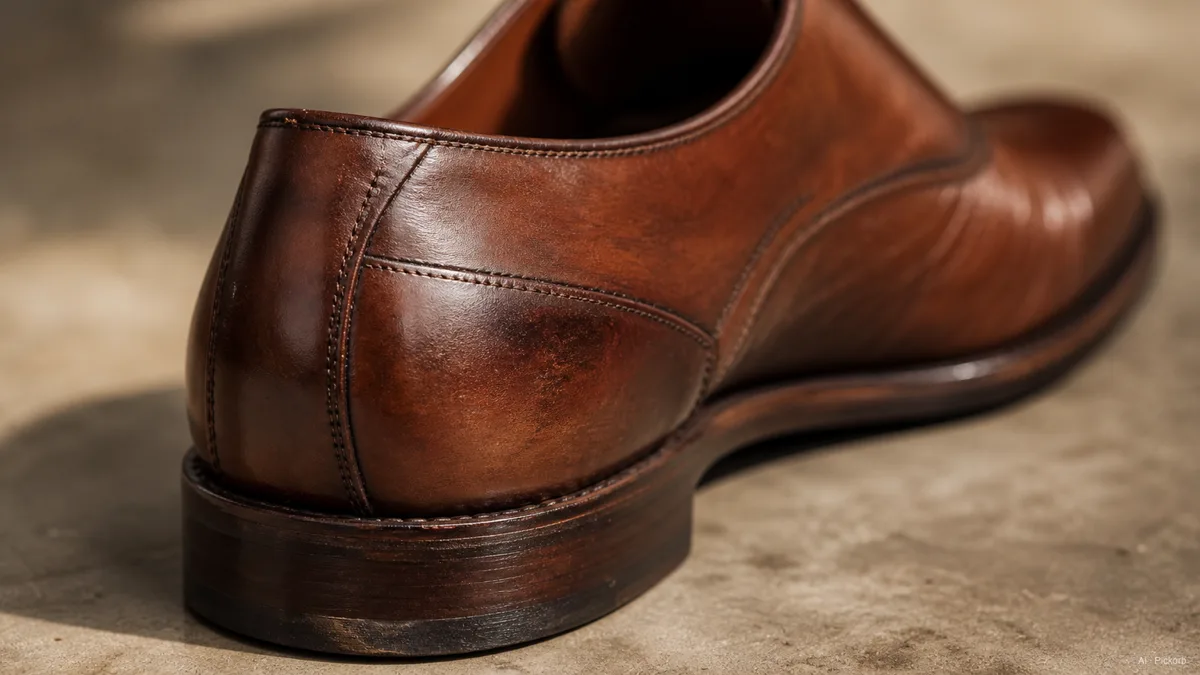
Close-up of the heel area of a brown leather shoe showing early patina depth building across the vamp and slight heel cap wear visible from the rear angle (AI generated illustration)
AI-generated illustration

Months six to twelve: resole decision and leather surface

Around the six to twelve month mark, depending on how often the shoe is worn and on what surfaces, the sole starts to reach a decision point.

Goodyear-welted construction (the upper, insole, and outsole are stitched together via a strip of leather called the welt) can be resoled repeatedly. Brands like Crockett & Jones, Church's, and John Lobb use this construction, and their recrafting programs will replace the outsole, resole the midsole, and return the shoe to close-to-original condition (Crockett & Jones care and recrafting guide). The shoe doesn't die at the sole. It gets a new one.

Blake stitch construction (the outsole is stitched directly to the insole through the interior of the shoe) can also be resoled, but it requires a cobbler with the right stitching machine, and not every high street cobbler has one. Many Italian dress shoes use Blake stitch. It produces a cleaner profile and a more flexible shoe, but resole options are narrower.

Vulcanized or cemented construction (sole glued rather than stitched) generally can't be resoled. When the sole wears out, the shoe is done. This construction is more common in casual and fashion-oriented shoes than in traditional dress leather.

The practical rule of thumb: if the sole is worn through more than 50% of its thickness at the heel or ball of foot, the structural protection is compromised. Take it to a cobbler before the wear reaches the welt.

On the leather surface, you may see creasing across the vamp, horizontal fold lines where the shoe bends during walking. Some creasing is completely normal, especially in the toe box area. Deep creasing that looks like cracking is usually a sign that the leather has dried out. A leather conditioner, cream rather than wax because wax sits on top while cream penetrates, applied once a month will keep the leather supple and prevent stress creasing from turning into cracks.

The difference between conditioner and polish is worth knowing at this stage. Conditioner feeds the leather (think moisturizer). Polish adds color depth and shine (think foundation). Both have a role, but sequence matters: conditioner first, let it absorb, then polish on top. Using only polish without conditioning dries the leather over time, because many wax polishes contain solvents that strip oils as well as adding shine.

The full-year picture: leather color and the care routine

After twelve months, the leather tells you what it needs.

Brown leathers develop the most visible patina. The color deepens to a richer, more complex tone, especially in the creases and flex lines. Dark tan leather changes the most dramatically, shifting from a light, even tone to a significantly darker and more shadowed finish. Black leather changes less visibly, but the surface gloss tends to flatten without regular conditioning and polish.

Suede and nubuck follow a different track entirely. Both are the underside or buffed surface of hide rather than the grain surface, and they're more sensitive to water and staining. A suede shoe caught in rain needs immediate attention. Brush the nap with a suede brush while still damp, stuff with newspaper, and dry away from heat (Saphir Médaille d'Or care product documentation). Neglected wet suede dries stiff, and the nap permanently flattens. The care routine for suede is different from smooth leather at almost every step.

For smooth leather in daily rotation, a reasonable rhythm looks like this:

  • After each wear: brush with a horsehair brush to remove dust and surface dirt. Takes thirty seconds and prevents debris from working into the grain.
  • Monthly: apply cream conditioner, let it absorb for ten to fifteen minutes, then buff with a clean cloth.
  • Each season (two to four times a year): apply wax polish in color-matched or neutral. This adds depth and a surface layer of protection. A high-shine mirror finish requires more layers and buffing, but a natural matte finish takes one thin coat.
  • As needed: sole edge dressing when the edge looks dry or starts showing scuffing.

Leather construction materials: full-grain, corrected, suede, nubuck

The material of the upper determines how much the shoe can change over time, and what care tools apply.

Full-grain leather is the most durable upper material. The grain surface is intact, which means the natural fiber structure is tightest at the surface. It resists moisture better than the alternatives, builds patina, and responds well to conditioning and polish. Most shoes intended for long-term wear in the dress and dress-casual range use full-grain.

Corrected-grain leather has had the surface sanded or buffed and then coated with a uniform finish. It looks consistent and clean when new, but the coating sits on top rather than being part of the leather structure. It doesn't build patina, and the coating can peel or separate from the base leather over time. Care is simpler, conditioning matters less because the coating limits absorption, but the ceiling for how good the shoe looks after five years is lower.

Nubuck is full-grain leather with the surface buffed to a velvet texture. It shares the durability of full-grain underneath, but the surface behaves more like suede in terms of sensitivity to water and marking. It requires a nubuck brush and dedicated nubuck/suede spray rather than the cream conditioner used on smooth leather.

City environment variables

Where you walk in these shoes changes what care they need.

Rainy cities (London, Amsterdam, Seattle, Tokyo in summer): waterproofing spray on full-grain leather can reduce water absorption, but it also partially blocks the leather's ability to breathe. A better approach for regular commuters is to let the leather develop some natural water resistance through consistent conditioning. Well-conditioned leather repels light rain reasonably well. Keep a horsehair brush available for drying off surface water quickly after arrival.

Cold cities with road salt (Stockholm, New York in winter, Munich, Toronto): salt staining is a real risk. White residue marks left by road salt pull moisture and oils from leather aggressively. Wipe salt residue off with a barely-damp cloth as soon as you get inside, before it dries into the leather. Then condition. Don't let salt sit on the upper overnight.

Hot and humid cities (Singapore, Hong Kong, Bangkok, Miami): leather in persistent humidity is at risk of mold forming inside the shoe, in the lining and insole, if shoes are stored in enclosed spaces without adequate drying. Cedar shoe trees are essential here. Let shoes air out for several hours before storing.

Dry cities (Los Angeles, Dubai, Denver): leather dries faster and is more prone to surface cracking without consistent conditioning. In very dry climates, a monthly conditioning schedule may need to move to every three weeks.

When to visit a cobbler

Some repairs are easy to delay past the point where they're cheap to fix.

  • Heel cap 50% worn: replace now. Letting it wear to the welt means the cobbler has to replace welt material as well as the cap. A £5 repair becomes a £30–50 repair.
  • Uneven heel wear: the faster-worn side is placing asymmetric stress on the construction. Address it sooner.
  • Welt stitching loosening on one side: a Goodyear-welted shoe with a section of welt that's coming loose can be re-stitched cleanly. Left alone, water and grit get into the gap and damage the midsole.
  • Insole compressing significantly: the insole (the inner footbed) compresses with use. Some cobbler shops can add an extra insole layer or replace the insole, which revives comfort significantly.
  • Resole cost vs. new shoe cost: a full recrafting of a Goodyear-welted shoe (new outsole, heel, minor upper repair) typically costs a third to half of the original shoe price from a quality cobbler. If the shoe originally cost USD 400–600, a USD 150–200 recrafting is rational. If the shoe originally cost USD 120, the arithmetic is different.

The general principle: the more a shoe was worth at purchase, and the better the construction, the more resole and recrafting make sense. A well-made Goodyear-welted shoe, maintained correctly, can outlast a dozen pairs of cemented-construction shoes. But only if it's brought in before problems compound.

Sources

AI product analysis

How this guide was built

This piece started from a question that shows up often: people buying a decent pair of leather shoes want to know what actually happens to them over a year of daily commuting — not just general care advice, but the specific moments when intervention matters. We cross-referenced care guidance from Allen Edmonds' Recrafting program documentation, Crockett & Jones' published care guide, and Saphir's product use literature, then layered in the construction differences (Goodyear welt, Blake stitch, vulcanized) that determine what's repairable at the one-year mark. The framing sits on Chexlow's leather shoe catalog across the everyday-wear price range, but the care guidance itself is brand-agnostic — the same stages apply to a £300 Blake-stitched derby as to a £600 Goodyear-welted Oxford.

Chexlow topic editor · AI illustration disclosed in image alt text

Related guides