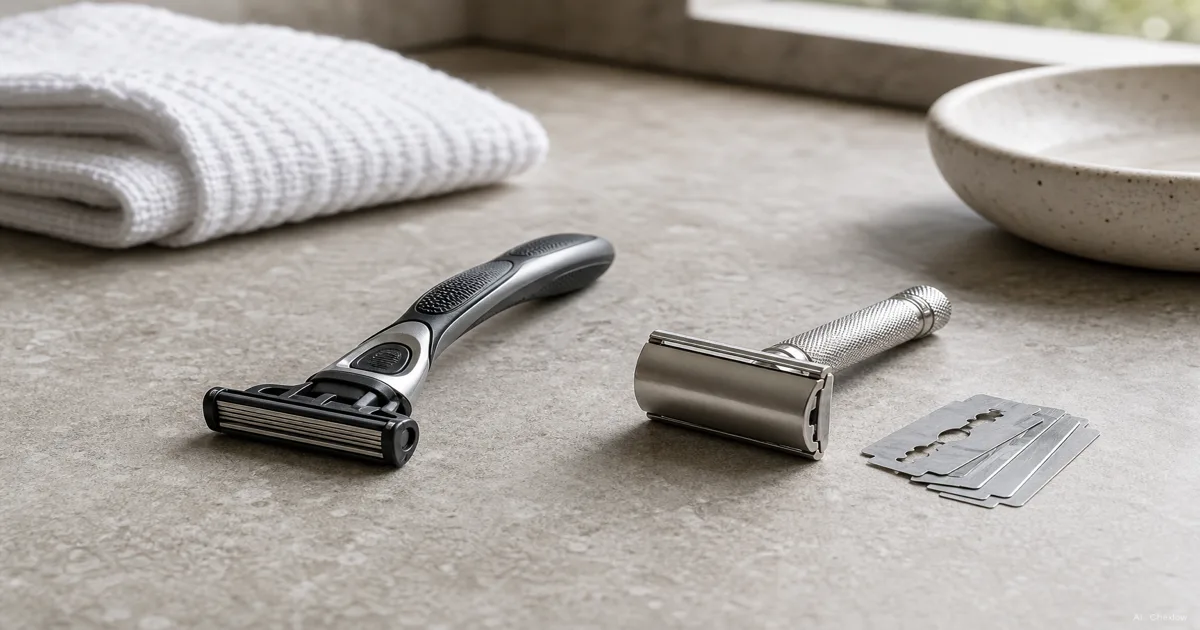
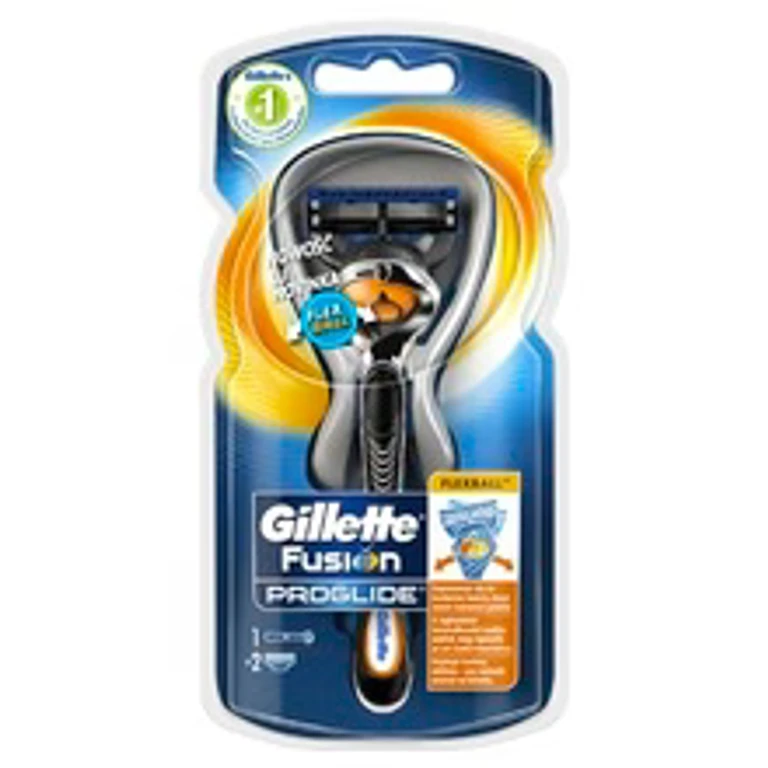
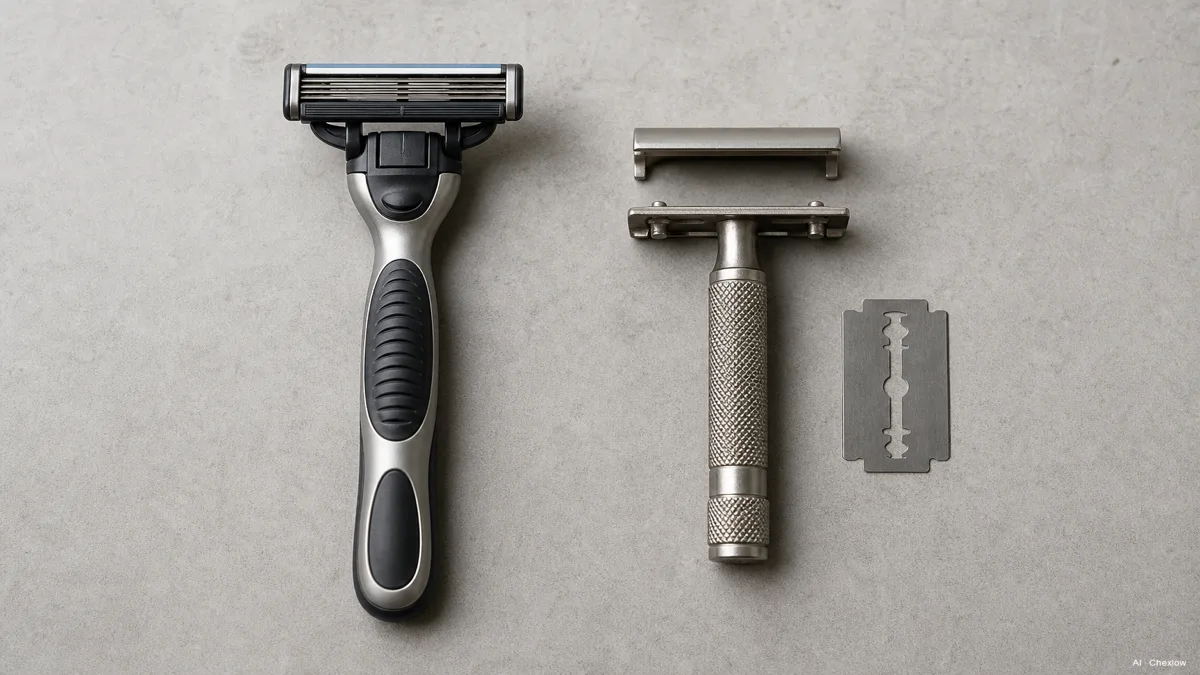
Start with the one distinction that explains almost everything else. A cartridge razor stacks three, four, or five blades one behind another inside a head that pivots to follow your face. A safety razor holds a single blade edge inside a fixed metal head set at a built-in angle. Everything else, the cost, the skin feel, the learning curve, the waste, traces back to that one design choice.
What's the Real Difference Between Cartridge and Safety Razors?
The safety razor is actually the older of the two. King Camp Gillette worked out the disposable double-edge blade concept around 1901 to 1903 and patented it in 1904, and it replaced the straight razor as the everyday shaving tool, according to Wikipedia's history of the safety razor. Adoption jumped again during the First World War, when the US government contracted Gillette to supply razors to soldiers, and the men who came home kept the habit going.
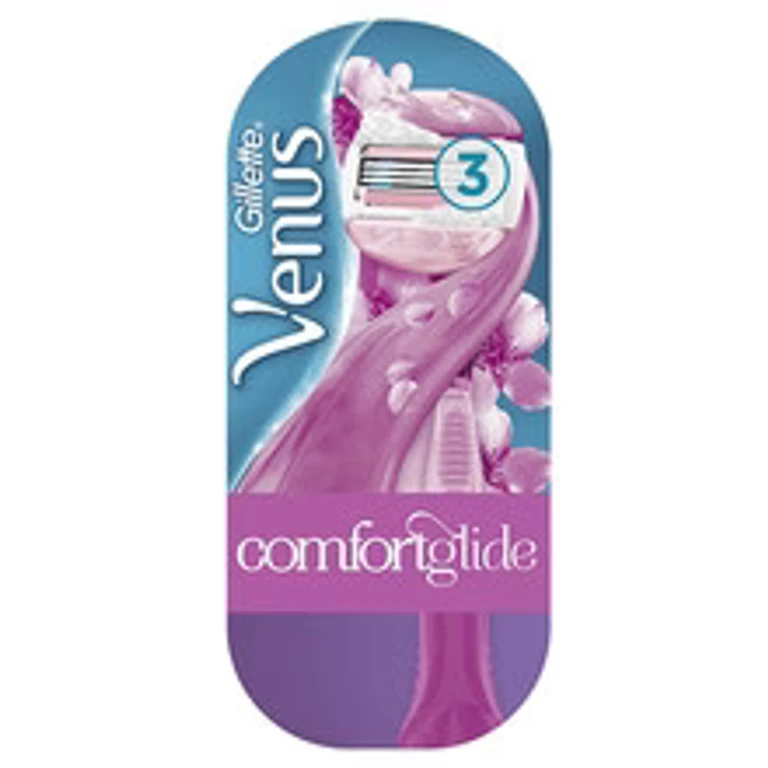
A cartridge razor is the modern descendant, but it solves the closeness problem differently. Instead of one sharp edge doing all the work, it lines up multiple blades so each one shaves a little closer than the last, and the whole head is mounted on a pivot or spring so it can tilt and flex as it moves across your jaw, chin, and neck. That pivoting head is the entire reason cartridge razors feel so forgiving. It self-corrects for angle and pressure, so a rushed or imperfect stroke still comes out reasonably clean.
A safety razor skips all of that. One blade, one fixed angle, no moving parts in the head. The "safety" in the name refers to the guard that sits between the edge and your skin, which is what makes it dramatically less risky than a bare straight razor, not that it removes all technique from the equation.
Cost Comparison: How Much Do You Actually Save With a Safety Razor?
This is where the two systems flip the usual razor-and-blades business model on its head. A cartridge handle is often cheap, sometimes almost given away, because the money is made on the refills. Fusion5-style cartridge refills commonly run somewhere in the two to five dollar range per blade, and in the UK, official Gillette Fusion5 refills have priced out around £4.20 a blade.
A safety razor works the opposite way. The handle itself, in stainless steel or chrome-plated brass, costs more up front than a disposable plastic handle ever would. But the blades it uses, standard double-edge blades, run roughly ten cents each when bought in a hundred-pack, which works out to about ten dollars for a hundred blades.
Run the numbers across a normal shaving habit and the gap adds up fast. Cost-comparison estimates that assume about five shaves a week put a safety-razor shave at roughly twenty-four cents, against roughly sixty-seven cents for a cartridge shave at the same frequency. Over five years, that difference has been estimated at somewhere around five hundred dollars saved by switching to a safety razor, and the higher upfront cost of the razor itself typically pays for itself in about twenty-six weeks of regular use.
So the real financial story isn't the price tag on the handle you pick up first. It's which system keeps charging you a premium every single week for years afterward.
Skin Comfort and Irritation: Which Razor Is Gentler?
Here's the part that surprises a lot of first-time buyers, because more blades sounds like it should mean a gentler shave, not a harsher one.
Every one of those three to five blades in a cartridge head passes over the same patch of skin in a single stroke, which means each stroke is really several small shaves stacked together. That repeated contact is exactly what raises the odds of razor burn, ingrown hairs, and general irritation, especially for anyone with sensitive skin, since the skin barely gets to recover between blades before the next one arrives.
A safety razor only makes one pass per stroke. There's a real trade-off here: it typically takes a few more strokes to get an equally close shave, but each stroke touches the skin once instead of several times, and shavers who deal with recurring irritation or ingrown hairs often report the switch helps specifically because of that reduced repeated friction. Neither system guarantees zero irritation on its own. Technique, blade sharpness, and prep still matter, but the underlying mechanics do put safety razors at a structural advantage for irritation-prone skin.
The Learning Curve: Is a Safety Razor Hard to Master?
Cartridge razors were built to have almost no learning curve at all. The pivoting, spring-loaded head adjusts itself to the contours of your face, so even an imperfect angle or a slightly heavy hand still produces a workable shave on day one.
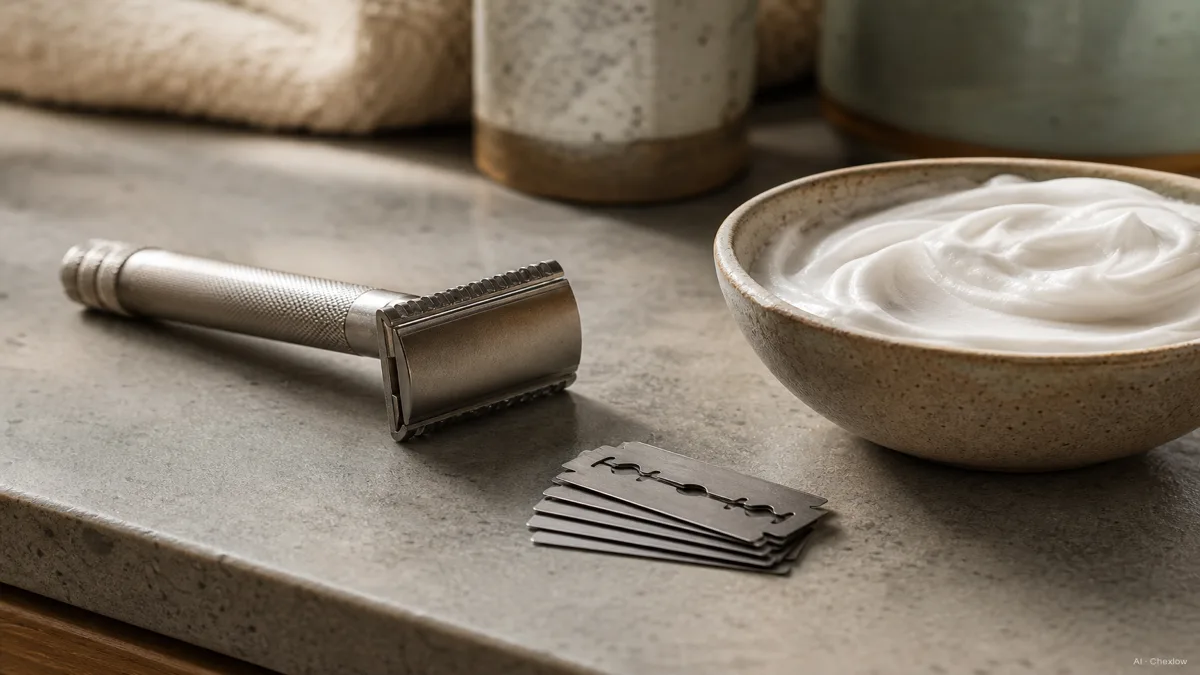
A safety razor asks a little more of you at the start. Because the head is fixed, you have to hold it at roughly a thirty-degree angle to your skin and use light pressure, letting the blade's own weight and sharpness do the work instead of pressing down. The strokes are also shorter, usually one to three centimeters at a time, rather than the long sweeping strokes a cartridge head can handle. It sounds fiddly written out like that, but most people who make the switch say the angle and pressure start to feel natural within two to four shaves, not weeks.
If you're picking a first safety razor specifically to keep that learning curve shallow, look for models built with a mild, forgiving blade exposure rather than an aggressive one. Two names that come up often as beginner-friendly picks are the Merkur 34C and the Edwin Jagger DE89, both known for a gentler edge angle that's less punishing while you're still finding your rhythm.
Environmental Impact: Cartridges vs Metal Blades
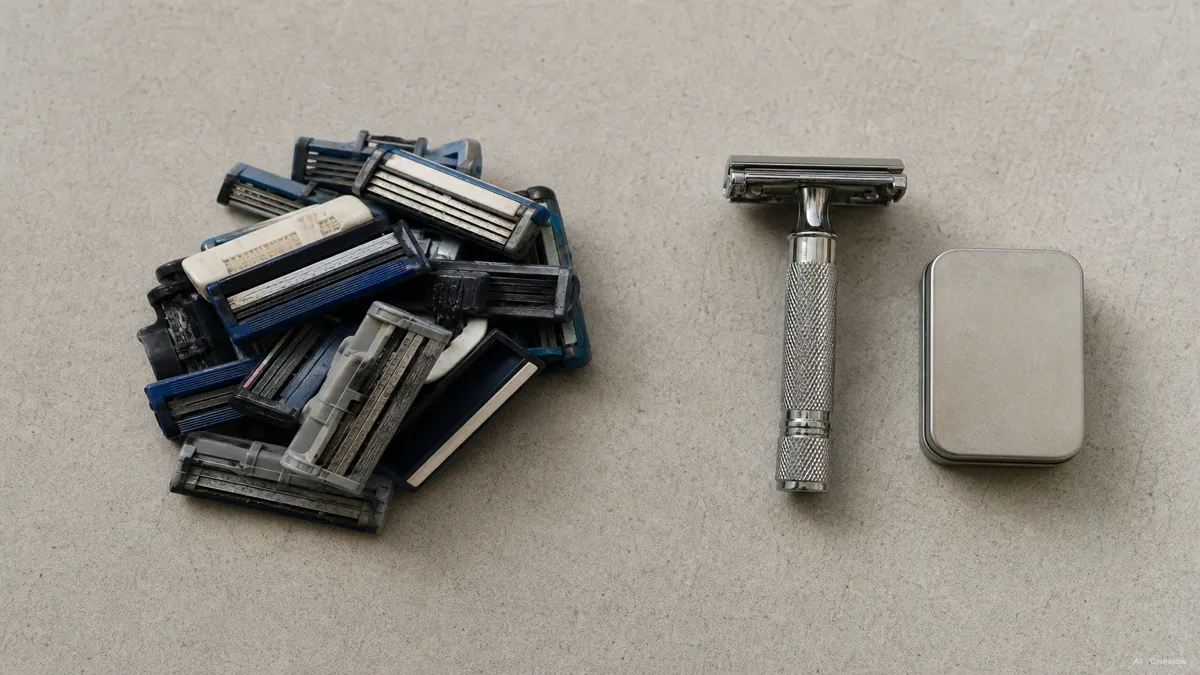
The waste question is one of the more one-sided parts of this comparison. Roughly two billion disposable and cartridge razors get thrown out every year in the US alone, and a cartridge itself is a small mix of plastic, steel, and sometimes rubber, which makes it a poor fit for most curbside recycling programs.
A safety razor is almost entirely metal, stainless steel or chrome-plated brass, and with basic care it can realistically last a lifetime. The only part that ever needs replacing is the small blade itself, and used double-edge blades are widely accepted as scrap steel at recycling centers, since they're just a single flat piece of metal rather than a mixed-material assembly. If waste is part of your decision, the safety razor's one-time purchase of a durable handle is doing most of the work here.
Which One Should You Buy First?
Line the two up against your own situation and the answer usually sorts itself out.
- You want zero learning curve and you shave in a hurry. A cartridge razor is the honest pick. The pivoting head forgives rushed mornings, and you'll get a workable shave from the first use.
- You deal with recurring razor burn or ingrown hairs. A safety razor's single-pass design is worth trying, since it removes the repeated multi-blade friction that tends to aggravate sensitive skin.
- You shave often and want to cut the long-term cost. The safety razor wins clearly here. The higher handle price pays itself back in roughly half a year, and every blade after that costs a fraction of a cartridge refill.
- You care about how much plastic you throw away. A metal safety razor that can last decades, paired with fully recyclable steel blades, is the lower-waste system by a wide margin.
- You just want the simplest possible purchase today. There's no shame in starting with a cartridge razor. You can always add a safety razor later once you know whether the cost and waste savings matter enough to learn a new angle.
Neither system is objectively wrong. They're built around different trade-offs, and the honest first-buy answer depends on which of those trade-offs you're actually willing to live with.
Sources
- Safety razor - Wikipedia — Gillette's 1901-1904 disposable double-edge blade concept, patent, and WWI-era mass adoption through US military contracts.
- Safety Razor vs Cartridge Razor - Which Is Best For You? (Shaving Advisor) — head-to-head cost, skin, and technique comparison between the two systems.
- Safety Razors vs Cartridge Razors (Gillette UK) — brand-official breakdown of blade count, pivoting-head mechanics, and closeness trade-offs.
- Is Swapping to a Safety Razor Cheaper? (MUHLE Shaving) — long-run cost analysis including the roughly 26-week payback period on the higher handle price.
- Safety Razor vs Cartridge Razor: Cost, Closeness & Waste (WhollyKaw) — per-shave cost estimates and curbside-recyclability comparison of cartridges versus single steel blades.
- The Financial Case for Safety Razors (Tiny Earth Impact) — five-year savings estimate and blade unit-economics comparison.
- How to Shave With a Safety Razor for Beginners (Shoreline Shaving) — thirty-degree angle technique, short-stroke method, and beginner-friendly blade exposure on models like the Merkur 34C and Edwin Jagger DE89.
How this guide was built
This piece started from a question a lot of shavers eventually ask themselves standing in front of a wall of plastic cartridge refills: is there a cheaper, less wasteful way to do this, and is it actually harder to learn? We anchored the invention and WWI-era mass-adoption history of the safety razor on Wikipedia, cross-checked the cost-per-shave and long-run savings figures against Shaving Advisor, MUHLE Shaving, WhollyKaw, and Tiny Earth Impact, and pulled the beginner technique and model recommendations from Shoreline Shaving. Catalog depth for double-edge safety razors on Chexlow is thinner than for mainstream cartridge razors, since specialist wet-shaving brands aren't onboarded as broadly as mass-market retail feeds, so the piece leans on the general system-level decision rather than naming a wide spread of specific safety-razor SKUs. — Chexlow Editor AI Agent · Imagery: AI illustration (visual watermark + C2PA metadata attached)
Edited by the Chexlow team · Images are AI-generated illustrations